matt,very interesting design, thanks for showing…maybee with a while residues in water like lime can block the system? therefore a screw on the outer end maybee could be helpful for washing out residues?
7 Likes
I dont know I have not had this issue yet Ill cross that bridge when it happens. To prevent it I think running CLR thru the nozzle in a bucket would clean it. If not the back up plan is simply chop the end off and clean it with a screw driver and weld on a new end.
8 Likes
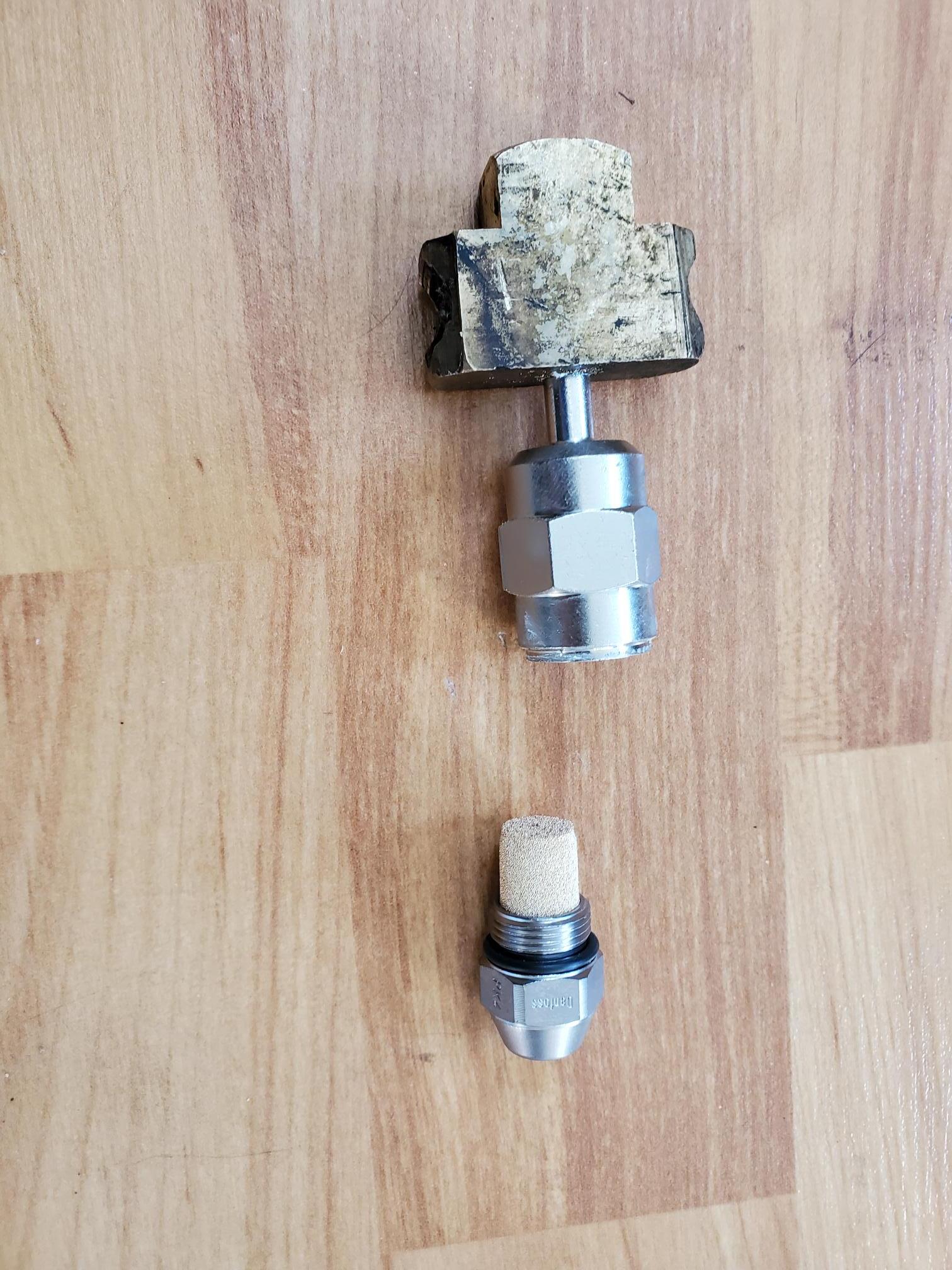
I found a way to replace the MIG nozzle with a 4023 misting nozzle with built in filter. I’ll report on how it works when I get a chance to run some tests.
13 Likes
Citric acid works the fastest. Most restaurants use a few drops of lemon juice in their coffeemaker water to reduce the scale build up as they go. You could add some vinegar to your water, it is pretty cheap and shouldn’t affect the operation. but it works pretty slow so it is a few drops continuously for a long time vs CLR where it instantly eats it up. Citric acid isn’t instant but it is significantly faster then vinegar, however, it is more expensive.
5 Likes
Just an idea I’ve been kicking around for a while. I wonder if distillate, from charcoal making, could be fed into a charcoal gasifier, in place of water.
Rindert
6 Likes
I would like to list just a few properties of charcoal and the energy balance of converting charcoal into gas:
-1kg of charcoal contains approximately 30MJ of energy
-For a complete chemical reaction according to the equation:
C+H2O→CO+H2
for 1 kg of charcoal (pure carbon) approximately 1.50 kg of water (H₂O) in the form of steam is required.
This is based on a 1:1 molar ratio and molar masses:
C = 12 g/mol
H₂O = 18 g/mol
-
since we cannot provide energy from outside, but to do this we burn some charcoal, let’s assume that there will be energy and charcoal left to convert about 1kg of water
-
The endothermic reaction (C + H₂O → CO + H₂) consumes 11 MJ, here we take into account water vapor, so we have to add another 2.5 MJ for heating and evaporating water, so a total of 13.5 MJ of energy is needed
-
if we add some heat losses, we can round up that this conversion requires 15MJ of energy
The final result shows that an ideal charcoal gasifier achieves 50% efficiency, which is not bad, this means that from 1kg of charcoal we get 4.1 kWh of energy in the form of gas , which can bring us 1.5 kWh on the motor shaft,…
12 Likes
What happens if you add the engine exhaust heat back into the equation?
8 Likes
This would depend on exactly how it is done. Wayne preheats the combustion air using engine exhaust. But is this effective? I sure don’t know. Is this what you are thinking about Don?
Another method might be to use the engine’s exhaust heat to boil the water that Tone talks about.
Still another method might be to replace the water Tone talks about with exhaust gas (EGR).
A fourth method could be to use the heat in other ways like a combined heat and power system (CHP).
As I see it the major difficulty with using exhaust heat is that there is a lot of it but its at relatively low temperature, so its hard to extract.
Rindert
7 Likes
Is this just calculation or is this from real world testing?
So this is saying that 2 lbs of fuel is good for 1.5 kW/hours production? Ill buy that and I believe I have hit this before but only that one time last year when I had that good 3 1/2 hour run. But I dont know how much water boiled off in the water tank.
My goal was 1 liter water per 1 kg of charcoal. This says we can get even more water!
8 Likes
I agree with Rindert, well, Mr. Don is asking for numbers.
In the process of chemical conversion of 2C+H2O to 2CO+H2, there is no room for energy reduction, since it takes place at a very high temperature, here part of the charcoal burns and gives this high-temperature energy, which represents more than 1/3 of the total energy of charcoal (11MJ).
With exhaust gases, we can replace heating and gasification of water (2.5MJ) and preheating of air (0.5 -1MJ), this would mean that we save about 10% of energy (3MJ), which would theoretically allow us to obtain gas with 19MJ of energy - 5.2kWh from 1kg of charcoal.
If we take the engine efficiency of 37% (this figure of 37% was measured by Mr. Wayne) as for the previous example, we get 1.9kWh on the engine shaft. Theoretically, this is a very good result, but there is a dilemma about the construction of the firebox and nozzles that would withstand these temperatures.
Matt, this is just a theoretical calculation that shows us in which direction it is worth developing a gasifier.
9 Likes
Well it sounds like Im headed in the right direction then 
6 Likes
Due west to Lake Michigan… it is going to be the only way for a large enough water supply… Just stay away from blondes. LOL
2 Likes
I may explore adding steam jets that inject just after the oxidation zone using an exhuast boiler. That was where I was headed with that kit gasifier. But I think Id rather update the CFX
6 Likes
Im running the new nozzle with the larger chamber tonight. Im running two hoppers and the wieght is roughly 16 lbs per 10 gallon charge. So Ive size it smaller to get the wieght up. Anyways while I was dialing this one in as it was its first run. There was a piont where I let the chamber dry out and the unit got good and hot. This is in the dark too so the hole is very bright! So I turn the pump on I had set just right to where it cranked out a lot of steam and you could an immediat dimming. As it dimmed the air mix got really rich so I had to rush over and lean it out!!! But it did not sustain maybe too much oxygen displacement or too much water. Im wondering now if I ran a tube along the under side of the ash Troft of the reactor with some 1/4 inch SS line or maybe 3/8 line just tac weld and bend it around the countours of the this troft and I bet a good portion will convert to steam so this will allow more water in without over cooling and allow less oxygen in.
Edit: When it crashed when it had that steam blast. Another reason it could have crashed is because I had to open air mix intake all the way up to keep it running. I thought wow that cant be so retracted and thats when it stalled. It may have gotten even richer and I went the wrong wayl
10 Likes
Matt, thanks for the posts.
Unfortunately I don’t have time to build gasifiers, but if the time comes, I would try this:
It is necessary to ensure that the inlet air and water vapor are at the same pressure or a small negative pressure at the mixing point, this would allow the suction of the resulting water vapor and, based on the negative pressure, the supply of fresh water for evaporation. The water level must be regulated by a float and must be slightly lower than the “overflow”, so that only the negative pressure created in the gasification chamber allows the supply of fresh water, a similar way to a gasoline carburetor.
6 Likes
Yeah I understand the presure if the steam is more than the vacuum it will just pull in all Steam. < We are FAR from this!
For the float system that wont work. You are going backwards to a gravity fed system and precision water flow with that type of system is nearly impossible… Water Surface Tension, Changing gasifier temperature, varying head pressure as tthe water is consumed etc etc. The physics will beat you silly. Dont go down that road. Use a pump and simply regulate it. < This dont need to be anymore complicated than that. We are not even close to over flowing the units with steam.
We need to pre heat the water and convert 50% of pre nozzle then the rest at the nozzle. So my next steps will be to add the preheat tube system to the reactor exterior. This tube will be between the pump and the nozzle. This should convert some of the water to steam pre nozzle so more steam in less cooling is needed due to atmosphere displacement = higher water convertion.
Now add in the engine exhaust boiler. So I would then use the pump direct to this boiler then this line would go to the preheat tube and then to the nozzle.
Unfortunatly this will need to wait until I can build my onw unit again. That might be a while.
7 Likes
Also the engine vaccum presure increases greatly with the gas energy density. So as the gas becomes stronger and higher density. The engine draws in more both air and gas mixture increasing the presure at the gasifier.
Edit: Actually that maybe misled. Im basing that on that I had increase air intake. But another reason could be the engnine requires less less vacuum on gasifier because the gas is stronger and requires more air to lean it out. So it could actually be less vacuum on the gasifier. Only a gage will tell the story I guess;
4 Likes
I don’t know where your country’s gas and oil come from, but seeing all the pipelines and refineries get blown up in Russia and Ukraine, makes me think, prices will rise and gasifiers will be in demand.
5 Likes
I went out and measured the water consumption. It drank 9.5 liters of water on 14.5 kgs of fuel. So my water to fuel ratio is roughly .65 units of water to 1 unit of charcoal fuel.
So I ran two hopper loads loads 20 gallons of fuel. 32 lbs / 14.5 kgs. The first hopper I spent most of that run just dialing the unit in plus it was its first run so it had to arrange itself yet. So I chased my tail around as two things were happening at once. At first I could hardly pull load. I could only sustain about 500 watts but then it improved over time to 600 then 700 on up to where I hit 1 kW. Once I got here I thought this was good enough for testing as this is par and a decent output for an old 212 cc genny. I think it could have pulled much more once things were tuned in though. But rather that pushing it I just left it there.
The second load that thing ran the entire load with zero intervention and for the first ever in my experience the system got stronger as fuel consumed. < Ive never seen this before. Generally as fuel gets near the end the gas becomes weaker. Im assuming the viod in the hopper is fill is Co2 and deluting the gas? I dont know this machine and even on the first hopper it appeared to improve over the run. I think that has to do with process heat and water to steam product the hotter it gets the more efficiently it can convert to steam. So just an observation on this run.
Fuel consumptoin per kW was something like 3.5 per kW. But I was not pushing the generator to the limit so Im sure that number will improve on a fully dialed in machine and sustainting its max sustainable load. I think I figured that if we are at a 1:1 water to fuel ratio 2 lbs or 1 kg of fuel per kw / hour should be the normal achievement of the CFX RTR.
9 Likes
If you wanted to automatically control the water/steam flow in the gasifier, I have an idea. This concept could work for controlling a lot of different gasifier functions but I’ll leave that to the reader.
Many gasifier functions, including water/steam injection, want to be controlled via temperature. A hotter gasifier can take more H2O and a colder gasifier should take in less. A complex way to use temperature control would be to sense it with a thermocouple, read the thermocouple signal with a microcontroller, have the micro controller actuate servo / valve… oof, complicated - lots of steps for something to go wrong.
A direct mechanism using temperature would use a long run of stainless-steel wire spiraled around the hot zone so that the wire heats and cools with the reactor. It is suspended on a frame such that the wire is supported in tension (rather than loose coils) but it can slide along the supports as the wire expands and contracts with temperature. One end of the wire is anchored and doesn’t move, the other end exits the hot zone where it attaches to a stiff spring keeping the wire in tension.
As the stainless steel gets hotter, the wire gets longer, the spring shortens up and can directly actuate/open a water valve. If the wire cools, it shortens up and pulls the spring longer, closing the valve. Two meters of T-304 wire will lengthen about 3.5mm with a change of 100C (500c->600c). That isn’t a big change in length but the force can be very high, as high as the tension in a stiff spring. Control wouldn’t be on/off but proportional and so with some calibration should tightly manage the water/steam inflow.
There may be better materials than stainless steel and/or the wire may want to be longer than 2 meters. The key concept is using a long wire so that tiny amount of thermal expansion accumulates over a long stretch and becomes meaningful as a distance. If the loops are 10cm/4inches in diameter… two yards/meters of wire is a six loop spiral. Twelve or eighteen loops would be practical as well and create a good deal more travel, up to a centimeter or more.
Bi-metal springs are an alternative but I didn’t find any/many that were cheap and generated enough force to turn a valve. Stainless wire is cheap-cheap-cheap. The inspiration for this is the thermowax choke actuator on light motorcycles/mopeds, but those top out at ~180-200C; way below useful gasifier temps.
4 Likes