Very satisfying woodgas grunt, Tone. Good " reactor-muffler" and camera. I’ve actually been DOWing window down today - to listen to the exhaust 
OMG it’s green down your neck of the woods. Buds just started bursting here - a few weeks early.
11 Likes
Tone, your experience with wood gas and high compression engines is rare and helpful.
Most of us are converting spark/petrol engines with compression ratios that are lower than ideal for woodgas. There are ways to boost the compression ratio but (1) easy ways do not create much increase and (2) big increases require major surgery on the block and/or head.
Great to read about your experience taking a very high compression engine and tuning it down to improve performance. Most of what I read is that wood gas is so knock resistant that 16:1 is fine, even optimal, but those are research projects with every variable tightly controlled and optimized. Lower compression may trade off a little efficiency for a lot of practicality.
My list of woodgas engine tweaks:
(1) Higher compression (assuming an 8-9:1 donor engine)
(2) Earlier timing (to address slow flame speed)
(3) Two or more spark plugs per cylinder (again- flame speed)
(4) Well insulated gasifier to improve gas quality (more H2, less N2)
Woodgas is tricky because it has lower energy content vs petrol. To improve power, we could run higher RPMs since displacement of a given engine is fixed. More cycles per second means more fuel burned and more power.
But… the slow flame speed of woodgas leads to a drop off of efficiency as RPM increases. At faster RPM you may just be pumping half burned fuel. Earlier and more spark would help lift that ceiling a bit. Early spark through a timing bump is easy. More spark is harder- needs a custom or customized head.
13 Likes
AnthonyB. you left out one engine choice factor when using woodgas or charges . . .
just use a larger displacement engine for the true needed power output. This has been the classic engine solution still applicable today.
Two spark plugs are used in wide across, shallow depth combustion chambers primarily. Or as an emissions reduction in trying to keep the flame front off of the surfaces, more centered.
Woodgas though considered “slow” has very simple fuel molecules, more readably completely combusted. So more efficiently completely converted to heat and pressure.
The other engine design factors then dictates how well the made heat and pressure is converted into the rotary mechanical power you want.
The higher static compression heats and intensifies the combustion speed rate. So woodgas is then not so “slow”.
Good job Tone showing with your hillside living and working on slopes; true engine loading conditions. Flatlander’s have a hard time truly loading engines except at stunting accelerations; or at fast continuous highway speeds.
Regards
Steve Unruh
13 Likes
Ain’t no replacement for displacement: Can’t argue with you there, Steve!
My use case wants power a bit above what a simple lawn tractor v-twin can produce on woodgas/chargas. You can squeeze a bit more but it isn’t so easy- as you can see from my suggestions above. My next best idea is running two of the v-twins on two separate genheads and have the option of half production if one goes out or needs tending. Double the displacement, just spend twice- ha!.
You might be curious what I am trying to avoid? To me, the next step up is a salvaged 1-1.2L 4-cylinder car engine. I look at all the parts and cables and such hanging off the block in the ebay pictures and sense that it is beyond me.
I can do carbs and lifters and simple points/ECI. Modern car engines are an alphabet soup of EFI, ECU, MAF, variable valve timing… I’d be spending weeks taking complex things off the block, adding back simple and hoping it would still work in the end. If it does? likely can push 10kwatts through a genhead which would be amazing.
11 Likes
Hmm. How to relate my experiences with systems making 10kW/el without rabbit-holing Tones topic?
O.K. Anthony here.
IF your goal it a combined for space&domestic water heating woodgas electrical system (CHP) then you really, really want to go with a water cooled engine. The engine jacket water flow gives you the pumpabe off board heat transfer. Engine comes with it’s own water pump even.
Problem. Generator capable engines this size are MARINE and TELECOM; and are expensive. But at least you do get a directly coupled H.D. electrical generator head.
Use a watercooled take-out auto engine and once past all of the ignition electrical and fuel mixing problems you will find that engine relatively hard; and pieces expensive; to front end or rear end, couple up to a 10kW generator head. THEN you get to play around with electrical variable loading and sudden unloading speed control systems. Mechanical/vacuum, or electronic. More skull-sweating and expenses to pay out.
So a searched out USED marine water cooled generator system, or telecom as complete then will seem reasonable in comparison.
Now go back to that original CHP premise . . . an idealistic now IMHO from experiences.
Woodgas the #1 concern is having to feed the system wood chunks/chips sized and especially dried down that it will need.
Most fellows spend a whole lot of time, energy and efforts on the woodgas/engine/generators systems expecting they will sort out true fuelwood consumption needs later.
Nope. Nope. They at best - end up with a system that can, and does work, until they run out of summertime dried wood; or kiln dried mill scraps.
Now instead pretty much as Tone now does make the systems heats condition down year around as prepared fuel wood stocks, to be able to use year around.
That had became my “Ideal” by ~2012/13.
Then a more noisy, smelly, air-cooled engine become the way to go. To to cool itself; it must blow off external cylinder & crankcase, and even oil heats. Ha! Come with it own air blowing fan!
The easy to see examples of this all-heats-blowing-out concentrated focused, are the suitcase sized inverter-generator units. They are even focus blowing out engine exhaust heats too.
Drying down a one hooper load of prepared fuel wood stock just-in-time is very doable. It is in the maths. And wood will not complain about noise, vibration, or the smells of an air-cooled the way a SHMBO will.
Yep. Yep.
$4,000 for a Harbor Freight big single cylinder 9500 variable speed inverter-generator unit new.
$5,000 for a DuroMax V-twin 10/12,000 variable speed inverter-generator unit new.
But you do get an all in one package; variable speed and loading; all electronics safe system.
Sure derate and only then get an actual 6000-8000 watts.
If you really do insist on a full 10,000 that is where the investment in a reasonable battery bank and an inverter takes up the surge slack.
What you’s want anyway for overnights lights power; refrigeration to not have to be feeding continuously the woodgasifier beast system.
Space heating, and domestic hot water from wood is better done with its own separate dedicated system. My opinion? Nope. What the best of the best here are doing real, now, today.
Tone. J.O. Kristijan. And others.
Redundancy in systems is the pragmatic, safe way to go. Leave the Ideals, to Idealists. Be practical and pragmatic instead.
Regards
Steve Unruh
9 Likes
Friends, it is my pleasure to share my experience of using wood gas in an internal combustion engine. Now I can give the basic information quite reliably:
- if the engine has a large volume of each cylinder (example like my Fergie 800 cc), the compression ratio 1:12 is the upper limit, similar to LPG or 100 octane gasoline
- strong wood gas contains a lot of hydrogen and methane in addition to CO, so the auto-ignition temperature is somewhere around 550°C, if we calculate what temperature the engine reaches with CR 1:12 at the end of compression, ignoring heat losses and taking into account that the engine is heated to 80°C,… the result is interesting… 570°C, well in practice there is some heat loss during compression, probably about 100°C… anyway we are very close to detonation
- engines with smaller cylinder volumes, with aluminum heads (which quickly dissipate heat), probably can withstand CR 1:13, well, engines , with a head made of gray cast iron, which dissipates heat from the surface more slowly, and should not have a CR higher than 1:12
-I will not advertise wood gas, but now I can say that this is an excellent fuel for an internal combustion engine, the power and torque of the engine are quite close to diesel fuel
20 Likes
I will continue to think a little about optimizing the use of wood gas, … in previous posts I have already listed some of the characteristics of the operation of this wood gasifier, well, let me repeat:
-slightly slower start-up (large cross-section of the hot zone) … this does not pose a problem for me
- possible use of various shapes and sizes of wood, there may also be dust and sawdust in between
- produces strong gas, stable operation at low load or at high
- it is unfavorable when after a high load it switches to low, then overpressure is created in the gasifier, which prevents fresh oxygen from entering the hot zone - the result is cooling of the glowing charcoal
Here I will list one of the ideas on how to eliminate this disadvantage.
If I were to monitor (measure) the vacuum in the gasifier, I could turn on the compressor (belt drive with motor, switched on via electromagnetic clutch) based on this measurement, this compressor would at the same time put some load on the motor and start sucking the wood gas out of the system after the filter. I would compress the gas into a cylinder to a pressure of 10-15 bar, if the volume of this cylinder were 100l, I could easily store 1-1.5 m3 of gas (2-3 kWh of energy) in it, which is already a nice supply of quality gas for an uninterrupted fast load on the motor.
I browsed the internet a bit about compressing wood gas, I was especially interested in what happens to CO, well, there is mention of the Boudouard reaction at temperatures above 400°C, where CO turns into CO2 and C ( Boudouard reaction - Wikipedia ) and the reaction with water vapor ( Water–gas shift reaction - Wikipedia )
Both examples of reactions would not take place if the gas were compressed to 10-15 bar, for which a single-stage compressor would be sufficient,…
Don’t mind, this is just a thought for now,… 
16 Likes
Sounds like an idea for evaluation. For the first sight, I see another big cylinder, compressor and wast amount of tinkering parts all around. Nothing for poor hobbist and many more things to fail.
10 Likes
Great minds think alike😄
12 Likes
Hmm.
I would trust both of you Tone, and Kristijan to play around compressing gases to fill tanks to 10bar (~1500 psi).
Most guys however will injure, or kill themselves; or someone else.
The two guys I’ve been involved with who did do woodgas compressing had no real appreciation for just how dangerous even 200 PSI can be with cobbled together; jury rigged systems compressing combustable gasses.
Twice I’ve walked away with a, so-long, “You all have good luck with that.”
Tone there is a real world phenomena where under actual working conditions an amazing “that is impossible” happens that the Lab/Math folks will not accept.
The first manmade occurrence of breaking the sound barrier is said to be the tip of a long leather woven whip tip. What? 3000 years ago.
Hard worked water cooled diesel engines often develop pin-hole pitting of their wet side cylinder liners. The percussive energy inside of the cylinder is energy transfer creating a micro steam bubble on the wet side cylinder surface. The bubble pops taking away each time, some cylinder metal with it.
Ships blade propellors suffer from a similar cavitation pitting.
So you propose a scroll or centripetal compressor system? Versus a piston compressor system?
Either way; somehow at an internal compressive boundary condition I think you will encounter a percentage of CO to CO2 & C’s (soots) reversion.
Just like I have seen on the back side of throttle body plates. “But that is impossible!”
Steve Unruh
10 Likes
I have an engineering background and have worked with (VERY) high pressure gases including ones that have suffocation risk, though not flammable. Personally, I wouldn’t dream of fooling around with 10 bar woodgas. It can be lethal and you don’t get a second chance.
At the same time, I recognize that others may be (a) competent and (b) willing. And to that I say, have at it.
Please be safe and please (re)consider how you might endanger others who can’t appreciate the risks or consent to them.
13 Likes
Tone, I believe more condensing ability in the hopper would also meet some of your needs.
Another (easier) way to combat this phenomena has already been presented by @Joni - a hose connecting the hopper to the exhaust pipe. Now, that’s KISS
12 Likes
If the engine isn’t pulling hard and the gasifier overpressures… you might just have the system automatically flair gas, running a blower if the system has one. You’d “waste” fuel gas but keep the gasifier flowing.
5 Likes
Thanks for the answers and your opinion.
JO , the effect of the condensation zone is quite good with this gasifier , since the gas is practically dry , it has only enough moisture to keep sheep wool slightly damp. I believe that a modern hybrid car with batteries and electric drive would work great on wood and charging the battery would eliminate these unpleasant symptoms , well , that is not my way , I want to achieve simple " mechanical " solutions ,…
Truck compressor - piston , belt driven , pressure vessel , some pipes , … I intend to remove the diesel fuel tank and the propane cylinder that I use for short trips , and I would now do this with a supply of compressed wood gas ,…
12 Likes
Tone, I have no doubt you will make it work and I’m glad you’re willing to try it. Everyone of us will benefit from your experiences in the end.
14 Likes
Lately we have been talking a little about the technical details of the production and use of wood gas, well, I will try to write a few words in this direction here.
The basic element for converting wood into gas is the gasifier, where drying, pyrolysis and reduction of moist pyrolysis gases take place, all these processes need time and the appropriate temperature to work optimally, of course, this “optimal” area has a fairly large range, but everything has its limits. Now I have focused on the example when the gasifier operates at a high load and is very hot, pyrolysis gases are intensively produced, below there is a wide area of glowing charcoal, and the walls are heated to 400-500°C. These conditions cannot be changed instantly, neither up nor down, this takes time. Now we have reached a situation where the engine does not need much gas, and the gas produced under these conditions is extremely calorific, so in these cases I would start the compressor, which would store part of this gas in the cylinder, …
Description of equipment:
-vacuum switch installed behind the filter, where the compressor also takes in the gas, this turns the compressor on or off
- compressor with belt drive and electromagnetic clutch
- 100 l tank with safety valve and pressure switch for shutdown
- vacuum reducing valve ( LPG )
13 Likes
After the cooling rails on a WK Gasifier build there is a large tank that collects water/soot under the truck, then it goes up to a large hay filter. This is the extra wood gases already stored to use for excelleration while the gasifier delay like a stop light delay is kicking in. Also I can flip my gas fuel switch on and off for a shot of quick power. It works great. I have a good up hill climb from the house out of my driveway for a 1/8 of a mile before I am on a level road. So trying to be a only wood gas driver while driving my WK Gasifier is very hard for me on start ups. Once I have a few miles down the road a the gasifier is up to runnig temps it fine.
16 Likes
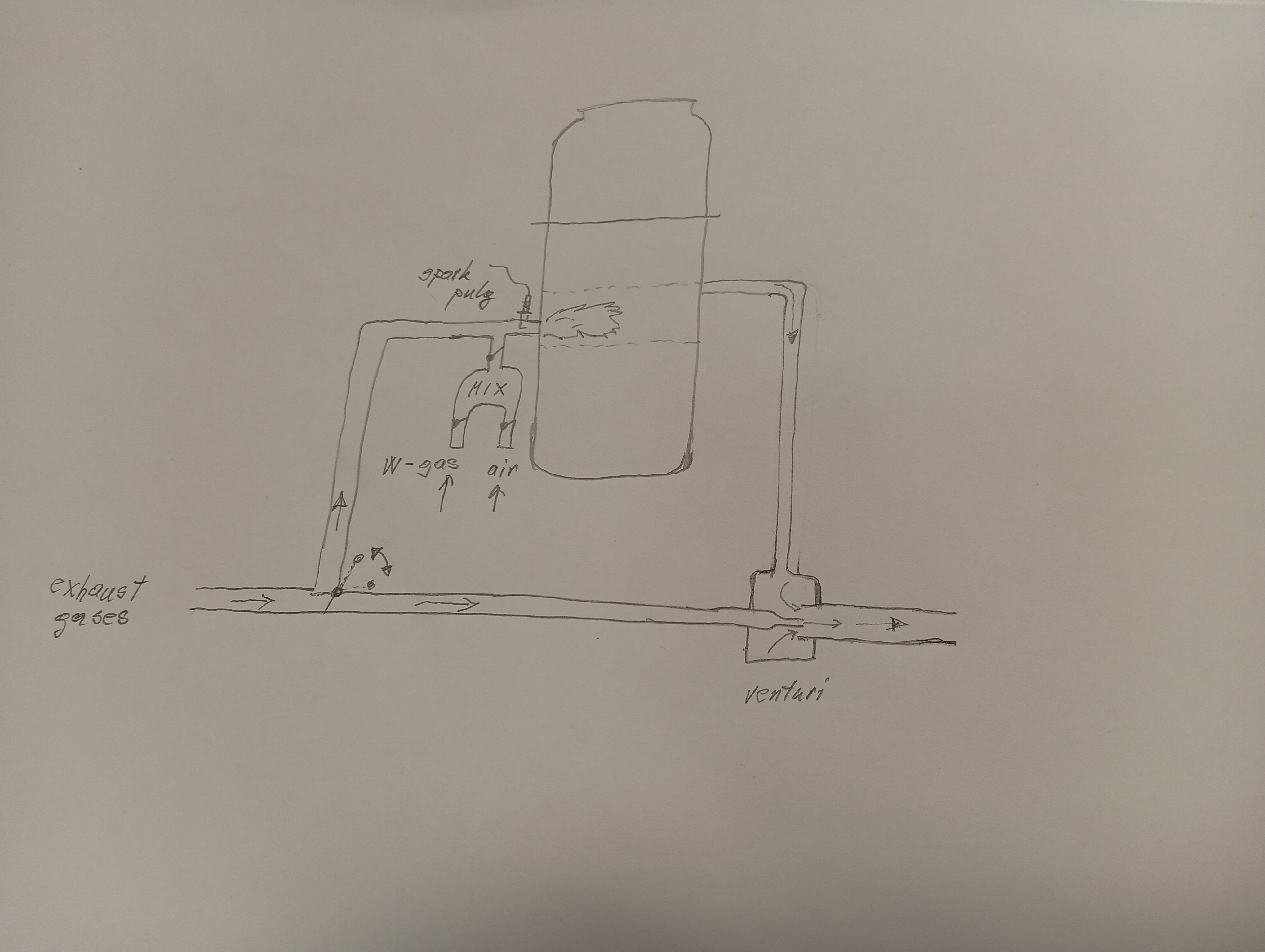
In Goran’s topic I talked a bit about this system, …heating with exhaust gas when the engine is under load, heating with excess wood gas, …venturi effect for creating negative pressure
8 Likes
I’m not understanding what I’m looking at. Is the cylinder just a storage container for excess wood gas pressurized by the exhaust gases? I see a valve for the air-gas sides of the mixer and one for the combined fuel gasses but what is the spark plug igniting and when? I’m also curious about the idea of a vertical grate mentioned in the Goran thread.
7 Likes
Hello Tom, I really skimped on describing this method, which would alleviate the critical moment when the engine goes from 100% to minimum load. The gasifier is located in the middle above, it has a built-in jacket for heating the interior with exhaust gases, they come from the left side to the three-way valve. When the gasifier is operating at high load, the valve redirects the gases upwards through the gasifier jacket, from the right side they return downwards to the exhaust pipe.
When the engine switches to a low load (stopping at a traffic light), the exhaust gases are redirected through the exhaust pipe to the narrowing, where the thrust increases significantly, thus creating a venturi effect - a vacuum that begins to suck in gases from the gasifier and fresh air, thus creating a combustible mixture that the spark plug ignites, well, this fire heats the jacket, the temperature inside is maintained for a smooth load on the system again (acceleration when the green light turns on and smooth driving forward). The diagram shows a gas/air mixer with non-return flaps that open at low pressure.
I hope it is understandable.
13 Likes