My Fathers late in life second wife was a gal from Belgium. She wanted to become American. Their daughter, my third sister, in her early 20’s visiting, fell in love with a Belgium man. Married. Two children. She wanted to become European. Had to learn both Dutch and French to get her nursing degree. Now a soccer-mom and teaching at the University.
Visiting, I came to love Trappist beer for bicycling hydrating. Drank warm.
Came to love street vendor “Fritten 'et Mayonaise” (sp?). Good for a border to border bicycling day trip blast. Touch Germany and France. Touch Nederland’s too for a four country same-day touch.
Belgium chocolates are some of the best. Not good bicycling food though. Drops you at 45 minutes.
The first woodgas/engine system I saw was in 1977 in the back of an old pub/cafe on the way to up into the Ardennes. From the WWII or earlier era. It took me 30 years to get around to it myself. I wasted too much time pursuing woo-woo’s, and heart loves lost. A couple of career’s got in the way too.
S.U.
You could say the world is small, but for me, a homebody, it’s still very big.
To cool off, drink a warm Trappist beer while cycling; I imagine the distance must have been longer after the refreshment (from all the wobbling).
It’s quite a ride, but here we don’t have the same concept of distance because everything is close.
I appreciate that you enjoy local food; many Belgians are very fond of it.
Life’s trials build character and help us move forward. Perhaps that’s what led you to make gasification your passion.
For me, it’s just one activity among many. What I’m passionate about is simply keeping my hands and mind busy, but for a useful purpose.
For example: insulating the house, installing home automation, creating everyday objects with my 3D printers, developing programs to simplify certain tasks… And if I don’t abandon the idea, the gasifier will become part of my passion, just like everything else.
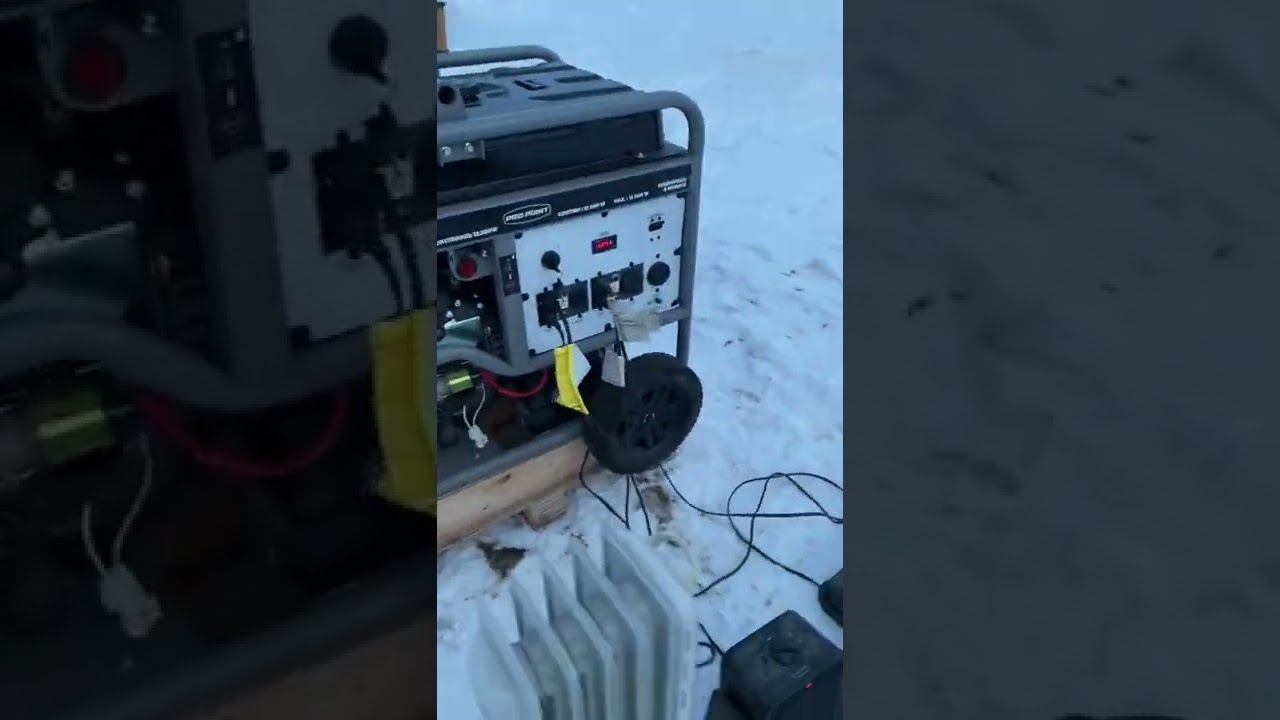
Here DavidP is an independent system built obviously from the 1st addition of Ben Pertersons book. No I do not know this person.
He compensated for the undersized recommended engine generator by using a very large suction blower system to first get the gasifier reactor flow sucked up hot and working.
To me he obviously did read the pages in that book on best operator practices. AND engine conversions.
I have others who did follow Ben’s book, I can show.
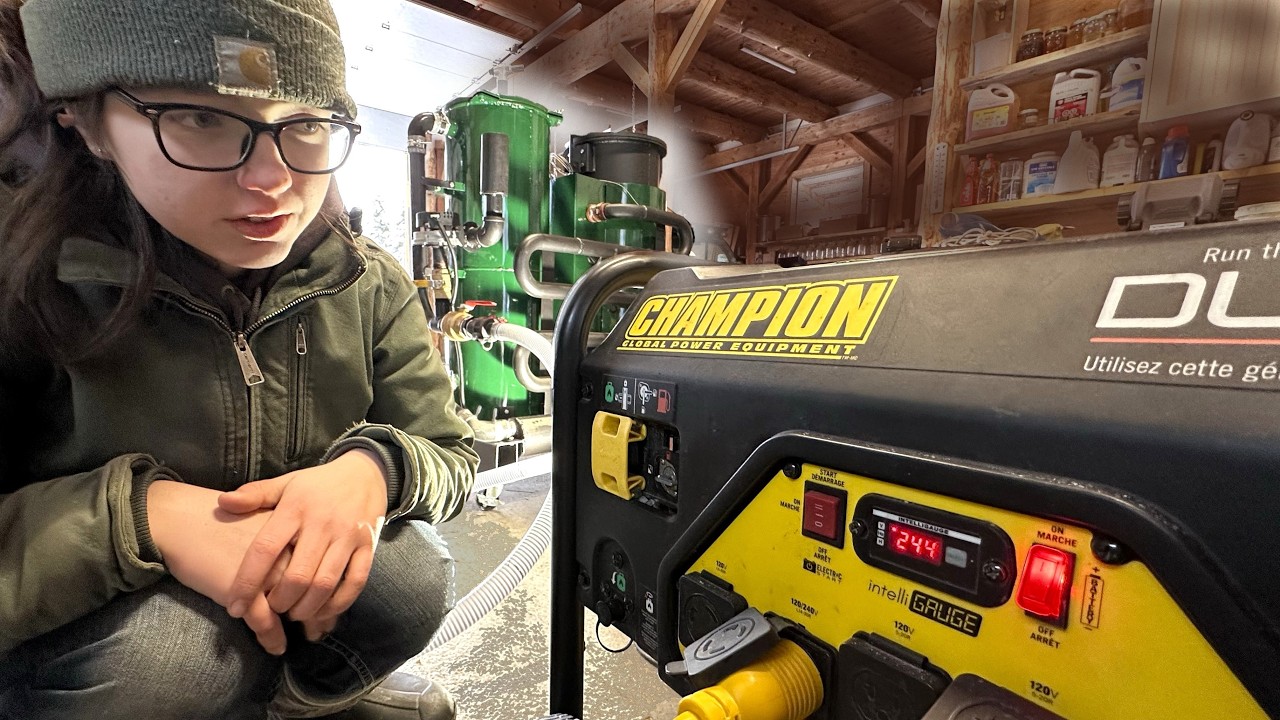
Now here is a very, very capable family made the virtually same gasifer and just could never get their engine generator to run and produce adequately, reliably.
In their first building video their construction was excellent.
Flares great. Flares do not run engines for loaded power.
The problems then? They were building from a different supplied book by a fellow who stole BenP’s design. Then so called improved it. Hanging his own name on the system.
He could never get his first by Ben’s book system he built up to flare for him. So then he had to “improve” the design. Write up, publish, and sell his own construction manual. Sell CNC parts kits.
But he never, ever did show it loaded engine running. So any buying and building his system did not have the best practices initial set up, and operating instructions. Had no written experienced learned, trouble shooting instructions. Had no live by camera other-the-shoulders help.
Crying shame to listen to for those of us experienced.
You will not be able to read through the hundreds of in-English comments below this video.
Matt Ryder and I did try in the comments to help them out. But how could they ever know of the too many inexperienced commenters who was giving valid experienced advices?
On the DOW we do not care so much what a fellow does build up. Just that something does get built. Then loaded engine ran.
We can step by step sort a person out within the limitations of what they did build. Want/need better results? Then they will listen to rebuilding advices. Or set aside and make up a better system for their needs.
-Figure out what wood you have in volume.
-Figure out how you intend to make that fuel consistent sized.
-Figure what engine you are going to run.
Then your gasifier ends up to be designed/sized around those parameters.
Wayne has a sawmill so he has endless supply of wood chunks made from slabs. You may not have a tractor to run a big chunker like he has either. Other people have different circumstances.
However, there are a lot of thing in common with wood and char, and small and large engines.
Thus I suggest reading wayne’s book.
With charcoal you are charring the wood first, then sizing it. and it breaks apart easier, you get the tar out, the gasifier is simpler. You may find other uses for char.
With wood, you processing it usually with larger machines, and the gasifier is a little more complicated because you didn’t get the tar out.
There is no wrong choice. It depends on what you have and what you are willing to invest.
I think Ben Peterson’s model is very well designed (from what I understand). The only slight problem is that I’d like to cool it with water. But perhaps the heat output will be too low? Any ideas?
I’m receiving Ben’s book on Monday. Because even if I don’t design the gasifier, or if I don’t build it completely, I’ll certainly get crucial information about them.
And maybe I’ll even be able to draw up the plans (oh yes, I’m pretty much proficient with CAD software).
This is only my personal opinion, but the heat you will be able to recover isn’t worth the effort. I’m sure it’s doable to, via heat exchangers, pipe in the waste heat from both the engine’s coolant and the gasifier’s gas cooler, but it won’t justify the complexity. Especially since you already heat with firewood and with your stated 1000 kWh electrical replacement a year, saving a log or two a week during winter won’t help your heating needs enough to be noticed. On an industrial scale, running 24/7, is another story.
BUT - the day you find yourself produce electricity and run out of chores, you can always add the capabilty if you still feel like it.
That’s precisely why this post was created, so I could get a referral to access the premium account and purchase the book.
Living in Europe, there’s a VAT issue, but if someone buys it for me and gives it to me as a gift, that works.
The amount will, of course, be reimbursed; I have no other way to get the book or the account.
And if you’re willing to help me, I can assure you that the amount will be paid to you. Furthermore, there’s still a promotion on the premium account until February 1st (with the promo code: FORUM30).
Unfortunately, I can only offer you my word as proof…
Hi JO and Kristijan,
Okay, thanks for the information.
That’s precisely my most urgent question.
To bring in electricity and connect my diesel generator, I need to dig a 40-meter trench between the house and another building (where I’ll also install the gasifier). If I have to lay pipes in the trench, I might as well do it right away. The pipe alone would cost over €2,000…
If it’s so difficult to recover the heat, and there isn’t much to recover (for 3 hours every two days), I might as well use the heat to dry wood in the same room or keep my small sanitary room frost-free (same building).
I highly recommend against trying to modify a known design at least until you have many hours of use. Ben Peterson and Wayne both spent many experienced hours working the bugs out of initial designs and ended up with systems that work. From experience I can tell you that these are integrated systems and changing one thing can lead to a cascade of errors.
So, initially, I won’t tinker too much, but later I can tinker with everything because I love doing that, hehe.
But only after I’ve fully understood everything, of course.
And I should expect some problems; noted.
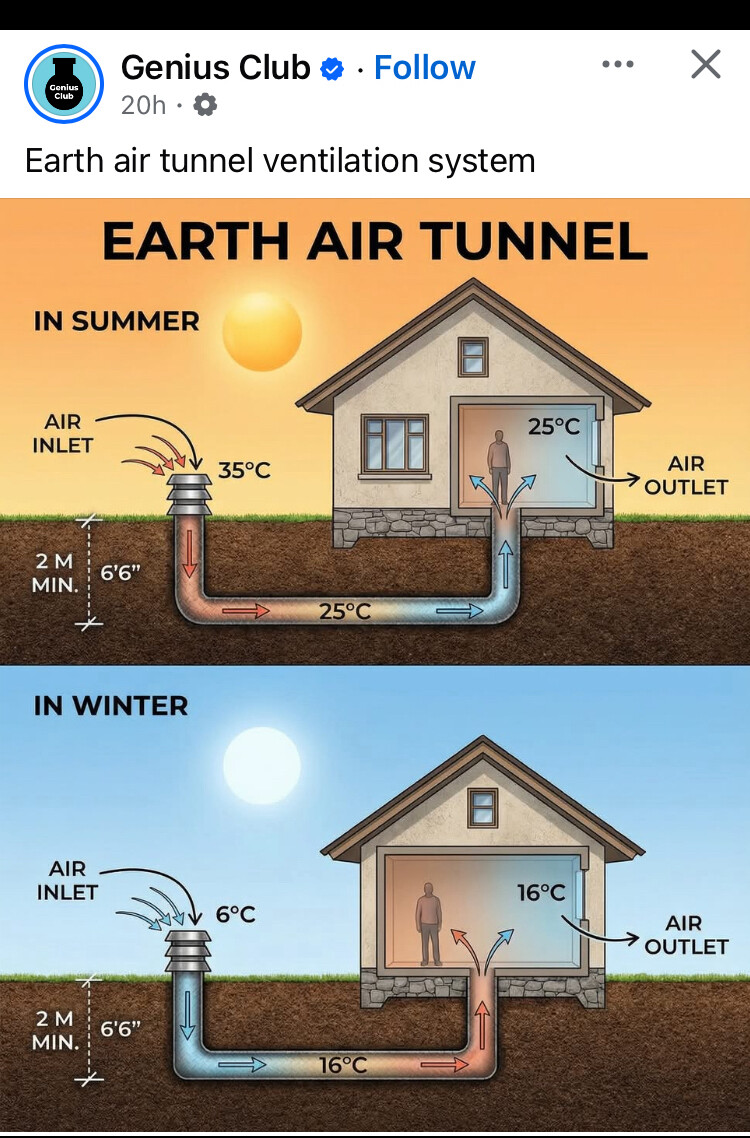
I stumbled upon the simplest of trench based geothermal energy transfer systems. The Facebook offering calls it an earth tunnel. To add this feature to an existing trenching project might be profitable especially if the tunnel provided fresh combustion air for the burn chamber instead of counting on cold air from the collective leaks in the habitat.
Hello Peter,
Thank you for mentioning geothermal energy, as it is useful in certain cases.
I’m very interested in anything related to construction methods.
In fact, I studied in that field.
For new builds, it’s advantageous because you can install a low-temperature heating system, such as underfloor heating.
However, for houses with an other existing system, the effort isn’t worthwhile because this heat exchange still requires a heat pump, which will consume electricity, and a well-insulated house is also necessary.
I say new constructions, but people who are willing to undertake major insulation work and replace their entire heating systems are also concerned.
Regarding the schematic representation, let’s say that in winter we can introduce air at 16 degrees Celsius without heating; I’m afraid that won’t be enough to warm my wife.
It will be necessary to heat from 16 degrees to 21 degrees Celsius, and it’s always the last degree that consumes the most energy.
And one more small detail: digging to a depth of 2 meters is much more involved than digging a trench 60 or 80 centimeters deep. It normally requires shoring to prevent soil displacement, or excavating a huge amount of earth.
I think better to spend time building than drawing. I can do that too. I went to engineering school. I can make thousands of beautiful drawings. But this is not productive.http://forum.driveonwood.com/t/spiral-path-heat-exchangers/3657/79
That being said you will need to make ‘layouts’. I have a big roll of brown paper. I use a pencil compass, ruller. I made a pencil/triangle that is very helpful.
RindertW. the “Cutting paper is easier than metal 1979 292” topic in on the Premium side of the DOW.
Not yet able to be Premium; DavidP. most likely cannot access and read this.
that system just uses a small blower fan. there is no heat exchanger. the main problem I see is rodent and bug protection. Then it is only good to whatever temperature the earth is. So for say an unheated workshop it might keep it warm enough. Summer cooling is where I have seen them used the most.
Hi Chris,
Thank you very much, and especially thank you to the sponsor .
Could they please get in touch here, or send me a private message?
Thanks again

 .
.