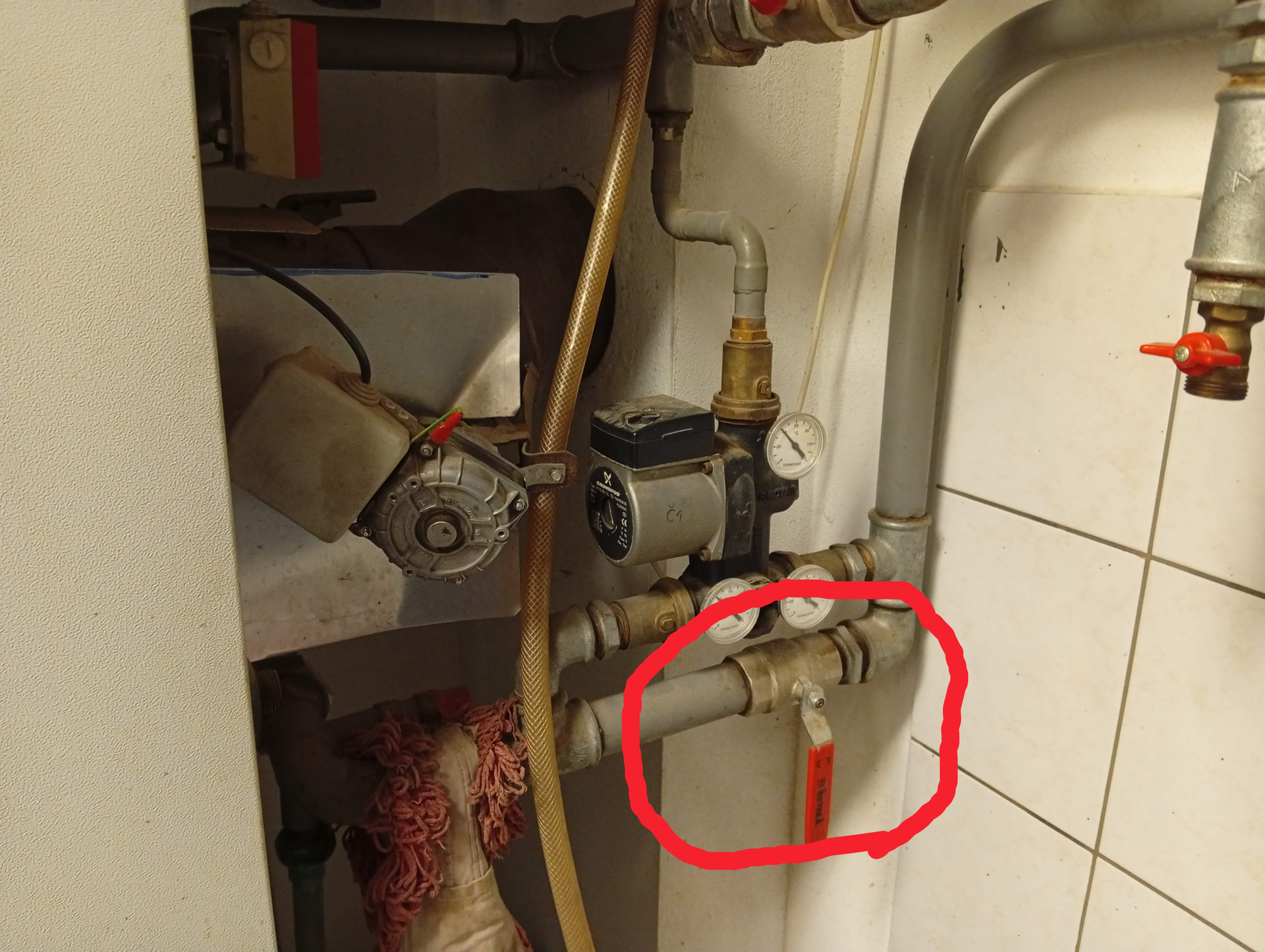
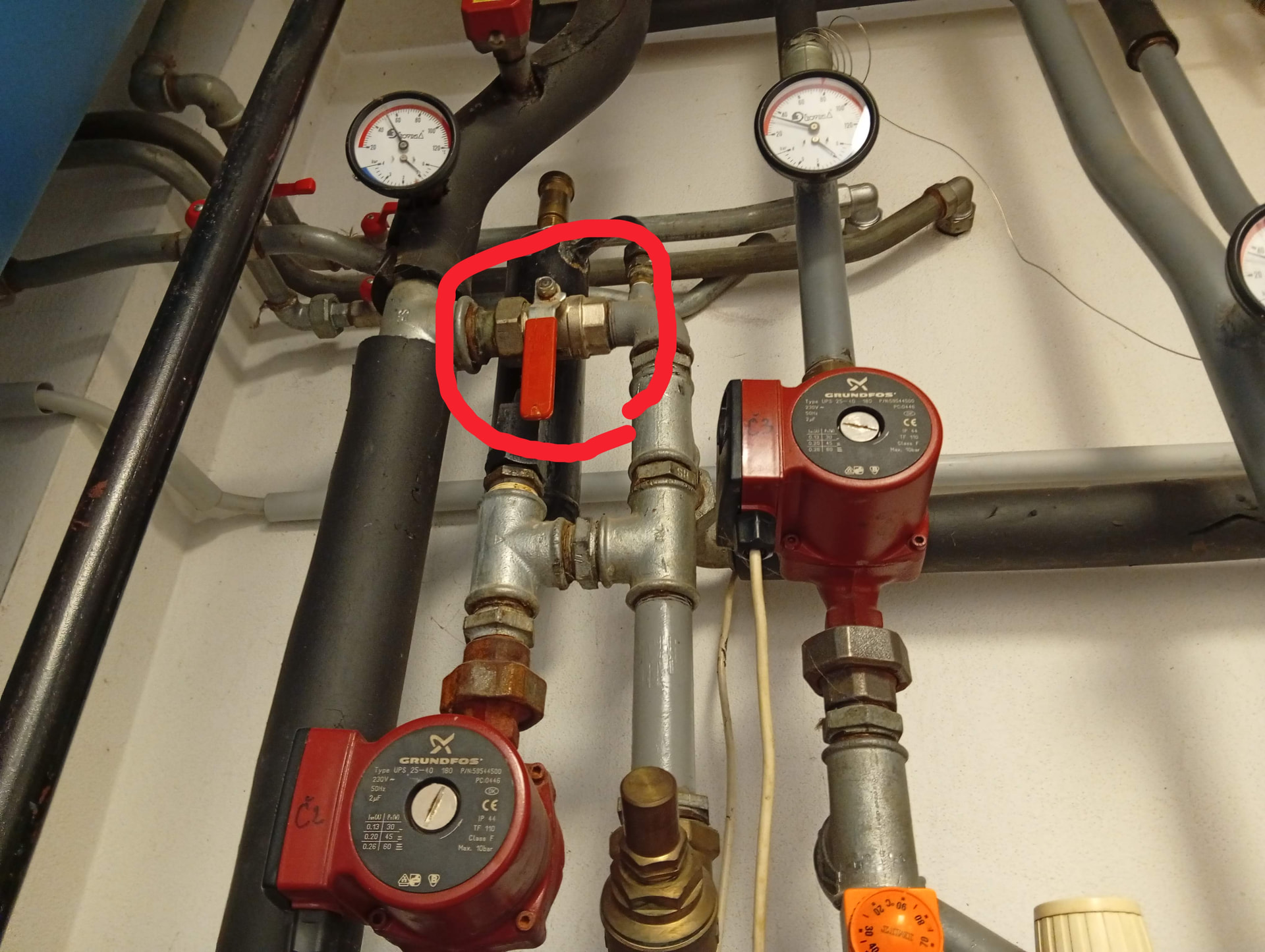
It’s interesting how, as the weather cools and winter approaches, heating becomes a frequent topic of conversation—after all, a warm home is one of our basic human needs. Twenty years ago, when I installed a heating system in my house, I set a specific requirement: it had to be able to operate without electricity. To achieve this, I installed two manual valves that allow water to circulate freely—via the thermosiphon effect.
I open this valve near the boiler pump; although the pump itself does allow for thermosiphon circulation, the cross-sectional area of its openings is quite small.
Naturally, the boiler is operated with care—not at full capacity. While the underfloor heating is not running, the radiator heating works perfectly throughout the house, and the domestic hot water system is also functioning.
We now have our own power plant, independent of the grid; by using electricity judiciously, just two hours of generator operation are enough to cover our daily electricity needs.
Speaking of heating—I’m having an issue where my tanks end up at different temperatures.
When I finish firing the boiler, they are at the same temperature, but after a while, the large tank becomes much hotter.
I draw all my hot water—both for domestic use and for the radiators—from the small tank.
I’ve bought a pump that I intend to install on the inlet to the large tank, along with a differential thermostat that will trigger the pump to move water over to the small tank whenever the temperature difference reaches 5–6 degrees.
But will this work while I’m firing the boiler?
Is there a better way to do this?
This behavior is perfectly normal, as hot water rises and cold water sinks.
Consequently, there will be a temperature difference depending on the height at which your temperature sensor is positioned.
I am not sure that a pump would be the right solution, as it could mix the hot and cold water, resulting in lukewarm water.
A circulation pump might be suitable, but a temperature difference between your sensors will persist regardless, which is actually a good thing, as you do not want the water to mix from bottom to top.
If the height difference between the tops of the tanks is not too significant, it is not a problem; the hot water at the top will gradually warm the water below through thermal inertia.
Perhaps the best solution would be to relocate the radiator connection point to the highest possible position.
But take this with a grain of salt, could a circulator pump solve the problem? I’m no expert.
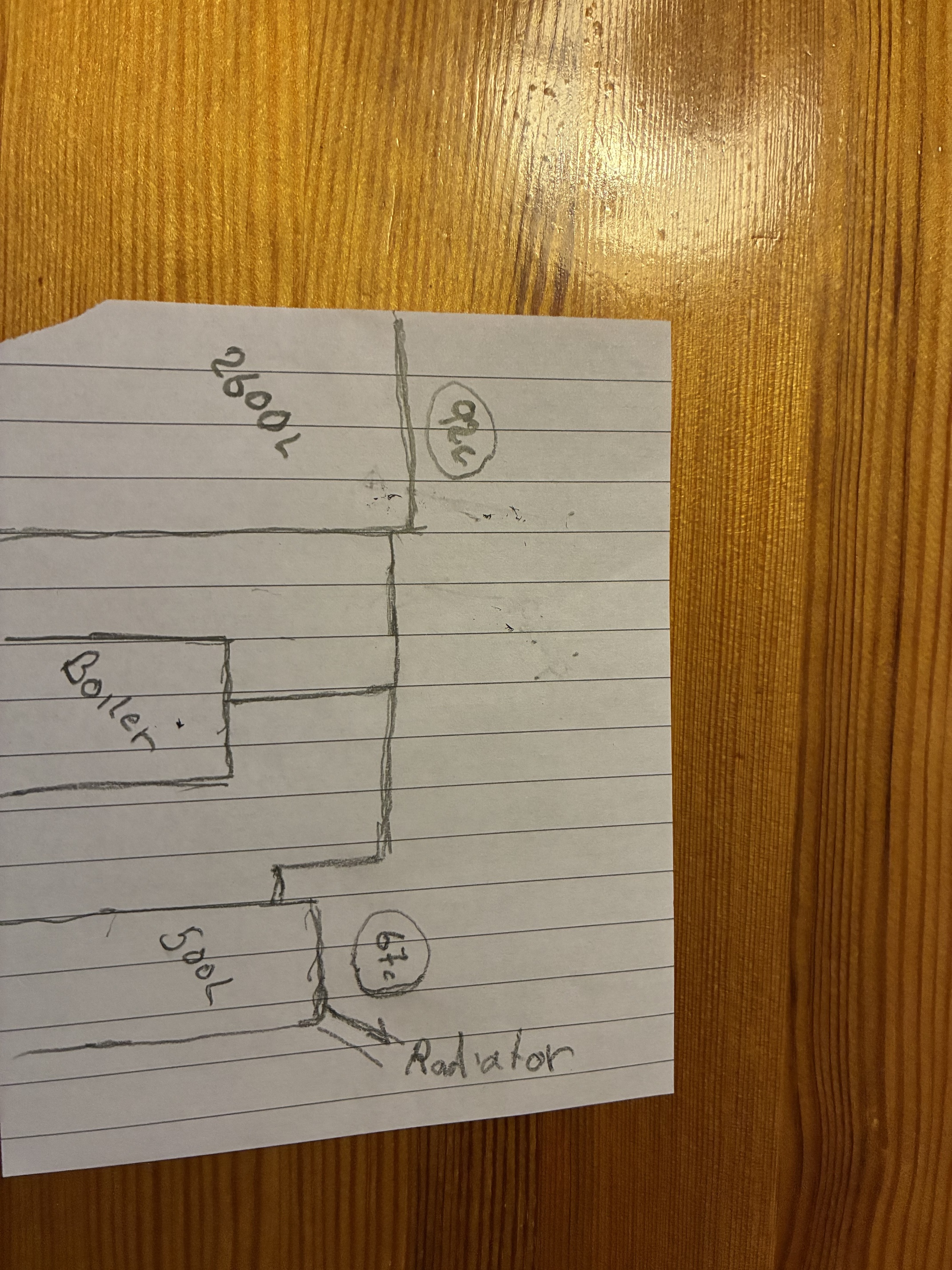
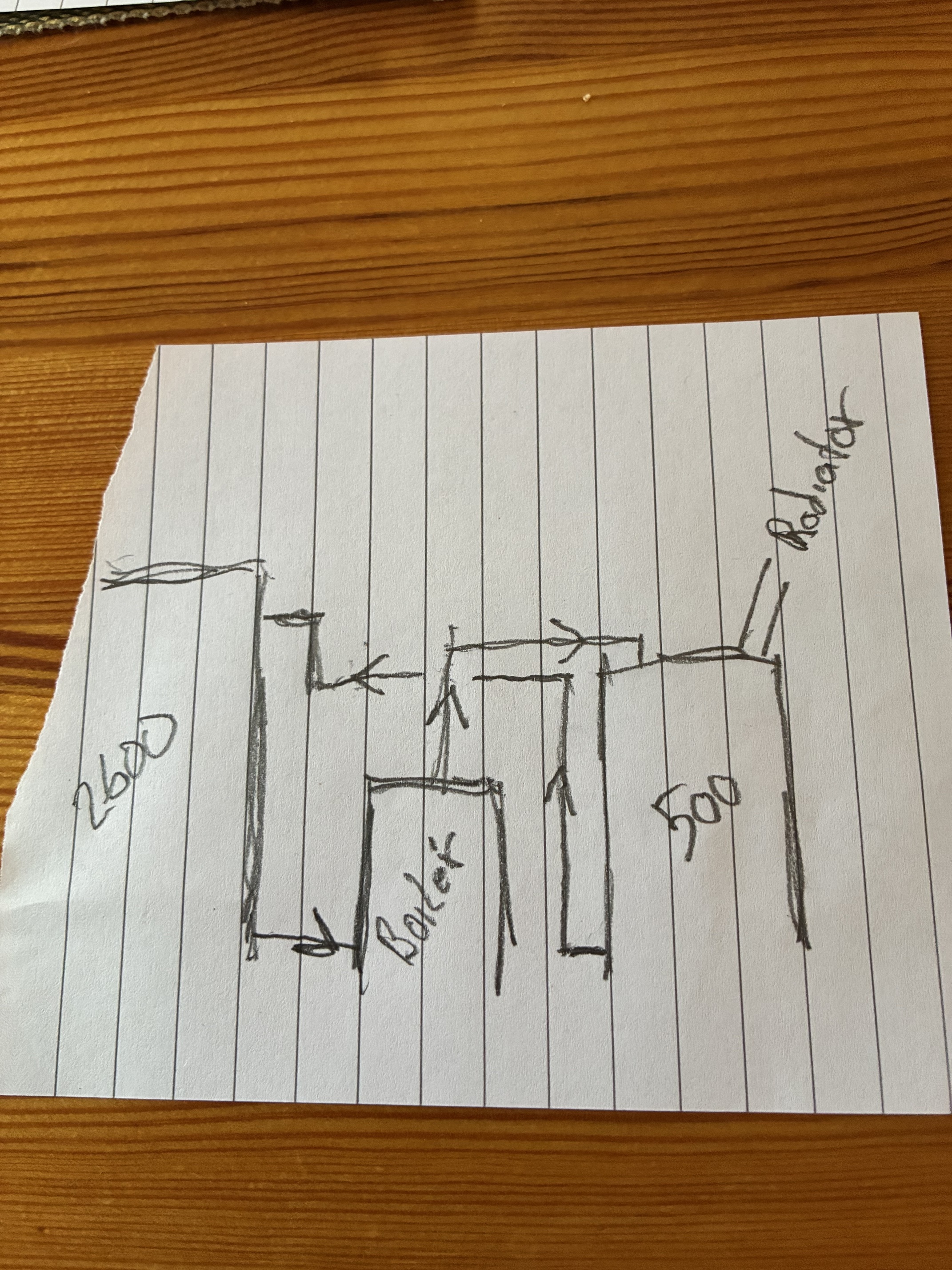
I was looking at my water tanks; if I raise the 500-liter tank by 20 cm, the inlet from the boiler would be at the same height—do you think that would solve the situation?
Jan, can you put them in series instead of parralel? The temp diff David is talking about is getting bigger then and the use of layers makes you can use the total amount of your buffers. For this reason I changed the pipes on my buffer. Sanitair water enters way higher now and layers stay intact. Works super. Another adventage is that the boiler takes colder water. Small difference of course with a laddomat.
I agree with Joep; although there will always be a temperature difference depending on the height, though likely less significant later on, the water usage will be better distributed.
You mean that if I do it this way, I won’t need to lift the small tank?
I have the small tank so I can just do a little bit of firing in the summer for hot water, but I could also just open a few valves so that it works that way too.
Jan, 30 years ago I started half a dussin changes to my system. New bigger tanks started falling into my lap, all different in size, shape and connections, one double wall tank started to leak and several times I just wasn’t satisfied for about the same reasons you describe. For the past 23 years things worked good enough and I’ve made no further changes.
I guess it’s all about how much plumbing you’re willing to do and what connections are available. Your drawing doesn’t show where your return pipes are connected, but if possible I would connect the radiator return to the bigger tank. It’s very hard to calculate which connection offers least resistance, but a huge advantage if you’re able to do without extra pumps and thermostats.
The shunt for the radiators is located inside the small tank, so I can’t access those pipes.
The return line runs from the large tank into the boiler; you can see it at the bottom left edge.
Ok, that means you can’t install the tanks in series either, or you can only heat the bigger tank but never cool it. Hmm…I guess you’re still left with raising the smaller one - or pump.
We kind of do it the same, only one big tank in the shop and the small one in the house for sanitairy water. The small one gets a refill from the big one. And this is were I changed te pipes. Return for santair comes back high in the big one. For now works super. I hope during summer too. The plan is to burn surplus PV. Two heaters, 3 kW in the top and 9 kW in the bottom for very sunny days. I hope not to burn any wood anymore when it is hot .
Jan,
I don’t quite understand your system; we’re talking about domestic hot water, but in your case, I assume it’s just hot water for the radiators used to heat the house?
When thermal storage tanks (buffer tanks) for heating systems first came into use, “experts” and manufacturers of fan-assisted wood-gasification boilers provided hydraulic schematics for their installation. According to these instructions, the storage tank was connected to function like a hydraulic separator (low-loss header). In my opinion, this is a major error; the purpose of a storage tank is to store excess energy—energy generated by the boiler that is not immediately consumed by the heating loads—rather than to balance pressure differentials caused by varying water flow rates within the system.
To understand the “thermosiphon” operation of a heating system, one must consider that hot water has a greater volume than cold water and is therefore less dense (lighter), causing it to rise. However, this alone does not guarantee circulation throughout the system. In fact, it is more accurate to think in the “opposite direction”: as hot water cools down within a radiator or a domestic hot water heater, it becomes denser (heavier) and sinks. This downward movement displaces the warmer water in the boiler, forcing it to rise. Surprisingly, with the correct piping configuration, this method can even provide heating on the same floor level as the boiler. What does this configuration look like? If you connect a radiator on an upper floor to the hot supply pipe, and then route the outlet of that radiator down to the inlet of a radiator on the floor below, the lower radiator will also function—though it will be lukewarm rather than hot. In such a case, it is necessary to select radiators of an appropriate size—smaller ones for the upper levels and larger ones for the lower levels.
As an interesting side note… when discussing flow in hydraulic systems, the phrase “the pump pulls water from this side” is often used… however, water is not a rope or a chain that can be pulled; water can only be pushed…
So, to make sure I understand correctly: is your domestic hot water (for showers, etc.) contained within a 100L tank located inside the 500L tank? Does the water for your radiators circulate through a coil, as part of a closed-loop system, within the 500L tank? And are both the 2400L and 500L tanks also part of a closed-loop system, even though they do not connect directly to the radiators?
David, I should let Jan answer this himself but I’m not patient enough I’m pretty sure everything, except those 100 l domestic, is “boiler water”. That’s common practice, unless you have a very special arrangement.
2800 of domestic hot water?
You must be all shriveled up by the time you get out of the shower, it must be an incredibly long one!
I suppose that at a certain age, you might not even notice the difference anymore, but still, haha!
Yes, the 500-liter tank contains a 100-liter tank for hot water (showers, etc.); it also houses the mixing valve for the radiators, as well as the water for the radiator system—400 liters of water.
This tank is connected to a 2,600-liter tank, which is used exclusively for the radiators in the cabin and the garage.
I installed the extra pump today; let’s see if I can get this to work using a differential thermostat.
 .

 I’m pretty sure everything, except those 100 l domestic, is “boiler water”. That’s common practice, unless you have a very special arrangement.