Poor man's chunker

Or maybe I should say poor craftsman’s chunker. I’ve thought about this for a while, and finally decided to see whether it would work, or whether it would try to kill me :slightly_smiling_face: :slightly_frowning_face:.

Sorry about the cluttered background. I wasn’t paying attention.
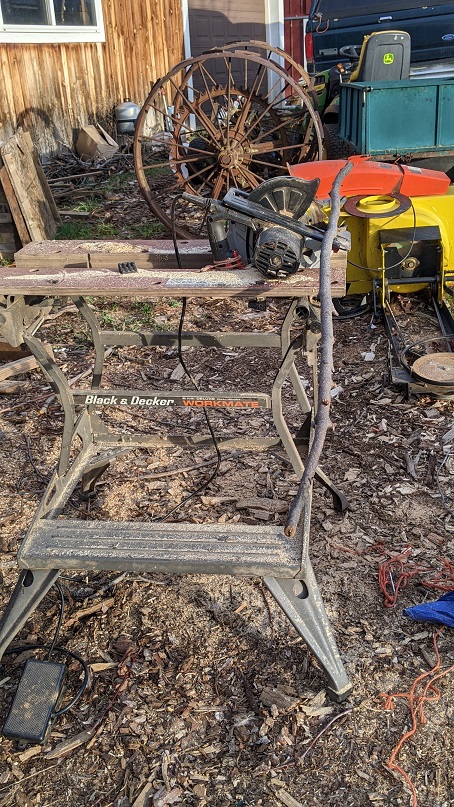
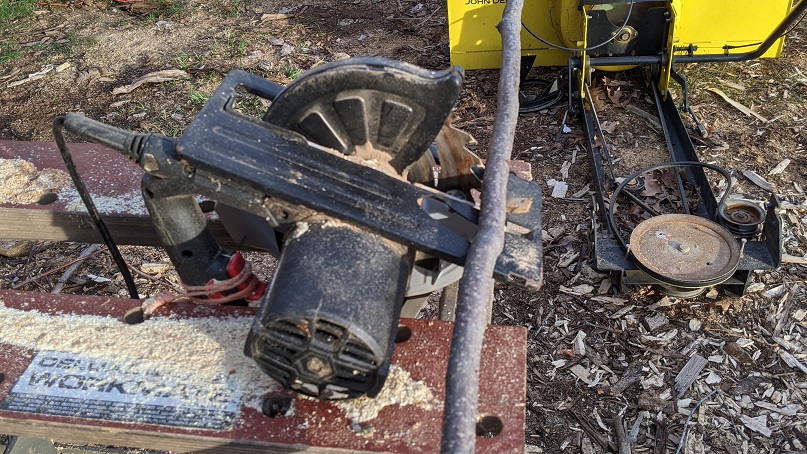
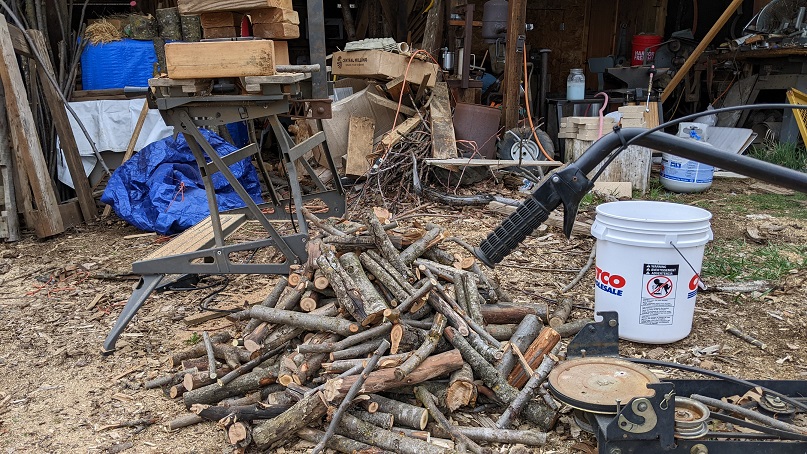
The saw is tilted slightly downward, with the guard locked to keep wood away from parts of the blade that are moving upward. You stand where the camera is, holding the wood with both hands on your side of the saw, and cut by sliding sticks up the base of the saw into the blade. It’s a little tricky keeping the angle between the wood and blade the same as you cut, to keep the blade from binding.

I’m still alive. It does work, but a few improvements are necessary. First, don’t use a blade with carbide tips missing, or that are missing their original edge. This is a family saw, which may have been used on concrete block :slightly_frowning_face:. The next version will have a fixed blade angle, with a narrow slot for the blade. The gap here is about 3/4 inch, say 2 cm. Chunks with a diameter smaller than that can get stuck between the base and the blade. This happened once, with no real problem. The foot switch works well, since you can step back, tap the switch, and stay away from the moving blade. The current blade guard will be replaced with a rigid fence, with something like a 2x6 on top covering the blade. This will form a U-shaped guard with a 2 inch/5 cm slot to slide the sticks into. Less blade exposed, and some protection from pieces flying in the operator’s direction. A chute below and to the right of the blade to fill a bag, bucket, or box would be a good idea also.

It’s noisy, a bit scary, and has limited capacity. On the positive side, it’s cheap, light, relatively easy to build, and reasonably fast, and cuts any length you want. An induction motor would be quieter and more durable, but heavier and more work. Suggestions are welcome, but if you just think I’m crazy, save your breath, I’ve already been told :slightly_smiling_face:

17 Likes

I will give you some serious bonus points if you figure out how to incorporate the Steel wheels. :slight_smile:

be careful, that is essentially a not super well fastened table saw.

13 Likes

I commend you for using what you have! :slight_smile: I imagine it works well for what it its.

Maybe to make it safer you can cut a square out of some plywood, build a box around it and fasten the guide of the saw to that with some bolts? If there’s no holes in the guide I imagine you can drill some yourself without inhibiting the normal use of the saw. Then you can fasten the box into the table as you did now and the whole thing would be much sturdier.

8 Likes

That’s basically the plan, with a stronger guard. I only have about 150 other important things to do today, so it may be a while :slightly_smiling_face:

7 Likes

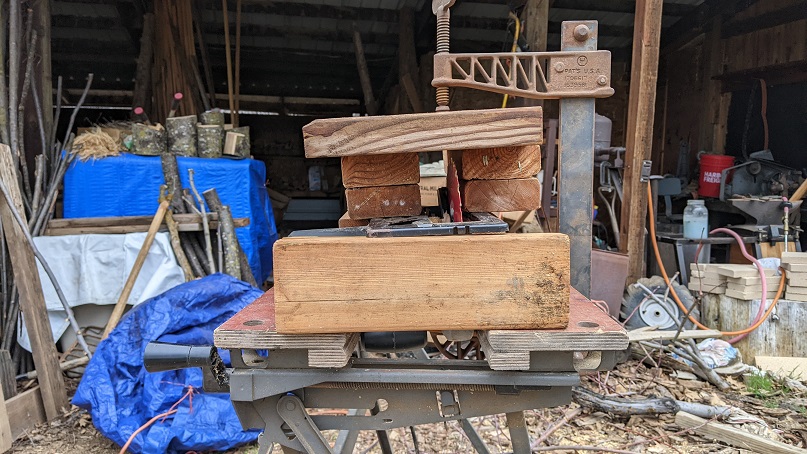
No bolts or plywood yet, but a serious clamp at least:

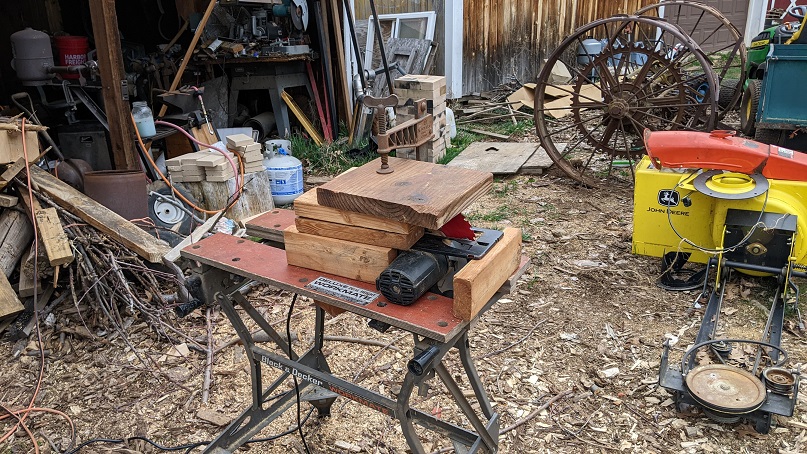
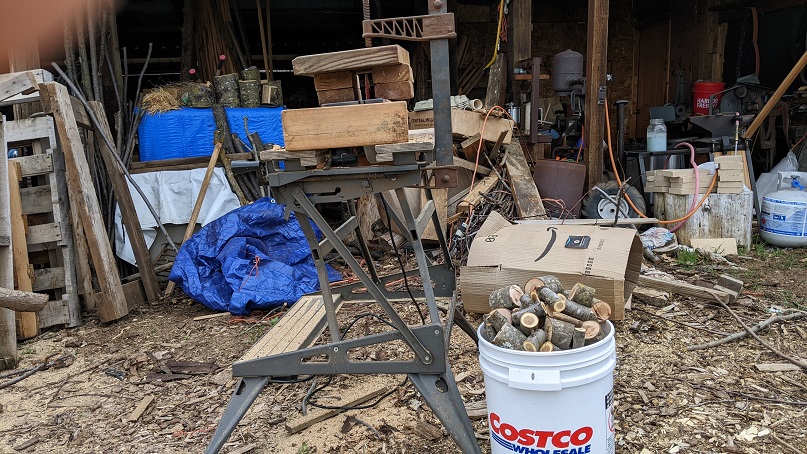
The saw is upside down still, supported by 2x4’s, clamped in the work table, pinched between more 2x4’s and a 2x12. What could go wrong? Don’t try this at home, anyone’s home.

The blade is now covered by the 2x12 where it’s moving upward, but branches up to 2 inches/5 cm or so can be slid under the guard. It’s sturdier than the first attempt, but that’s not saying much. It does work a little better, especially on larger limbs.

The pile of small firewood took just under 15 minutes, faster than I can do it with the chop saw, but not setting any records.

A bit more than 5 gallons/20 liters of 2-inch long chunks, in a bit under 16 minutes. TLUD fuel and/or charcoal feedstock. The bucket has sticks from 1/2 to 2 inches (1 to 5 cm) chunked up. I could have posted a lot shorter time if I had thought to do the small stuff later. I’m honest, but sometimes think a little slow. More uniform sized chunks would have been better for a TLUD. Notice the custom fabricated chunk chute that looks like an old Amazon box, in the background. It was better than nothing, but only slightly.

I think it’s worth putting one together with real fasteners and a more serious chute. I wonder if one chute could handle both chunks and kindling?

13 Likes

Seeing that just about everybody’s yard and work area looks about like mine makes me feel better about myself. :joy:

12 Likes

Now is a great time for you to take pictures! it is all covered in snow! :slight_smile:

9 Likes

kent, in the first foto, what is the thing with the great iron wheels? …a seed machine?

7 Likes

Sorry, Sean, I don 't get it :face_with_diagonal_mouth:

4 Likes

The big wheels are the rear end of a manure spreader. My son was going to convert it into a wagon, but the main frame rails were all rust and no iron. We’re in the process of turning those wheels into a base for a new address sign for our farm. We’re in the process of lots of things :slightly_smiling_face:

12 Likes

I was trying to say if you somehow incorporate the big wheels into your chunker project I would give you rather meaningless style points for your chunker. :slight_smile:

4 Likes

My goof. You were talking about Tom’s snow, not ours . At least, that’s what I’m thinking now.
Told you I could be slow :slightly_smiling_face:

3 Likes

OMG I feel bad! I didn’t know you got snow! You probably need to take pictures now too! :slight_smile:

4 Likes

I once made a makeshift table saw from a skillsaw. It worked okay until a large piece of a knot fell down inside the guard. This jammed the blade and made the motor burn out.
I have used a chop saw for making chunks. It works well. I imagine a makeshift chop saw would make good chunks. I imagine chutes could be made that would direct the chunks and sawdust into separate bags.
Rindert

Some Ideas.
youtube search: diy chop saw https://www.youtube.com/shorts/re1yiQ5Wbjc https://www.youtube.com/shorts/5OFLyLn_SZI https://www.youtube.com/shorts/XYLhCkW9vlA

4 Likes

When Jacob North made his cross country trip and we were making fuel for it I cut mine with a 100 dollar Metabo miter saw. I don’t remember how much I made but it took longer to get the branches up on a makeshift feed table than it did to cut the chunks. Unless I was making fuel for a daily driver I wouldn’t put too much effort into a dedicated chunker.

8 Likes