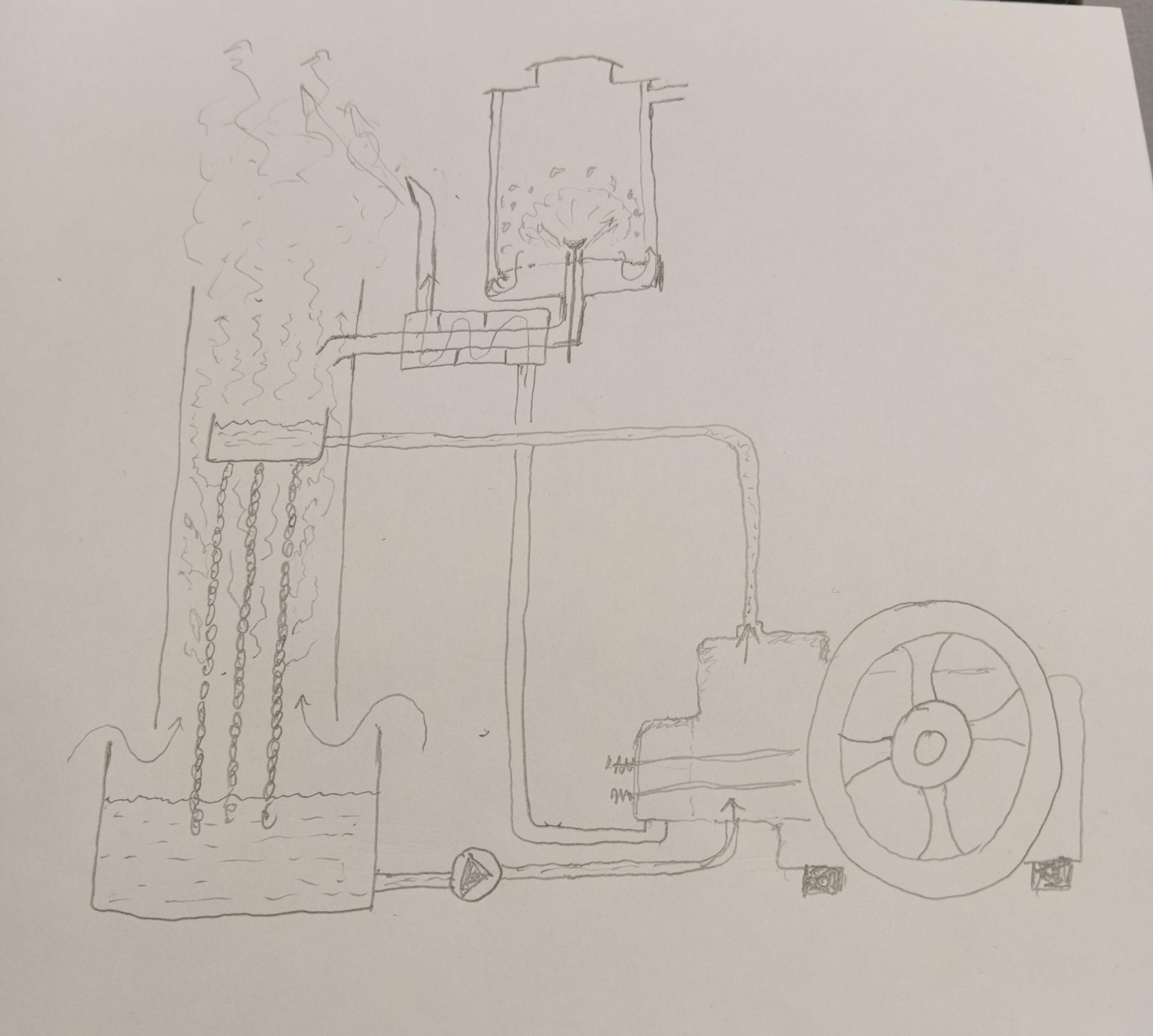
Here is a rough sketch of the air humidification and preheating system for a charcoal gasifier, and I definitely agree with Mr. Steve U.'s thinking.
11 Likes
Hi Tom, it’s probably the reason they don’t exist anymore?
(They belong to John Deere)
9 Likes
This is precisely what I was thinking of.
6 Likes
Hey Darrell, I link the observations I write now to you and your needs because we actually live in very similar climates with the same trees. And far-Left coasts; me-too, I am very shy about bring the attention of our now resident Eco-Freaks, piled up onto the Fire Watch folks down on my ass.
I was gob-snacked way back when in ~2012 or thereabouts when I found that WayneK had made his US coast to coast runs in his first Dakota truck, electric table sawing up found woods along the way. That table saw was electrical powered by a portable electric generator that was hose fueled off of his large truck system. The point was that he was making the electricity he needed with road side found wood fuels chunked sized large. NOT tiny wood that a small system would demand.
Then, later J.O. did the same thing first off of his Mitsubishi pickup truck system. Then he woodgas converted his wheeled tractor. All along in between; and later, other vehicle guys were doing the same. Woodgas fueling electrical generators off of thier larger vehicle/mobile systems. All of them then setting aside efforts on small woodgas systems for small electrical generators. No need then.
Tone has currently 315 posts in this his topic. You can click over his green circle avatar and get a box with a button to just narrow down to only his 315. Very, very instructive his evolutions in efforts and achievements just scrolling down and looking at the pictures. Stop and read for sure any post he puts up numbers.
Up through ~53 he was woodgas developing for a later trailer mounted small single cylinder diesel electrical generator.
The at ~post #123 he shows woodgas fueling his medium sized three cylinder converted diesel tractor. Ha! Maybe to move using wood fuel; his trailer mounted electrical generator system. He spent over a year improving that wheeled tractor system. Showing us he was able to PTO shaft power some pretty significant systems like his rock crusher.
Then along about post 192 he shows rebuilding and piston compression modifying an acquired single cylinder Jenbacher JW 20K water cooled electrical generator system. He said maybe to be a woodgassed CHP for his house and a shop.
Ha! Ha! But all along to current: his three cylinder tractor system has been being continually improved. And he shows in videos using it more and more. Reporting his power and efficiency gains. So . . . I figure he has come to the same conclusions as many others have now . . . . a larger, well developed system will give the thermal overhead to be able to use a wider range of sized, species and humidity of woods. Making the wood fuel part of it as reasonable as possible.
Yup, Darrel we need to stay off of the monitored and controlled roads out here far-Left coasts. A wheeled tractor; or a forestry skidder, small tracked forwarder like JanA has woodgas converted and uses; could be your electrical power live fueler. I have the Father-in-laws IDI J.D/Yammar 2wd tractor kept stored and set aside for just this future possibility.
Regards
Steve Unruh
8 Likes
Hi Steve, I read everything you post and agree with almost all of it. My foray into charcoal is to get my feet wet. My thoughts are that the Wayne K is very good for the bigger systems, the Tone and Ben P and Matt R for the medium and various char designs for the small. With overlap for experienced operators of course. This is an amazing forum and I read and enjoy more than I post. Part of the breadth of knowledge here is to pick the system than one thinks will fit their needs and then switch back and forth based on experience and ability. My abilities are boating, milling, building, chainsaws and running equipment. My weaknesses are welding and more complex electrical.
9 Likes
Tone, aren’t you afraid that burning gas in the pyrocoil (when the engine is idling) will produce a lot of pyrolytic gas that could prevent air from entering through the nozzles into the reactor?
4 Likes
Thierry, if you use charcoal, then there is no large expansion of gases from the gasifier, since there is no pyrolysis and moist gases inside, which causes overpressure in the wood gasifier, this is a great advantage of charcoal.
I have to thank Mr. Steve for the kind words and support in advocating wood gasifiers, the development of these is not yet finished, as far as I am concerned, I will continue to work on “improvements”. This gasifier, which I am using now, produces really good gas with minimal moisture, has a high capacity and stable operation. As I already wrote, due to the large diameter of the hot zone, it takes a little longer to start and heat up and has symptoms of overpressure when switching from a large to a small load.
I think that a good wood gasifier can also work without problems on charcoal into which moist air is sucked.
11 Likes
Tone, I’m also interested in wood gasifiers, I plan to build one someday. I don’t plan to install a ‘pyrocoil’ on a charcoal gasifier. I’m just trying to really understand how wood systems work before building.
6 Likes
There’s been a lot of talk here about adding moisture to charcoal gasifiers. I seem to have a problem of too much moisture. I always get a bunch of water draining from my radiator. I have in essence a cross draft gasifier so I must have enough moisture is the charcoal already and I don’t have to add any more. If I am missing something please correct me.
11 Likes
Hi Martin ,
Do you have any photos or diagrams of your gasifier core? depending on the gasifier setup, +/- steam can bypass the restriction… but I might not be telling you anything new
6 Likes
Trigaux, I appreciate any comments. There is always something new to learn.
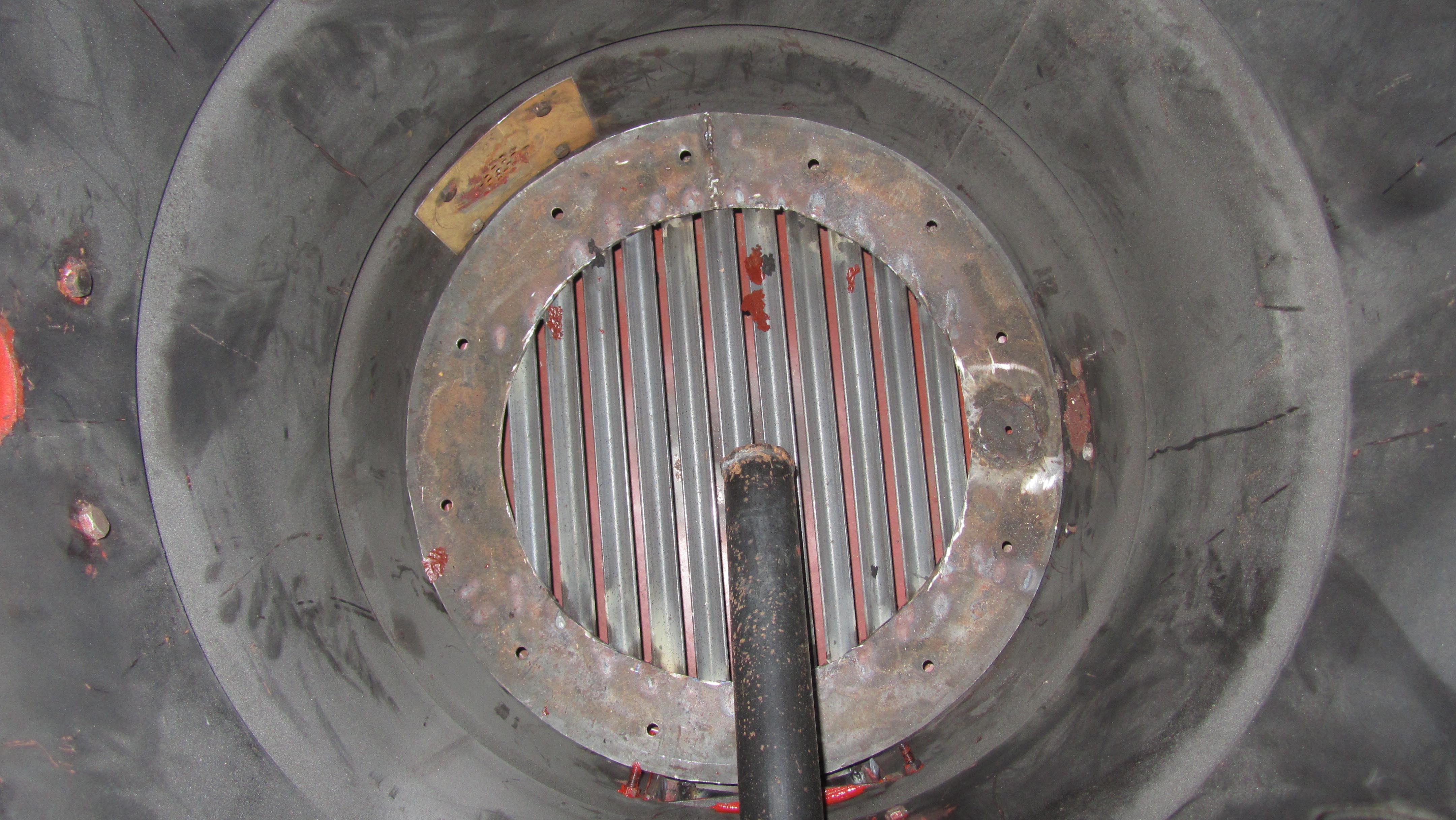
The nozzle is a downward sloping pipe to the center of the barrel, just above a grate. The gas exit is to the upper left in the photo.
.
An outside view
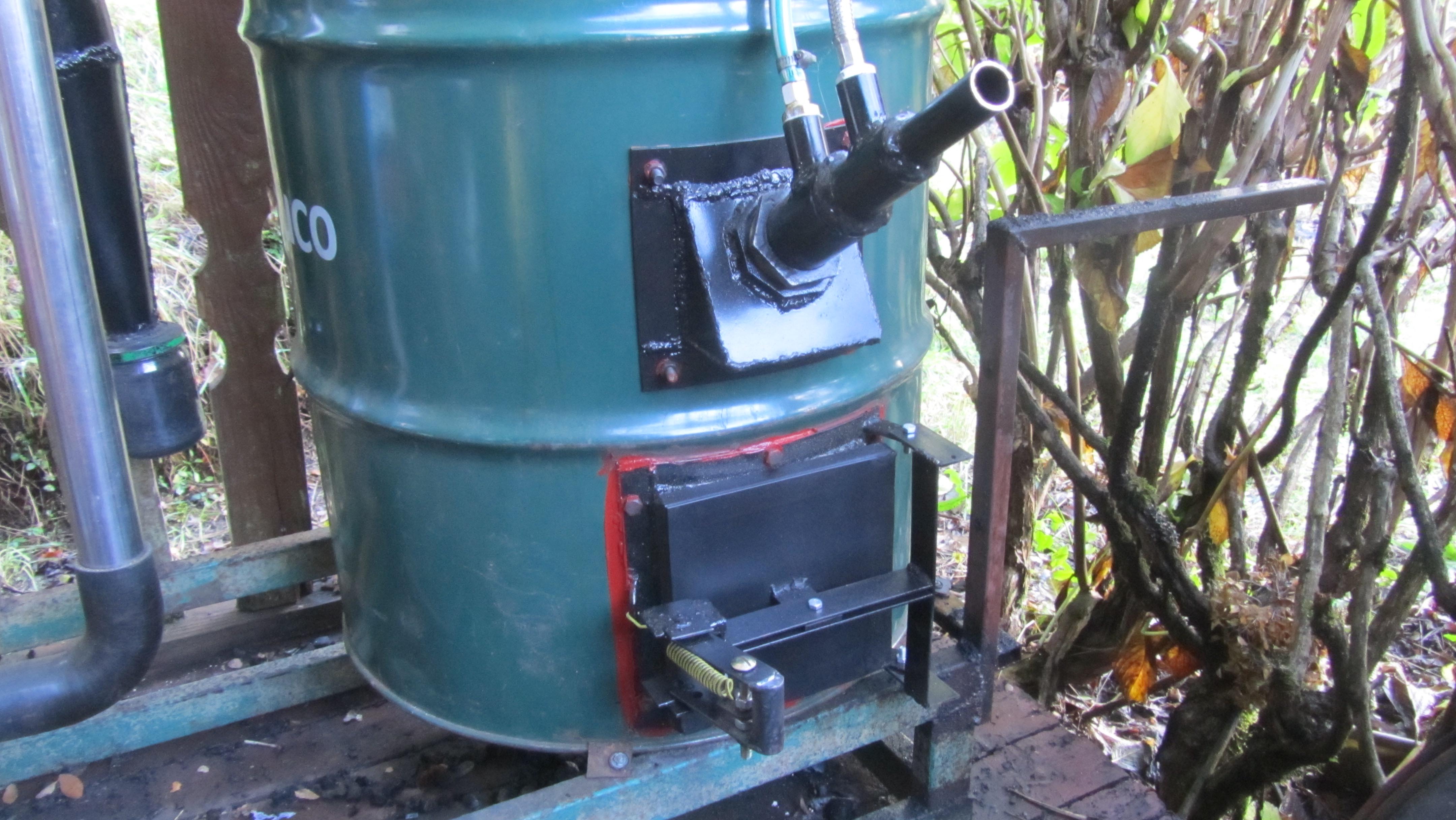
I have 2 water collection points, 1 under the cyclone visible in the above photo and 1 underneath the radiator. I never get much from the cyclone cleanout but I can get 250 cc’s after a 4 hour run from the radiator. I suppose water could bypass the ball of glowing coals somehow?
13 Likes
That’s a nice looking unit Marty. I’d go so far as to call it pretty. I’m wondering if the downward sloping nozzle is not leaving enough time for your water feed to flash to steam. What happens if you don’t add water into the nozzle? You can tell a lot by the color of your flare whether you are cracking the hydrogen out of the H2O.
10 Likes
Thanks Tom. Actually, the water at the nozzle is only for cooling the nozzle and preventing a meltdown (had that once with a previous nozzle  ). I don’t add any water to the charcoal.
11 Likes
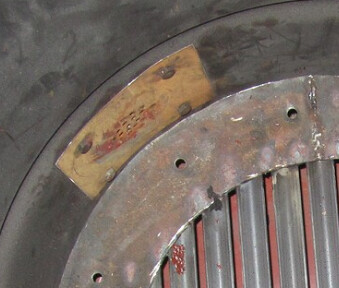
Thanks Don. Those holes feed a 2" pipe. I sized the holes and number of them to equal the area of the pipe.
12 Likes
Do you have circulation of the water that cools the nozzle?
10 Likes
Hi Martin ,
I have little experience with cross draft stoves, but in my opinion, they aren’t meant to work with wet coal (too much steam can bypass the hot zone and end up in the gas).
8 Likes
If you asking if the water is cooled in a closed loop, no. I just attached the inlet to the garden faucet and dump the heated water on the ground. It only really requires a trickle, and even then the water’s temperature is only raised about 30 degF or about 15 degC. I’m planning at some point to try making a closed loop system so that I can add anti-freeze to the water. I’m sure I’m getting some corrosion in the nozzle, but it hasn’t yet manifested in a leak or the ability to not cool the nozzle. Ideally, I would like a gravity driven system. All I care about is keeping the nozzle from melting, so even if the water temperature climbs to just short of boiling, that would be OK.
12 Likes
Could you expand on that Tom? I am not aware of what colors I should be looking for. Mostly I get an orange flame with maybe a little violet.
10 Likes
I’m sure that others can give you a better analysis with much more experience than I have but what I have observed is an orange-ish flame is the first flame and as you add the water drip the flame will go bluer and more translucent up to almost white and invisible. I believe that is the hydrogen being separated and burned. I would be interested in what others have found as well.
9 Likes