I don’t understand, are these holes the outlet for the synthetic gas?
7 Likes
Yes Trigaux, those holes let the gas out to the cyclone which is fed by that 2 inch pipe.
6 Likes
Why choose to exit the gas through small holes distributed around the grid? A single exit orifice should, it seems to me, concentrate the heat and optimize the reactions?
4 Likes
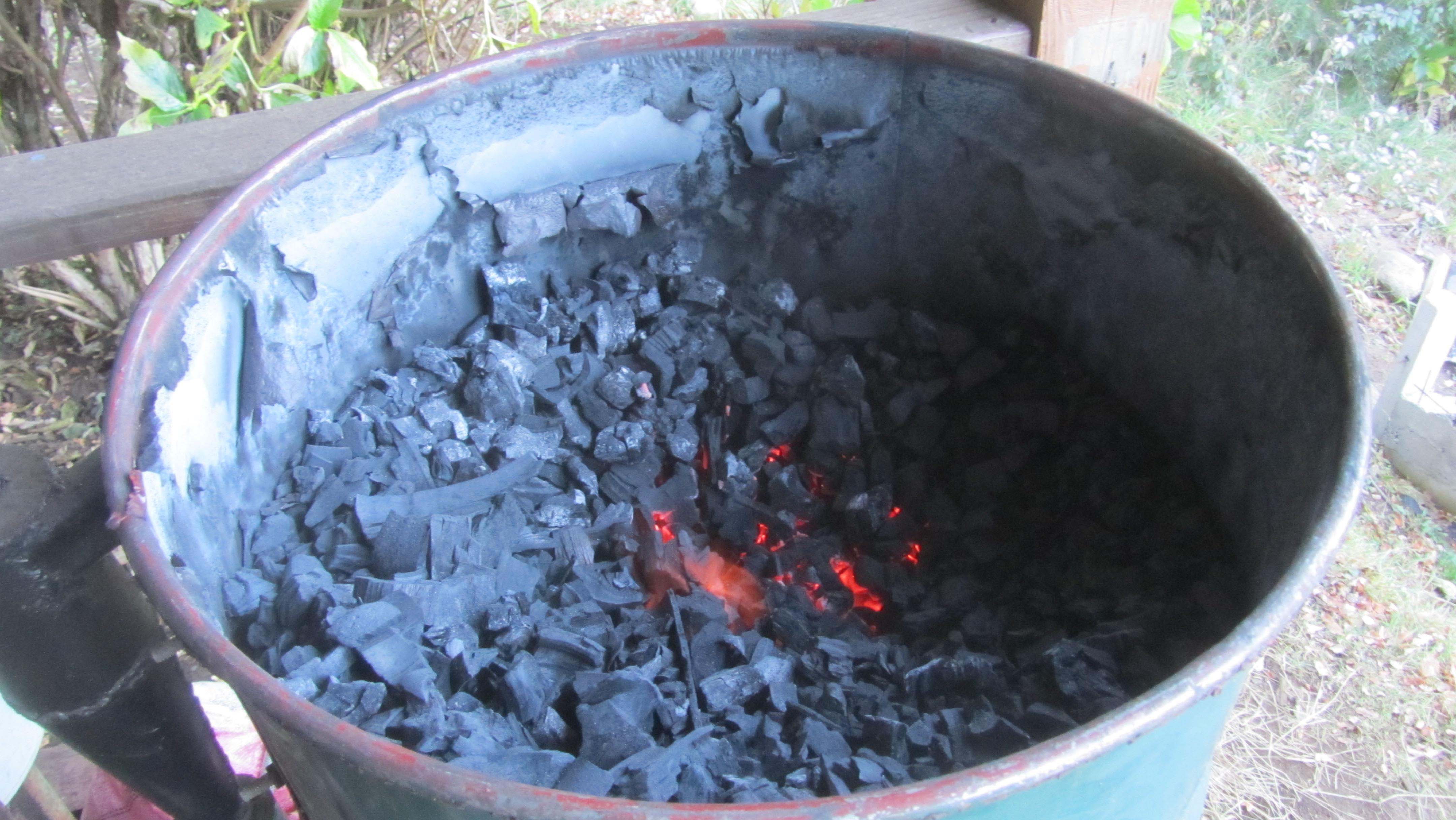
The heat is concentrated in a ball around the air inlet nozzle at the center. This photo shows what it looks like immediately after a run.
The charcoal surrounding the glowing coals acts like an insulator for the barrel. I exited the gas through the holes so as to keep charcoal out of the pipe. By the time the gas is leaving the barrel, the reactions have ended and the gas is starting to cool.
13 Likes
I have wondered why with so much water in the exhaust I would still have an orange flame. I guess the intense heat of the ball of glowing charcoal cooks off the water from the surrounding charcoal before it can enter the combustion zone. The steam can’t get to the high heat zone because of the outward movement of the combustion products. Is this correct thinking?
If so, this would indicate that despite all the water in the gas I am removing, I need to add more at the air inlet. I think I see an experiment coming up. It should pretty easy to inject water and see almost immediate results at the flare.
6 Likes
Martin, I agree with you, the hot ball of charcoal dries the remaining charcoal, and the resulting steam flows down the walls and is sucked in by the engine with the gas. A nozzle with one air opening creates heat in a narrow area, which is good for a quick start, and good gas is also produced. A suitable constriction in which the reaction takes place, so that the glowing area would spread to the wall, would make it impossible for the steam to escape conversion.
My idea of the construction of a charcoal gasifier is illustrated by a sketch I drew, one nozzle at the bottom with a shutter, so that the hot area spreads in the shape of a mushroom, and the gas is sucked down the wall of the container, similar to what you have. The gasifier will have a double wall, where the gas will rise, creating insulation of the interior and acting as a cooler the outer wall, while at the same time the speeds here are very low, so that all the ash falls down, so it has a triple function, cyclone, cooler and insulation. The nozzle at the bottom does not need cooling, because it is surrounded by ash, and the shutter is actually surrounded by ash from the top, and cooled by air from the bottom, the heat load is much lower below than above, because the heat forces upwards. so the heat losses are also lower.
I still have in my ears the words that my brother Primož said a few years ago, “water vapor must be supplied to the center of the action”.
10 Likes

6 Likes
Tom and Marty,
I got curious and found this article posted on the DOW forum regarding flame color which could be applied to flares. It sounds like there are so many variables affecting flame appearance that it is difficult to come to definite conclusions.
10 Likes
Thank you Steve for that article. The part about mixing oxygen in was dead on and made me remember my efforts with using chargas as a fuel for a foundry furnace.
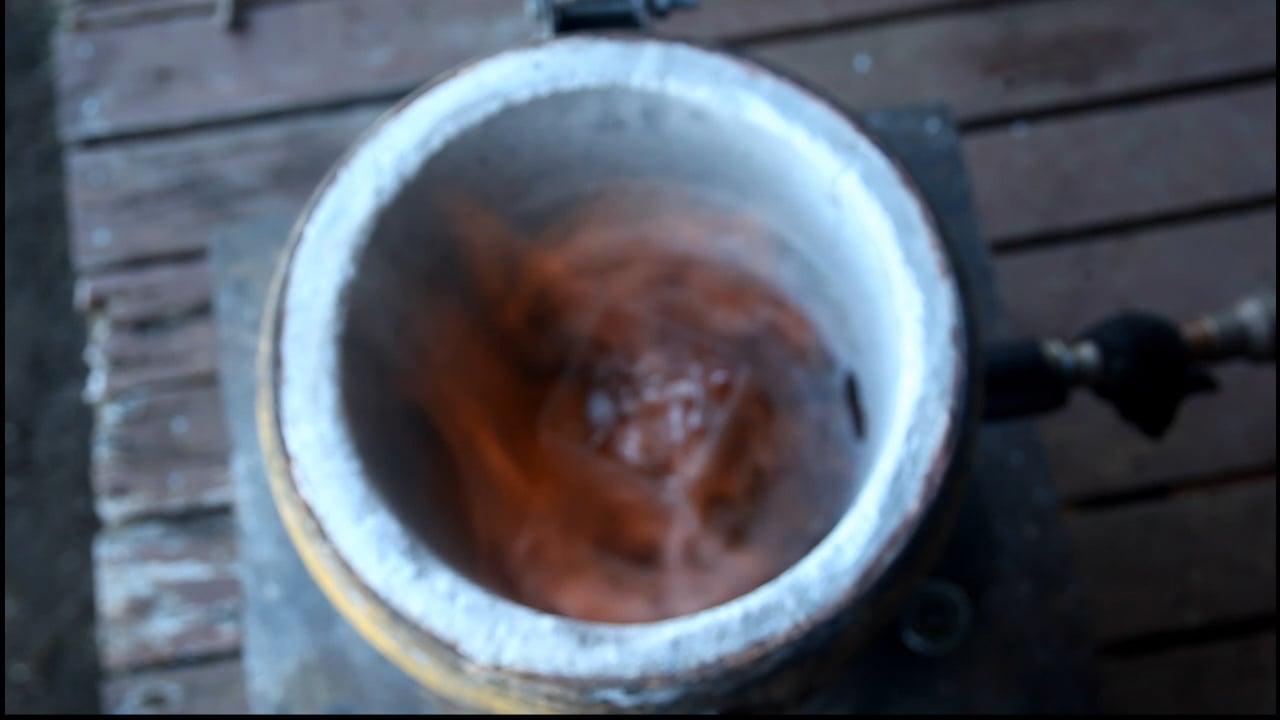
When I just introduced pure gas into the furnace it burned slowly with an orange color as it searched out oxygen:
Then when I premixed in oxygen, I got a bluish flame:
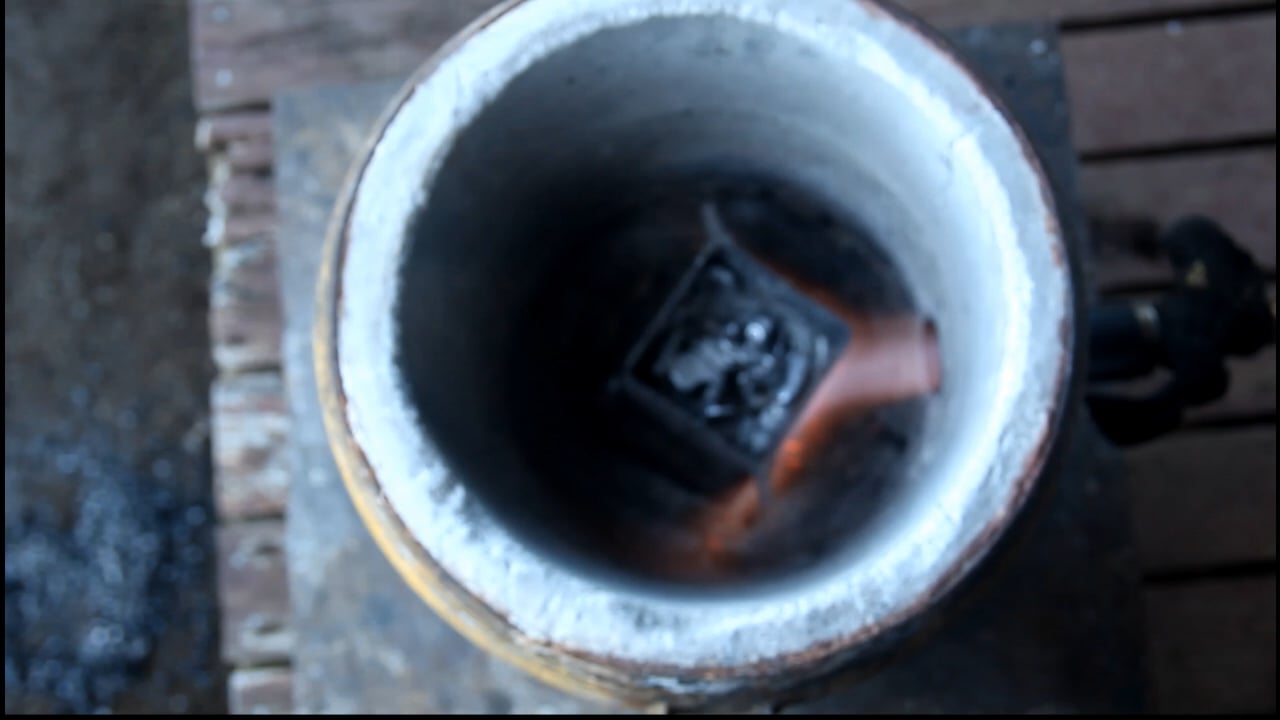
Sorry about the quality of the videos…
9 Likes
Tone, is the sketch you mentioned the one you posted 11 days ago? It totally makes sense and I will have to explore that approach. It could solve 2 issues at once: cutting down on water in the exhaust and not having to introduce a metered supply of water.
5 Likes
Martin, this is this sketch, well, it’s not perfect yet.
You actually have two options for maintaining a high temperature of the glowing ball, either use a single-hole nozzle, or supply air from a ring of nozzles. For the operation itself, supplying air from the ring towards the center is probably a better choice, because this way the highest temperatures are concentrated in the center, literally the glowing ball floats in the center and here the high temperature is concentrated away from the housing, which effectively converts water vapor (and tar gases - wood gasifier) into quality gas. You posted a picture that confirms the theory of the upward expansion of the glowing area, hot gases are light and rise upward, although the gas extraction is at the bottom, so I have an idea that the air nozzle should be at the bottom in the center. There should be a flap above the nozzle that keeps the air inlet clean and redirects the air to the side, thus creating a slightly wider hot area that would allow for better fuel combustion, and the gas flow would pull this area to the side and down. I read somewhere that ash is also necessary for the ideal operation of charcoal reduction, namely that it creates good insulation and prevents the flow of air and water vapor between the pieces of charcoal, where there is otherwise empty space, well, anyway, this method of charcoal gasifier should theoretically have “the properties of a good gasifier”.
Let me mention another very important feature of the nozzle in the middle at the bottom, this placement of the air inlet causes the formation of gases at the bottom, and the formation of gases from solid fuel means the expansion of gases below, which in turn lift the material, loosen it and mix it, the resistance is thus greatly reduced, and the ash retreats in the gas flow
10 Likes
Marty, do you ever get clinkers that don’t pass through the grate? What are the grate bars made of?
6 Likes
Tone , Do you think your charcoal gasifier would work with wet charcoal like what Kristijan does?
5 Likes
The grate is made of 3/4" angle iron. I have yet to clean out the barrel, I just keep adding charcoal to top it off. I have an upgrade plan for some of the tubing and I plan to clean out the barrel at the same time. It has been burning poorly as of late. I think it is because I added some uncrushed charcoal just as an experiment, but I am checking out everything while it’s cleaned out. I’ll let you know what I find.
10 Likes