Thank you Terry. That is the kind of stuff I was after.
Interesting to note, but just last night I found several of his videos and watched them with interest, since it was obvious that he was using a Victory Gasworks machine. But I didn’t see the one that you are probably talking about. It did not occur to me to go to his channel, which is where your link takes a person. I assume the video you are referencing is the one where has taken the gasifier completely apart and is showing us the most recent modifications he had made. That video is about a year old.
It is: Gasifier performance problems - and resolutions
Is that the one you meant?
Or am I missing something more?
That video sets the tone for the changes he made… I think he has made more changes since that video.
It doesn’t really represent a contemporary Victory Gasifier at this point.
TerryL
1 Like
Morning All
The SteveT that TerryL and PeteS speak of is member Steven Amptramp here on the DOW.
Yes his base machine was an original VictoryGasWorks carbon steel Woody model - late 2008 era.
PeteS also on youbube look at engineer775’s cnannel for video in-use, teardown of an early VGS all SS Offgrider unit.
YouTube “wgc1444” shows using a late model Victory XL system to fuel up a big Onan/Ford gen-set.
Another fellow can be found by youtube searching “Victory gasifier” in his carport with a standard sized Victory hearth/filtering set-up with this exact same blower. No. This IS NOT Ben Peterson. Shows plastic piping in the produced woodgas out stream. You will never see any plastic piping on any of BenP’s personal systems.
ThePlanetGreen team sw USoA horseshit/litter fellows first youtube show useing an early GEK, then an SS VictoryGW SS hearth. And now in private vidoes show using a ground up, densified fuel chunk belt conveyor/air-lock fed Powerhearth. Running a V-10 Onan/Ford.
I point out this last as AGAIN to illustrate that this BensGift book system is intended for saw/sheared sized chunked WOOD fuels. And sized screened WOOD chips. He shows this in words and pictures in this book pages 174-177 “Feedstock Preparation”. Page 177 shows his arboitist/tree servce all-of-the-tree chipped up four grade shaker screen classification table. And he says only ~3/8 of tree service dump delivered will grade out useable in this gasifier systems. He reinforced this is his now 11 system support videos comments sections.
Truth in presentation.
The very last wider fuel range use commercially made VictoryGasWorks system is shown here:
http://www.victorygrid.com/
This BensGift book system will like all other WOOD fueled systems produce as best ~22% hydrogen. ~20% carbon monoxide. ~5-6% methane. There is not the molocules and heat buget enrgy to do more than this on a fuel wood base stock. This has been well documented, systems in-use proven and published up since 1907 into ~1984 in most all of the downloads available here on the Drive On WOOD.
Regards
Steve Unruh
Here is an archived link to an early 2010 VictoryGasWorks sales brochure:
http://www.elmiraohio.com/Gasifier%20Docs/VictoryGasworks-Hotwatt.pdf
Skipping down to the approved Feedstocks section you can see NINE different approved as “Excellent performance” types of bio-mass fuel stocks. THREE additional “Needs Custom (system) modification” bio-mass fuels. And THREE listed “Do NOT Use” in his production units fuels types. These fuel recommendations were in-Shop proven for gravity movement in-line downdraft systems. The last three “Do Not Use” fuels really do need offset metered in feeding. BenP did make up a few custom special order units side-fed for these fuels in 2009 and on. His University unit as the first side feed capable. His one dedicated pellet fed machine was the Mechanics Illustrated featured EPS system - 2008.
This BensGift book DYI carbon steel unit in my woodgas Operators experienced opinion could easily do at least 6 of the Excellent approved fuel stocks listed. Now MY corn cobs all go to my chickens. And I’m never going to have coconut shells/husks and bamboo chips available as fuelstocks.
My point is every possible “bio-mass” fuel was asked for, and shipped into the VictoryDelelopersShop and systems tried.
While the chemists and idealists may be correct that any, and all biomass could be gasified - IMPOSIBLE to do them all in the same system. Only systems that come even close are those that grind up ALL fuel stocks including all woods into a uniform small particles. Then with much more automation and complexity fludized bed gasifiy that pre-particlized feedstock with much more systems energy imputs to make fuel particles and make the fludized hearth bed function/flow.
Or . . . take the all bio-mass ground up fuels particles and with even more energy and machine complexity then briquette/large pelletize them into uniform fuel briquettes or large pellets.
Use chunked up wood or coarse made wood chips and it all becomes just so easy.
THIS is what I see this book system designed for.
Just build it. Run it easy. On WOOD.
On this 2010 brochure HotWatt Gas Composition Specs see the all SS, VGW systems units typical numbers when fueled on wood:
N2 pass through ~50%; H2 - 20%; CO - 20%; CH4 (wood methane) 5%;
and an only remaining unconverted to CO an CH4, carbon dioxide CO2 at a low, low 5%. Typically wood gasifers out put 8-12% unconverted CO2.
So PeteS; on BenP’s units the excellant performances are not so much on the hydrogen making side but the CO2 to engine fuel relevent CO and CH4 conversion sides of it.
My personal actual use hearth was the prototype to the pictured Victory MODEL production hearth.
My actual ash/soot sweeper/ fuel drying bin the prototype to the pictured VIctory SYSTEM in this brochure.
The book does not give you two of the the patent level features in this system. Only VGW production system buyers/users got these.
VictoryGasWorks never required worshiping at the opensource demands alter.
Or joining-in the blue-flare stare-ist perfectionists cult.
No matter how hard these two Believers groups tryed to force warp it!!
Before I let Believers steal my trees I would either burn, or cut then all down to rot in place.
I can say on the IC engine side it VGW Developers Shop was always about proven documented engine shaft power.
Now with this every weld step layed out book there are no more excuses to make woodgas and learn the 75% operators side of the Woodgas Users success equation! NO SHORT CUTS TO THIS.
Regards
Steve Unruh


Steve slow down. You said you were including a link to a 2010 VWG on different materials. You forgot to post it. Then you go on to talk about it at length which with out the link doesn’t make sense. You say that Victory Gases Lab asked for and tested “every possible” bio fuel. Really? You say Ben’s design is"just build it and run it easy". Are you saying if I build his design, I eliminate the 75% that we have all come to expect? Then you jump to “typical numbers on wood fuel”. The sum total of those gases does not add up to even close to 100%. What are the other fuels. Then Pete S asked why Ben only mentions making Hydrogen. And you go on to explain how Ben’s “excellent performance in NOT because of hydrogen production but CO2 to fuel”??? Then you go on to talk about “your” designs in his builds but he won’t put those in his book only people that want to buy his “machine” get that information. Is he paying you a royalty or something. And then the bit about him moving on and “giving out these design developments now”. He is not “giving” these design out he is “selling” them just as Mr. Wayne is doing. You posted pictures but you didn’t give any explanation of what they were.Slow down. I can’t make any sense out of your post other than it is sounding like a advertisement for Ben’s book. TomC
Hey all, I have had the chance to look at Bens book as well. If I were new and wanted plans I would for sure pay the money to acquire his book. Im, not getting royalties are any benefits from it once so ever. We have in fact linked his site along with the DOW site on our home to help promote the DIY plans.
My take on the book is it is very well laid out, with easy to follow step by step instructions. The build uses ceramic insulation placed in the right areas and the heat recirculation systems are there. The tanks are hot water heaters and can be salvaged for free along with many of the other parts. Some parts would be best if purchased such as control systems like the 02 mixer control for instance. Like many others I have followed Ben through the years and now I am in his shoes. Any ways he has done great work and in my opinion the book is well worth the money for a proven system.
As for longevity its mild steel, the more you use the machine the longer it will last. Letting a gasifier sit is the worst possible thing you can do to it. If you clean when you know it is going to sit it could last you five to ten years. That does not mean the whole machine, this is just parts replacements. So it could last much longer that this.
As for the Hydrogen statement I cant answer that, but as a manufacturer we are mostly interested in the H2 production. Our goal is to get the machines well into the 20% range of H2 production. So this may be why he is making those statements. the CO is there, but this is not our focus. Many can build a gasifier, but producing engine quality gas, with high H2 yields is not easily done. So will it produce as advertised? At this time that remains to be seen yet. However, I would assume this will be the case considering what Ben has to bring to the table.
OK TomC I did edit hopefully for more clarity. Sometimes my brain meds muddle.
No I do not get a commission on Ben’s books.
Quite the opposite. I have fair-trade paid for every copy that I’ve gotten and sent out to true solar and off-grid friends and relatives. 9 books sent out so far. I have more to go.
These folks could care less about the H’s, C’s and O’s and the maths of it.
They all have Rural properties. Grow their own trees.
Harvest those trees for fuels and building materials and heat in bulk wood stoves. Know the value of wood-work-sweating.
They just want something that they can build up; or have built up that will works for them on their back-up gen-sets, with their own wood fuels.
None of them wants to be hobbyists, researchers, world saviors, or name makers. For most their extra time and energy goes into their chosen churches and local community.
They just want to keep the lights on; refrigeration on, washing machines washing, and well pumps pumping.
Simple enough is you just use WOOD as a fuel. Hard, Hard with other “bio-masses”
http://www.victorygrid.com/update-2014/
Some of the Ben Peterson personal designs developments will only work in a stainless steel fabricated system. These will not be in this carbon steel system book. Clear?
Even APL now patent protecting their newest SS systems. Wanna really see now? Have to buy a pre-made up system…
BenP says he will no longer manufacturer supply.
BensGift is MY name for this carbon steel plans set. Appropriate because this is a good-by, moving-on release out from him. Clear enough?
Regards
Steve Unruh
Steve U, I just caught your note about the “tar fence” today as I watch my exhaled vapor crystalize and fall in my lap … I’m glad he added those pages … Catch up later … I need to head to the main house and WARM up … Been splittin wood the last couple of hours … These folks can shove global warming up their behinds … I’d say we are headed into another ice age of sorts. SWEM, Mike
Hey Back MikeL
BenP would roil; you calling that drop-in performance improver sleeve a tar fence.
He considers this piece to be a combustion chamber shaper.
Also holds up the performance improving added in inner alumina silica insulation. So an insulation retainer sleeve also. On the production units this sleeve will have a top edge cone to keep the insulation from crudding up. You are a Premium member here on the DOW so look in my photo album here and see the very first use of this sleeve. HAD lower bolt down tabs - eliminated - unnessary. Shows later modified with the added on top cone/slope. He was tring to make this carbon steel DIY book “BensGift” system with NO cones.
This sleeve is considered a drop-in and pull-out consumable like his restictions plates.
Regards
Steve Unruh
I recently purchased Ben Peterson Wood Gas Mastery Course that contains print and electronic copies of his two books, the CAD drawings, arduino code, and construction videos. I believe that they are an excellent value.
Ben’s order page found here:
http://www.woodgasifierplans.com/order/
Ben has recently changed his mailing address, and requested that I include $8 shipping with my personal check paid order:
Ben Peterson
16625 Redmond Way, suite M #316
Redmond, Wa. 98052
I have been communicating with a fellow that has built and run Ben’s gasifier and he reports that it works well. He had a bunch of 8 inch diameter 3/8 SS grates made and still has about 50 left for sale for $20 each plus shipping. Dan’s email for serious inquiries about grate purchases:
[email protected]
3 Likes
Hi Tim,
I built a monorator hopper and it works well, but I had to experiment with fuel size to minimize bridging. I have a hopper vibrator mounted on my unit. I run it 5-10 sec every 15-20 min and have no bridging now. My hopper was based on a design I saw, the hopper grate was an exercise in artistry, lol. THEN, I saw Ben’s design, a much simpler build. If your interested in my unit’s fuel flow and water removing properties check out these vids. For Ben’s monorator hopper build check out comment 328 in My first small engine run in the Small engine section.
Pepe
drains at 1m
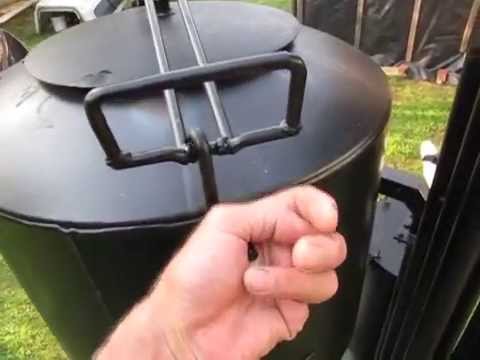
If you stop this vid at 58 sec(do it quick, it’s only 1 1/2 secs) you will see that the cooler condensate drain took over when the monorator hopper plugged. An original, it’s now a good backup.
drains at 6m27s
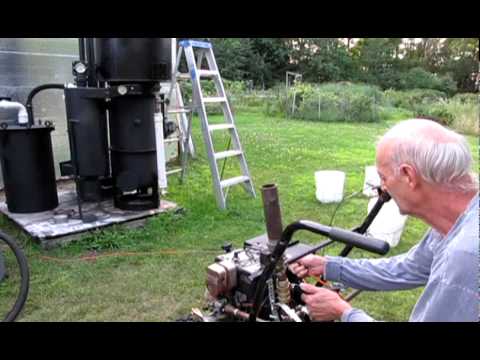
When the monorator runs well there is very little moisture for the cooler to remove. See at 7m14s.
Proof positive of the value of the monorator hopper.
2 Likes
Hello Pepe .
Thanks for the videos , very well done.
I noticed at 6:45 on the video a glug glug glug sound as you were draining the condensate . This usually indicates a clogged drain line above the reservoir .
Have a great Thanksgiving
2 Likes
Hello Pepe,
Thank you for the videos. Your monorator hopper is a work of art as you say! I have seen the BenP monorator build videos and am on the lookout for a 60 gallon air compressor tank.I have enjoyed reading your small engine thread here on DOW.
Tim
2 Likes
Thanks for the comments, Guys and a Happy Thanksgiving to all.
Wayne, there was some wood bark debris partially blocking the moat drain hole. I have 3 small bolt on inspection plates around the bottom of the hopper that I can remove to clean the moat during refueling. My little battery impact driver makes it an easy job. I’ll start running my fuel over a 3/8" screen to clean off loose sawdust, bark etc.,
Tim, My hopper was a 24" diam well water pressure tank from my neighbor, so it’s a bit large, but free. It’s good for a 2 1/2 to 3 hr run. I think it’s important, so I do a lot of “how I did it” pictures. It took me quite a while to figure out just what the heck was going on where and why. I was always looking for the “how to” myself, so I figured I’d document my trip and share it.
Guys, watch the second video again and listen for the unit blowing off a back fire, it’s at 1m43s. Did you miss it the first time? I didn’t, I almost snapped my neck. lol.
Pepe
1 Like
I have one 95% done. Just need to build a cooling unit.
Ben video that you may not have seen yet.
1 Like
Hi Brit,
Down to the cooler, great. I like the in line (linear) design myself for max even gas exposure to surface area of cooling tubes. Feeding hot gas into a manifold does not mean the same volume of gas flows into each “cooling arm”. They work, but imho are not as efficient as inline coolers. The challenge I had was " 180 degree elbows". I had to use metal because I recorded temps exiting my cyclone (headed into the cooler) at over 400*F. That would leave plastic out for me. Granted my cooler was more complicated to build, but it works great. You can check it out in the Small Engines section, “My first small engine run”, starting at comment 80 just to see how challenging it was. 2" diam metal 180’s would make it a lot easier and costlier and I couldn’t find any. I also could have fabricated the 180’s like in comment 211, but that seemed like a lot of work, lol.
I presume you have a cyclone built. Check comment 49 in above section for example from specs listed on this site. Mine works great, captures mega particulate material and from my overall unit design I have never had a hint of moisture in my cyclone. Worth the effort, for sure. Wish I’d have known all this stuff 3 years ago! So, some food for thought.
Pepe
1 Like
Hi Pepe,
No cyclone on mine. Ben recommended that I not do this, due to need for cyclone resizing based on engine size.
The bends are a problem. Having those done at a muffler shop is probably best.
1 Like
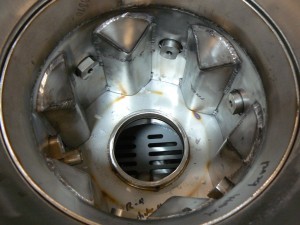
Ben just release his newsletter. In it he talks about a new the hearth designed to force wood and water vapor into the center of the hearth. He is using even number of jets though. Something in the library said that odd jets didn’t interfere with each other and not to use even jets.
3 Likes
Interesting, in a typical Imbert design you need the void in between and behind the jet ring. The fuels that flow through this void is where a good portion of the fuel that gets processed in the pyrolysis process not the fuel in the center. This is exactly why you want an uneven number of jets. As the air velocity goes through the oxygen is consumed with fuel and is converted into combustion stage processed gases and heat. This is then carried over into those voids to create the pyrolysis processes. Keep this in mind when considering jet ring diameters and openings.
Now then again this is Ben, so he may have some other concepts going on here. So we will be looking forward to seeing what he comes up with. 
2 Likes