I should really update this again. Not as much obvious progress this year, but a few things worth mentioning:
New Suburban
My foray into 21st century vehicles has been with… mixed results. This spring I managed to run our old 1995 Suburban completely out of oil, and the engine has a bad knock. The cost of a new engine is more than the truck is worth. I wanted to take the opportunity to upgrade to the GMT800 series, and also move into a 3/4 ton instead of the usual 1/2 ton. My reasoning for the latter, is that I have a house to build, and I have a need to move heavy equipment and building supplies.
I found this 2004 Suburban for $2,000 in Knoxville TN. Keep in mind these go for 8-12K in good shape, so I knew this was a fixer-upper. And immediately I started having issues. On the way home the alternator went out, and I replaced that on the side of the road, which wasn’t hard to do. But then I was seeing “reduced engine power” on the dashboard, and it would idle but not accelerate - which I ultimately solved by unhooking the battery for a few minutes, clearing the computer and it ran fine all the way home. It has done the same thing periodically ever since - and continues to be a source of frustration…
Over 2 months, I deep-cleaned and restored the interior, replaced a broken window, got new tires, and generally brought things up to spec. It runs and drives very well except for the above issue, the steering gear which needs replaced, and some electrical gremlins I’ve not chased down yet. I hauled a mini-excavator an hour each way from the rental shop, as well as two pallets of concrete at a time. It gets around 10 MPG towing, maybe 13 MPG unloaded. To date I have around $6K invested in it, so I am pretty happy as that goes. But the wife won’t drive it, and I can’t blame her… I’m probably going to restore the old Suburban for her to drive. It never had any of these computer related issues.
Culvert Retaining Wall
The excavator and concrete I mentioned were for this project. There is an existing culvert in the path of our driveway, which is about 4 1/2 feet in diameter and 20 feet long. I had the bulldozer build up dirt on top of it, to strengthen it and raise the driveway level for flood purposes. But he was only able to go up about 4 feet before the top was too narrow to drive on. The culvert either needs extended, or retaining walls built for the dirt. I opted for the latter option.
I did quite a bit of research, and came across stacked-bag concrete walls. They have been used by the forest service for decades for low impact trail maintenance and minimal equipment disturbances. You simply dry-stack the bags in place, overlapping like a brick wall, and the bags become wet with rain (or garden hose) and set up in place. Eventually, you can strip the paper away and you are left with a rounded stacked-stone look. Of course dry pour concrete done this way is much weaker than wet-pour, but for a retaining wall we barely need strength, it’s more about erosion resistance and sheer weight.


Stacking these was a TON of fun! 
Once I backfill the dirt, we will have around 16 -18 feet of driveway width. What you see there is two pallets, I have two more in the barn which should finish the first side, then I need to haul four more to build the other side up. It’s a lot of work. These are 60 lb bags, each pallet has 64 bags.
Eagle eyed readers may have noticed the shiny bags. They are indeed plastic not paper, much to my chagrin. I didn’t realize this until they were already here. So I’m making the best of it, I poked dozens of holes in the tops of each bag as it was stacked. Then I drove rebar down through the stacks, into the creekbed. Now that it’s had a chance to set up, the wall is surprisingly strong. But I will give it maximum time to set up before I try to remove the plastic, probably with a weed torch.
Mowing
It’s been a slow process getting a running tractor to stay running, but I’m now back in the game with bush hogging these fields. To recap, we bought the farm with two tractors. At the time, the red Massey Ferguson was the bush hog tractor, because the 3-point lift controls didn’t work (always up). The blue Ford 7000 has been the push-pull tractor, because the PTO isn’t working. So we worked the Massey doing some bushhogging, until one day I drove it up the steep logging road, and it lost oil pressure due to the grade. It took about 6 months to get it off the mountain, a very tricky procedure. It took another year to rebuild, in my spare time. Then it mowed gloriously well for about 2 months, and gradually started smoking and losing power. I assumed the headgasket was blown, and punted another year on fixing it. However, it turned out just the rocker arm had broken. That story is over here:
By the time I got back to mowing, some of the fields were overgrown by 3 or more years. I love trees. But I need usable land too. So, I compromised, and mowed the thinner areas and left strips of trees in strategic places for animal shade, shaped in such a way that I can easily mow around them. In the more overgrown areas, I have dedicated about 12 acres to completely revert to forest. This will eventually be our woodlot. I strongly disagree with the modern tendency to clear every inch of flat land for pasture and plowing… so this is my (small) protest of that. We have plenty of other land for hay and pasture, having flat land for tree harvesting will be very nice in the future. Some of these trees are now 6-7 years old, having never been mowed since we owned the land. We are going to have plenty of fuel and timber for future projects.
House Design
This is finalized. I put so much work up front into the 3D model I created, that the finished plans I got back from the structural engineer was basically the same as what I sent him. But we do have an engineer’s stamp of approval now. I didn’t strictly need that, we are not under building codes here. But I wanted the assurance anyhow. I also got cut sheets, each timber is marked individually with measurements so I can cut them with the right joints to fit each other.
Here’s a walk through of the model as it stands.
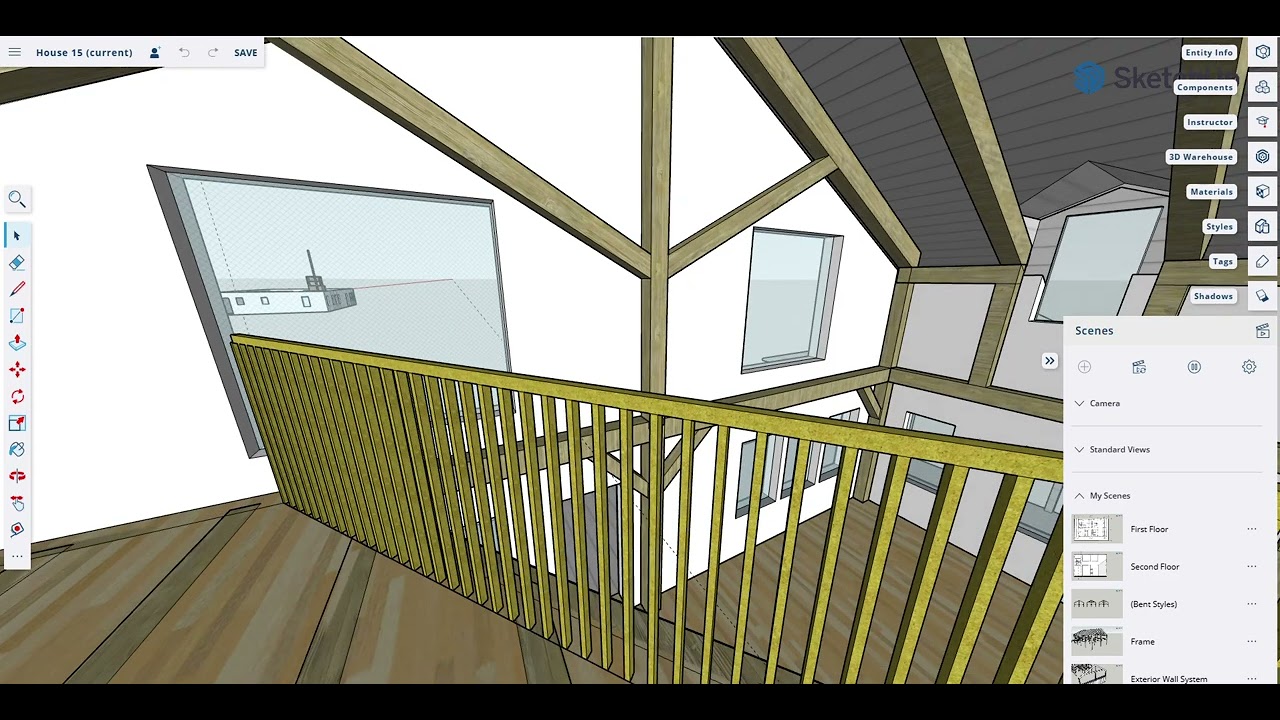
The masonry stove is still in design phase, and will probably shrink a bit. Also note there is now a full basement, not shown but definitely planned. Going with ICF walls and insulated slab with PEX. A portion of the basement will be walled off as a cistern, around 30,000 gallons.
Upcoming projects
I’m pulling back a bit on construction, as finances have tightened and the economy is less certain. We are instead turning our attention on the current house once again, to make it livable for awhile longer.
Things like:
-
Water system upgrade. The system works well enough, but is prone to freezing, and has limited capacity. A bigger tank, “real” water pump instead of the 12V RV pump, and insulated walls, relocated plumbing, etc.
-
Mini-splits. These are awesome, we have some at work and they are efficient, quiet, and unobtrusive. There are several DIY options now, and a few of them can run on direct PV solar, which is a nice option for future. My brother now lives year-round in the small cabin, and he needs something more automatic (and safer) than a space heater and window A/C. A second mini-split in the bedrooms will help with supplemental winter heating and summertime cooling.
-
Garage floor & insulation. This will help with the water system freezing, as well as making winter time vehicle projects more doable. I want to pour a partial slab, and insulate the walls, which are currently just sheet metal. I’ll install a small stove for heat, possibly a masonry batch-box style.
-
Vehicle / Tractor repairs. I have a Suburban with a blown engine, a Ford tractor with broken PTO, a second Ford tractor with massive oil leaks, and a woodgas truck with transmission problems. All of these are handicaps to effective farm work, and once the garage is usable again, I’ll be investing time in these repairs.