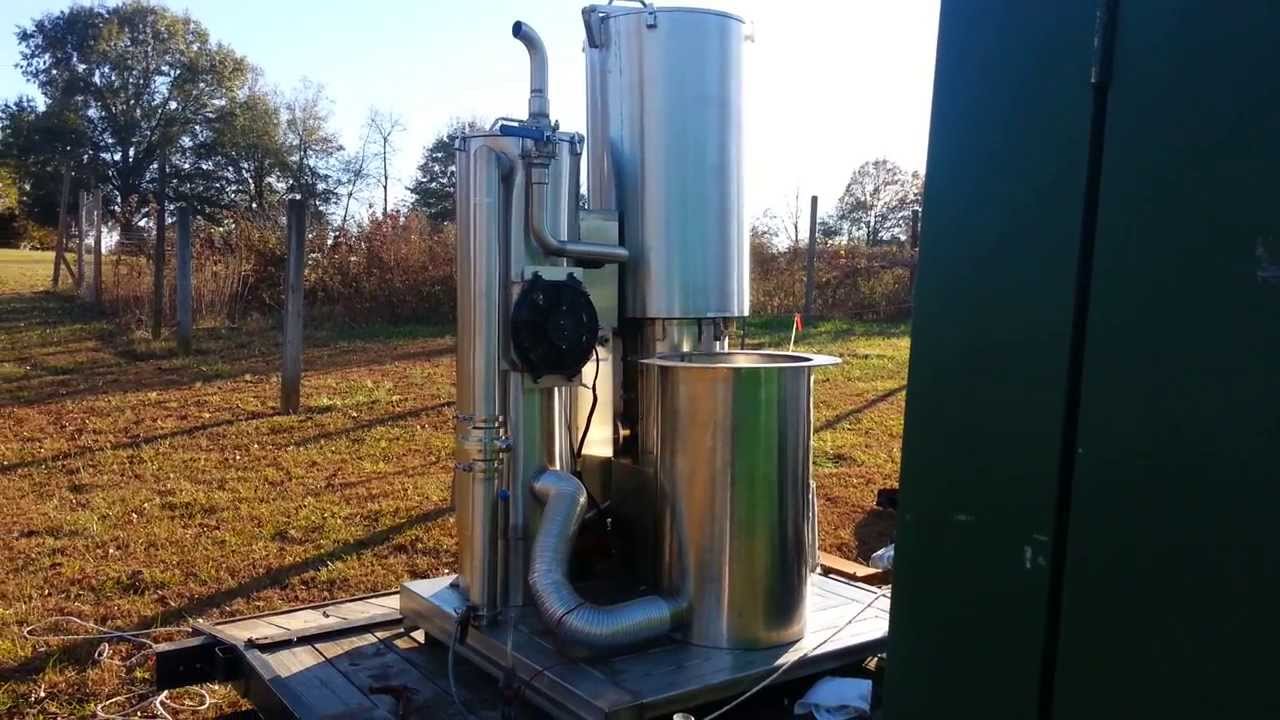
David's Stationary Gasifier

Hello everyone,

To start, a brief introduction: my name is David, I’m 34 years old, and I live in Belgium.
My native language is French, I use a translator to understand and speak to you, even though I have a basic knowledge of English (I apologize in advance for any translation errors).

My well has always provided me with water, and I recently had it treated to make it potable.
Just like with water, I’d like to become self-sufficient in electricity production.
I currently produce electricity with photovoltaic panels (12.3 kWp), two pico-hydro turbines (350W x2), and a diesel generator (14kva).
For storage, I have batteries (40 kW lithium).
For management, I have an inverter with backup power and home automation throughout the property (almost, as I’m currently renovating).
I am short approximately 1000kW per year, which I need to produce with the generator.

I’d like to use a gasifier as an alternative to my current generator because I own a woodlot and would like to utilize this resource.
Furthermore, I love chopping wood; it’s very relaxing for me.

Just to clarify, the wood-burning stove will be stationary and will run on wood. After doing some research, I prefer wood to charcoal.
I would like the fuel to consist of wood chips of varying sizes to minimize waste.
The wood chips will be produced in the summer when solar power is plentiful.
The types of wood are varied (European oak, birch, spruce, etc.).

The engine used will be a 4-cylinder engine from a small car (fairly easy to find around here). I would like the electrical output to be 10 kW/h and to last approximately 3 hours without intervention.

Recovering heat from the gasifier also seems preferable to avoid waste.

I hope I’m not being too demanding; if so, please don’t hesitate to let me know. I’m not one to give up easily.
I don’t want to revolutionize the world of gasifiers, but I’m simply looking for the best alternative for my personal situation, and I hope you will be willing to help me with my project.

14 Likes

First, regarding the gas temperature.
This gas needs to be cooled for the engine. Is there an ideal temperature? Is cooling the gas too much bad? Or is the colder the better?

11 Likes

You will squeeze more moisture out of the gas the colder it is and more energy per volume. Only freezing condensation is the limit.

12 Likes

Okay, thanks JO, a short and effective answer, just the way I like them. :heart_eyes:
Is there a limit to the length and height of the intercooler hoses for engine performance?
I assume so for the intake, but is the impact noticeable, and is there a maximum length and height?

6 Likes

That’s probably more of a practicallity issue. Also, you don’t want the cooler to be restrictive. The mixer-throttle-engine distance should be kept short though.

9 Likes

Okay, thank you.
Since the system is stationary and I have plenty of space, the practical aspects are less demanding, but of course, we need to be mindful of the cost and installation time.

From what I’ve read, a 2" pipe would be suitable for easy maintenance and to prevent tar from clogging the pipe quickly. Is that correct?

In the WK system, if I’m not mistaken (I haven’t received the manual yet), there are vertical and horizontal pipes that crisscross with several condensation points.
In the BenP system, there’s only one pipe that descends in a serpentine fashion and a single condensation point.
Which method is preferable?

6 Likes

10kwatts at a generator head is 11-12kwatts mechanical/shaft power or a true 16HP. That’s 13kg of wood per hour, perhaps 15kg+ depending on the moisture content of the wood. A 3 hour run is then 40-45kgs+ of wood. I’ll run with your preference for wood but don’t forget about charcoal. It’s the solution to a ton of problems you are going to have if you really do this.

Wood gas is less power dense than petrol, diesel, or traditional “gas” fuel (methane, propane, natural gas, whatever you call it in Belgium). For a given size engine you’ll get less power on wood gas than you would with those other fuels and you also can’t run it at the same high RPMs that those fuels allow.

Wood or chargas wants to run an engine at a lower RPM than it was intended to be run and a good bit lower than the RPM at which the engine was rated. This is because wood gas takes longer to burn and if the engine cycles too quickly, the fuel will not be totally burned and the power from the fuel will not be fully extracted. If an engine is rated for 60kwatts (typical 1.2L engine), that will be the output at like 5-6,000RPM running on petrol and measured generously.

Using woodgas you will be running 2,200-3,000RPM (experts correct me?!). Assuming torque stays the same… that’s a ~50% reduction in power output. 60kwatts just became ~30kwatts on RPM alone. Weaker fuel means lower torque… 30kwatts can easily become 15-20kwatts shaft power. Out of the generator you may be down to 12-15kwatts electric power but still above your 10kwatt target. If you end up with power above your target it means shorter running time, which saves engine hours and user “sanity” tending to the gasifier.

What am I getting at? You’ll want an engine rated for much higher power than you think, three to four times higher on the sticker / in the manual vs what you need/want. Great news… many/most car engines are rated for more than you need. I am curious what engine you source. I have a similar target for power output.

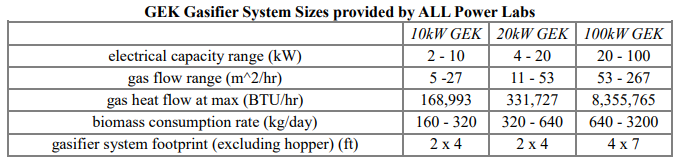
The smallest All Power Labs gasifier generator is a decent comparable for you:
Introducing the GEK Gasifier Systems_rev5.pdf
It uses a Kubota DG 972, ~1L, 3 cylinder engine intended for natural gas (methane)

image

11 Likes

There’s not supposed to escape tary gasses at all from the gasifier. If it does, you’re running the gasifier too cold, too wet or the wrong size fuel. Only “clean” soot deposits are allowed in your piping. They can be easily washed out with plain water.

For cleaning purposes - a modular straight pipe setup.

Also, very true what @abreaks said about power.

11 Likes

Thank you for all this very precise information!

At the moment, I have a 58-horsepower, 3-cylinder Opel engine, but the head gasket is blown.
I was thinking of maybe repairing the engine to do some testing first (I’ve never done any car mechanics before, but it doesn’t seem too difficult, and if I don’t try, I’ll never know).

Later, I’ll get a 4-horsepower engine that I’ll probably take from an old car that’s sitting in front of a body shop or in a junkyard.
I don’t know exactly which one yet, but I plan to produce the 12kW that will allow me to get 10kW of electricity from it.

I’m in contact with a nice lady at Allpowerlabs; their gasifiers are currently unavailable (a problem that needs to be resolved), and I’m also interested in their system.

Okay, so soot is the problem, so perfect, the WK system is preferable (or similar).

8 Likes

Good morning David .

Below is a quote from Chris .

Warm or hot air fed to the motor is like feeding it cotton candy.

Cool or cold air is like feeding it sugar cubes . :smile:

13 Likes

Hi Wayne,

So cotton candy sticks to dentures?
While sugar is just delicious and dentures can’t get cavities? :laughing:

6 Likes

Looks like you have a Z10XE or Z10XEP?
GM Family 0 engine - Wikipedia

While you are fixing the engine, you might look at advancing the spark timing. That engine already has pretty high compression, so I don’t think it is worth fussing with thin gaskets or shaving down the head. A different spark plug will help a little but I wouldn’t mess around with that until you had everything else working well. It might give you a little more RPM.

11 Likes

Wow, you amaze me!

I just found the vehicle’s documents and it is indeed a Z10XEP.
Ah, okay, so I don’t need to change the head gasket, or do I? And no other changes are necessary initially?

7 Likes

You said the existing head gasket was blown, so you will need a replacement for that?

You can replace it with the standard manufacturer one or you can get fancy and go thin. The compression increase for a thin gasket is/would be really minor, but car tuners looking for every last bit of HP do it. The stock gasket is about half a millimeter so even no gasket would only increase the compression by 6-7%. I’d use a stock gasket and have one less variable at play.

10 Likes

Ah, okay, thank you, I understand better now.
Having no knowledge in this area, I was a bit lost, but now it’s much clearer.
So I’ll replace the gasket with the same one as the original.

7 Likes

You should build a simplefire first and experience a charcoal system before jumping in too deep and learn real world usage with a charcoal system. Verses the perception of whats available; things like its less efficient. its more work etc. < none of that is true and is the contrary. Water injected systems produce higher gas energy so there are no losses. The water puts losses from charcoal back in cleaner water cracking. Fuel process is the same as cutting and splitting wood for a wood stove. The retort is not causing you to work. Its doing that on its own. Fuel to run the retort is no different than any other wood processing equipment. They all need fuel to run and you dont have to use good wood fuel for the retort. Use junk wood and those would not work in a wood gasifiere either. So you cant think of that as a loss.

We need to change the perspective because Im here to tell you its not accurate and many are going the wrong road intot this.

9 Likes

Hi Matt,

I’m not against charcoal and am considering using it partially, but I find it more of a hassle, especially in terms of waiting, monitoring, and the smell.

I enjoy putting branches through a wood chipper or chopping and stacking wood.
But smelling the smoke after burning branches, for example, is less pleasant.

Perhaps there’s a system that produces a lot of charcoal without monitoring or bothersome smoke, but I haven’t come across it yet.

Yes, a gasifier also produces smoke, but I find it easier to filter, though I could be wrong.

Just convince me and prove me wrong, if that’s the case.

2 Likes

“Yes, a gasifier also produces smoke, but I find it easier to filter, though I could be wrong.”

David, it may be a misstranslation but if you are reffering to woodgas as being the “smoke”, that shuld never be the case.

You probably seen videos of wood gasifier startups on Youtube, smoking for sometimes tens of minutes after lightup. That isnt woodgas realy… woodgas is clear or just a bit hazy frommoisture and dust. The “smoke” you can see is tar. And wery important to keep in mind as a beginer woodgaser. Tar can never be filtered out. You must not make any, thats the only way to be tar-free.
What you can “filter” out of the gas is only soot, wich is relatively harmless, ash and water.

11 Likes

This is based on what? Actual doing or reading? or a little of both.

If you are making smoke then you are doing it wrong. If there is smoke that is waste, there should be absolutatly zero smoke in your charcoaing process. This is also a great way to capture waste heat for heating and hot water production. < Factor that into your net energy.

There are very efficient ways to produce charcoal that is way less than a hassle than fuel chunking. Its not as simple as chunking up fuel and fueling a gasifier. You must dry the fuel and your environment has a huge impact on how viable that maybe.

Charcoal is NOT the only fuel input with a modern charcoal gasifier.Water is just as much a fuel input and reduces the amount of charcoal consumed and can indeed be lower gross input than wood fuel and also less time from raw process to finished ready to run fuel. I can create fuel the same day. You can not do that with wood fuel period.

yes we have way too much misconceptions of this tech by novices and those taking it at face value instead of actual doing, advancing and innovating the technologies. Ive done both and I have advanced charcoal far beyond wood fueled systems. The 2026 machine will push water / injection to the limits and will be the first machine to shift the water input ratio beyond the charcoal consumption.

11 Likes

Hi DavidP. I am coming into this later, recovering from dental surgery.
On the gas cooler for your stationary system . . .
the Ben’s book system is minimal to have the least potential air leaking weld joints to get a fellow up and running with the least Builder problems.
Ben on his own hand builds could get very elaborate:

Where is the gas cooler? In the SS skid base. Big passageways. Wash cleanable. The rising heat drying wood in the open topped shorter round bin.

WayneK. how ever is an experiences driven king of setting up for the longest time for functioning with then later a reasonable water wash out restoration.
His long distance between states traveling dictates a parallel pathways cooler system.
One pathway restricts and still useable gas delivery though another pathway.

As J.O. indicated it could be just a single LARGE ( think 150mm) inside diameter sloped pipe with a condensate catch.
Or . . . very small area with forced air like StephanA. shows using.

With your DOW access now you can see really system users here make their gas coolers to physically fit their application usages. Tone on his tractor front.
Regards
Steve Unruh

9 Likes