Thirry, no, the sech will not work. As soon as you start to open the manual valve the automixer will want to correct it back to 50:50!
You need to move the hybriding air valve to the gas side!
Thirry, no, the sech will not work. As soon as you start to open the manual valve the automixer will want to correct it back to 50:50!
You need to move the hybriding air valve to the gas side!
Hi, Thierry and Kristijan!
2.5.2020
Eaven this, by Kristijan proposed version does not completely “bypass” the air/gas automixing!
Following Kristijans proposal, the incomming gasoline/airmix will be further diluted if “infused” into the “gasleg” of the automixer.
The “clearcut” solution is to go “below” whole the gasmixer, directly to the motor’s intake manifold and keep the gasmixer flaps (gas and air) closed (100%).
But this asks also that the air/gasoline route shall have no “idle” leak during woodgas driving.
Max
Hi, Thierry!
3.5.2020
With a clear risk of being “picky” I have a question about your drawing.
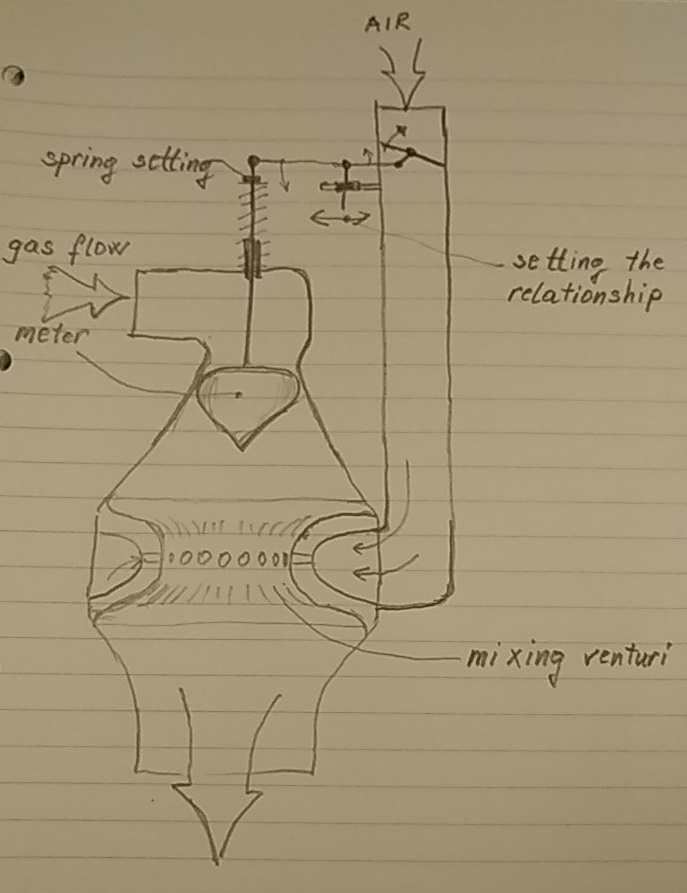
A two-throat air-gas mixer for 50/50 mixing needs two equal long (identical) tubes with equal-geometry flaps, ganged together, so that they operate in synchrony and meter equal flows.
To get equal flows, you need pressure sampling ahead of both flaps by a membrane between 2 “cups”.
The membrane adjusts a 3:d flap in the airline so the arriving air-pressure levels with the arriving gas pressure.
OK
The main criticism is, that the sampling points are not near ahead of the points of “flapping”= regulation, but instead very near the point where they flow together! How to “identify” the differences in the two routes? when they are almost flown together?
That gives an “unspecific” regulation quality.
Picky as picky!
The gasoline/air delivery is best to deliver separately between the described (char)gas/air system and the motors intake manifold.
Max
Hi Kristijan
here is an explanation of how i understand things : 
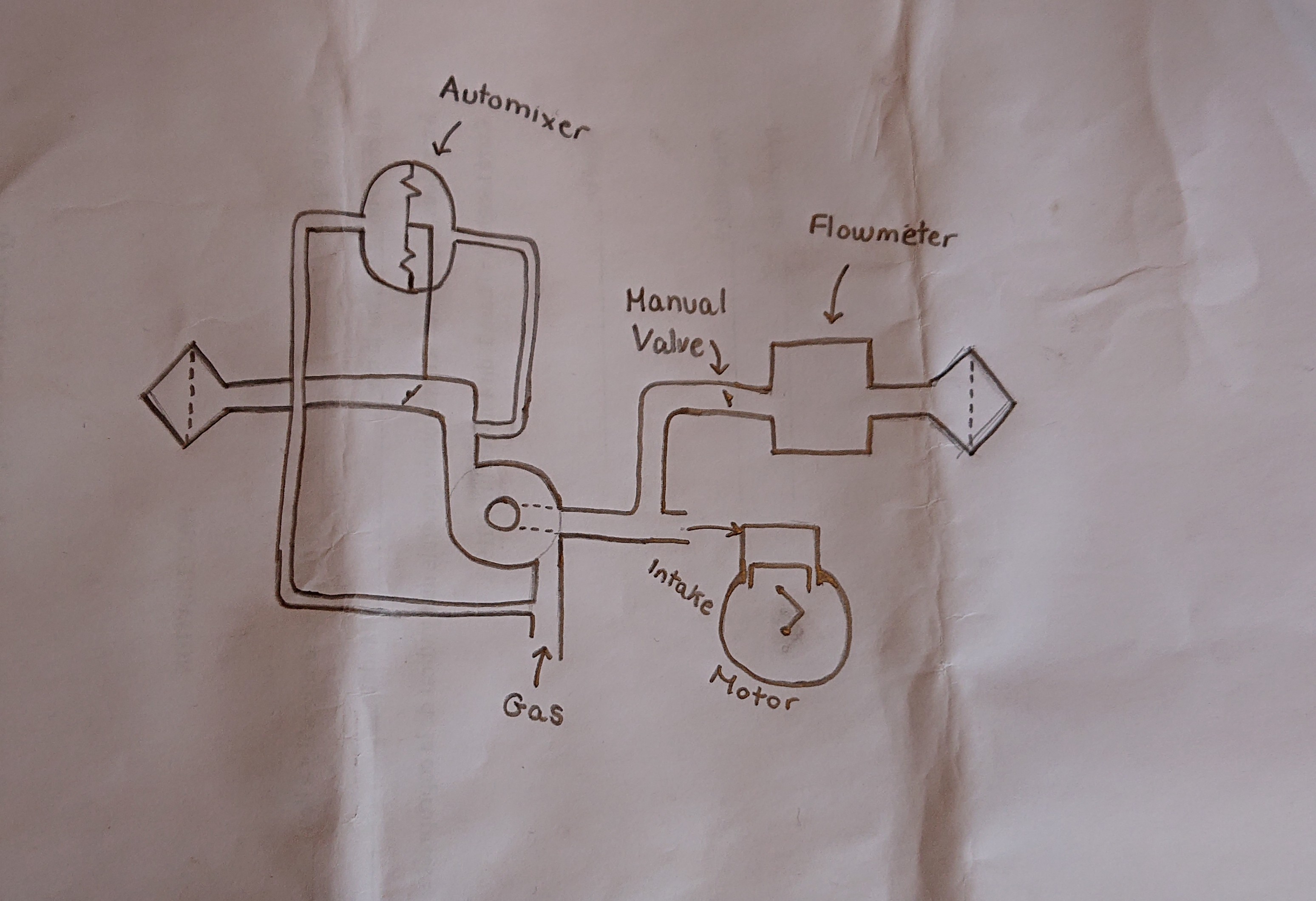
1 in the situation where the engine is 100% chargas powered. It is the automixer that adjusts the right air / gas mixture.( manual valve closed )
2 in the hybrid mixture situation (petrol / chargas) the mixture is adjusted manually
if the manual valve is partially open (to hybridize the mixture). The automixer will close the left air line (the pressure of the air line being higher than the pressure of the gas line ) and the air then arrives through the flowmeter . The injectors will be able to +/- enrich the mixture (thanks to the adjustment of the PWM of the pump)
Where am I wrong? 
Thierry
Max, thank you for your reply.
I think I know the conditions for the proper functioning of the automixer but the space I have in the engine compartment is reduced and I can not install double flaps
is this what you suggest to me?
It seems, that you are swirl-mixing together gas and air. Good.
But your pressure sampling has no sense!
You have one flap for air OK.
Add another IDENTICAL flap at the gas inflow! (same geometry)
Gang these two flaps together, with identical closing angles (and full opening angles).
Connect the ganged flaps to gas pedal.
Membrane diameter over 200 mm !! preferable ~300mm.
The membrane sampling tubes just before (in flow direction) these ganged flaps.
Then add an extra flap before the sampling-tube (in flow-direction) in the airline.
Let the membrane piston-rod now control this "3"flap!
Synchronization:
When the gas-side pulls the membrane, close the air-flap.
When the air-side pulls the membrane, open the air-flap.
If you do a neat work, I hope you get a neat functionality…
Max
Hello together,
I spent some time thinking over the “classic” twin-flap-automixer (see here: Vacuum Automixer project) and Tone’s automixer. Let me write down the pros and cons of both, which came to my mind.
Tone’s automixer:
Pros: Less parts, gas-air-relation “programmable”, insensitive to vaccuum fluctuations in the gas-pipe, good mixture from start, good gas-air-mixing due to venturi-effect, blocks off gas and air pipe when engine is stopped (valve seated in the venturi restriction)
Cons: probably higher flow resistance at WOT, prone to gum up with poor filtrated woodgas, no pressure compensation in the air-pipe (dirty air filter).
Classic twin flap automixer:
Pros: Lower flow resistance at WOT, compensates pressure variations of both air and gas pipe
Cons: More moving parts, needs some turbulence after the flaps for good mixing of gas and air, fixed 50/50 mixture.
I thought about "fine-tuning"of the mixture. This may be sometimes needed due to fluctuations in gas quality.
My idea, if don’t want to move too far away from 50/50 with the classic automixer: With a tiny three-way-valve you could lower the vacuum on one side of the membrane for a leaner or the other side to get a richer mixture. (Sketch from Max: Vacuum Automixer project - #145 by gasman)
For Tone’s mixer, it could be possible to adjust the basic mixture on the rich side and then blend some air in the woodgas pipe before the mixer to make it leaner.
Advantage: With the automixer you get a quite good mixture to start with and then you can do some fine-tuning with the air valve while running to find the sweet spot.
Hi,Til!
04.05.2020
I think we both this time left out the disk the gas-pedal first activates, as it has been described so often!
And modeled by Chris.
This disk covering "opposite slide-track settings for the gas- and air flap connecting rods 0 – 100% for each in opposing phase…
This, because of cram places in this case. But always available…
Max
Hi Til
this idea seems very advantageous to me to correct the fluctuations in the quality of gas. a simple micro solenoid valve on a bypass pipe between the two chambers of the automixer could easily be operated from inside the vehicle (possibly , automated / lambda / arduino probe …  I dream)
Max
does this diagram speak to you most?
it is similar to the previous two
the mechanism of my automixer is a little different from your
https://youtu.be/dj2R-8H5J4k
Hi, Thierry!
4.5.2020
NO! There is nothing regulating or controlling the gas-side!
No control without control over BOTH “legs” and their ratio.
A complete control does not get better by cutting off either member of flow!
And sampling should NOT be taken where the both flows are almost flowing together!
Where is the “individual” pressure then?
And that flow-meter route is placed completely random without controlling even the whole airstream!
Where is the logic?
Max
Hi, Thierry!
4.5.2020
Difficult to see details in your video,
but:
It seem you are blowing and sucking from one side of the membrane-pot ,
but the other side seems to have a lot of FREE HOLES + one bigger!
That gives no possibility to compare two different pressures when
neither of them are = the atmosphere!
Following instructions usually gives predicted results!
Doing otherwise gives different “results”.
Max
Perhaps your dream is not so far away. I would use an Idle Air Control Valve (IAC), on most vehicles. The one on my '91 Ford 2.3L uses 1.2A, 12V. A low cost PWM power supply can be had from ebay. this would be controllable from the dash or via lambda, arduino & etc…
Rindert
https://www.ebay.com/itm/5A-3-35V-12V-24V-PWM-DC-Motor-Speed-Controller-Adjustable-Switch-LED-Fan-Dimmer/133330551163?hash=item1f0b1ec17b:g:bNsAAOSwo-5eQkiF
Uff, the debate has gotten really lively …
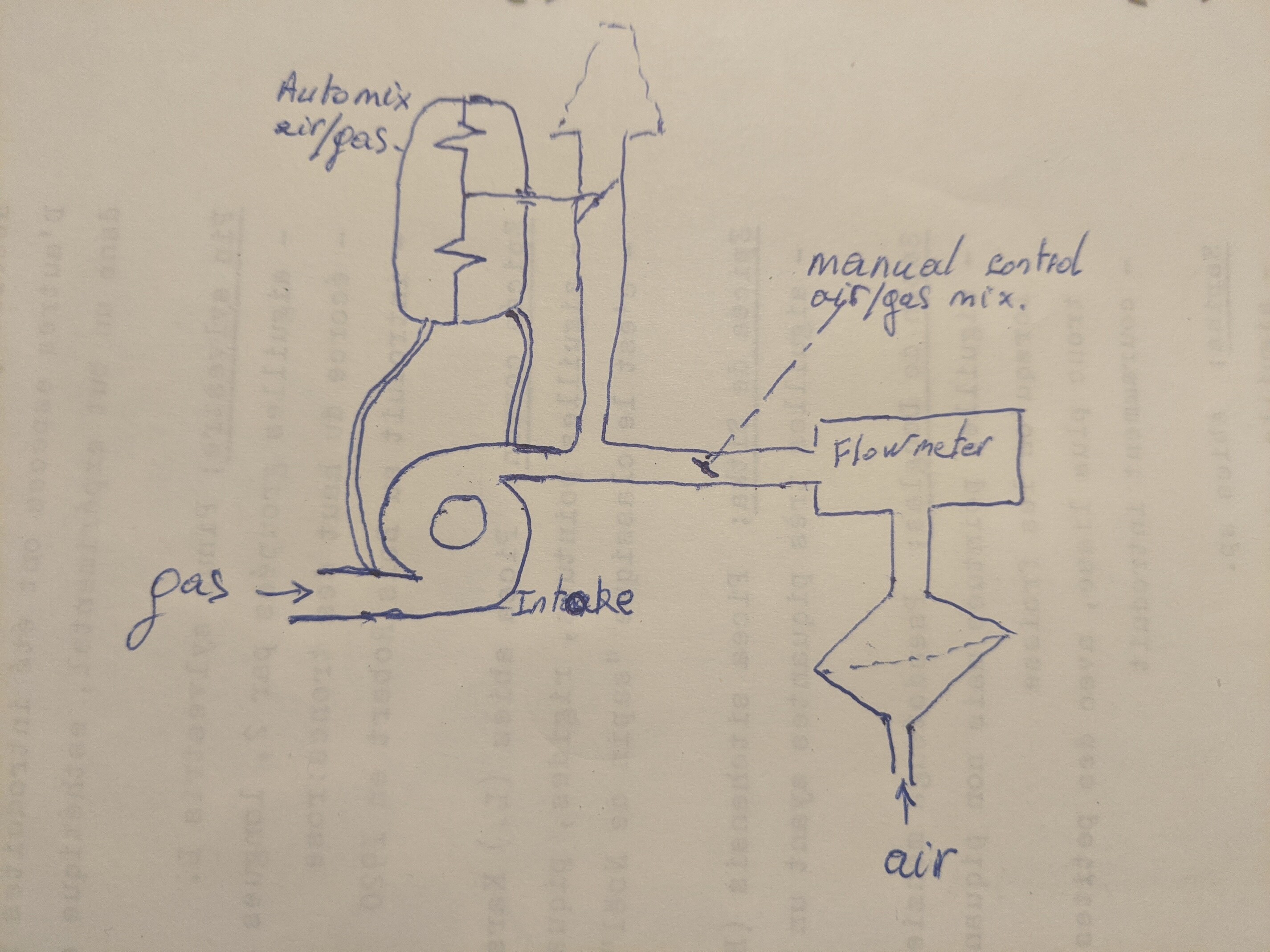
Me and Kristjan and I spent some afternoon chatting about the mixers, but I am attaching a sketch, this is supposed to be with an adjustable gas / air ratio and less downtime due to dirt
Tone got this idea from the Bosch K jetronic injection system, the kind JO had on his Rabbit and l had on my Mercedes. It does make sence, since it already does the job. Just instead of mixing the petrol in relation to air it wuld mixwoodgas in relation to air.
I think this wuld work great but wuld require some math, carefull analisys of the originanal flow meter etc… but once we get things done we shuld be able to maks a 100% foulproof automixer.
Tone, now thinking about it, you were right on the begining! The gas shuld pass the metering float. The gas is the variable (different drag on the gasifier) and IT must dictate the amount of air (constant pressure) to be metered in.
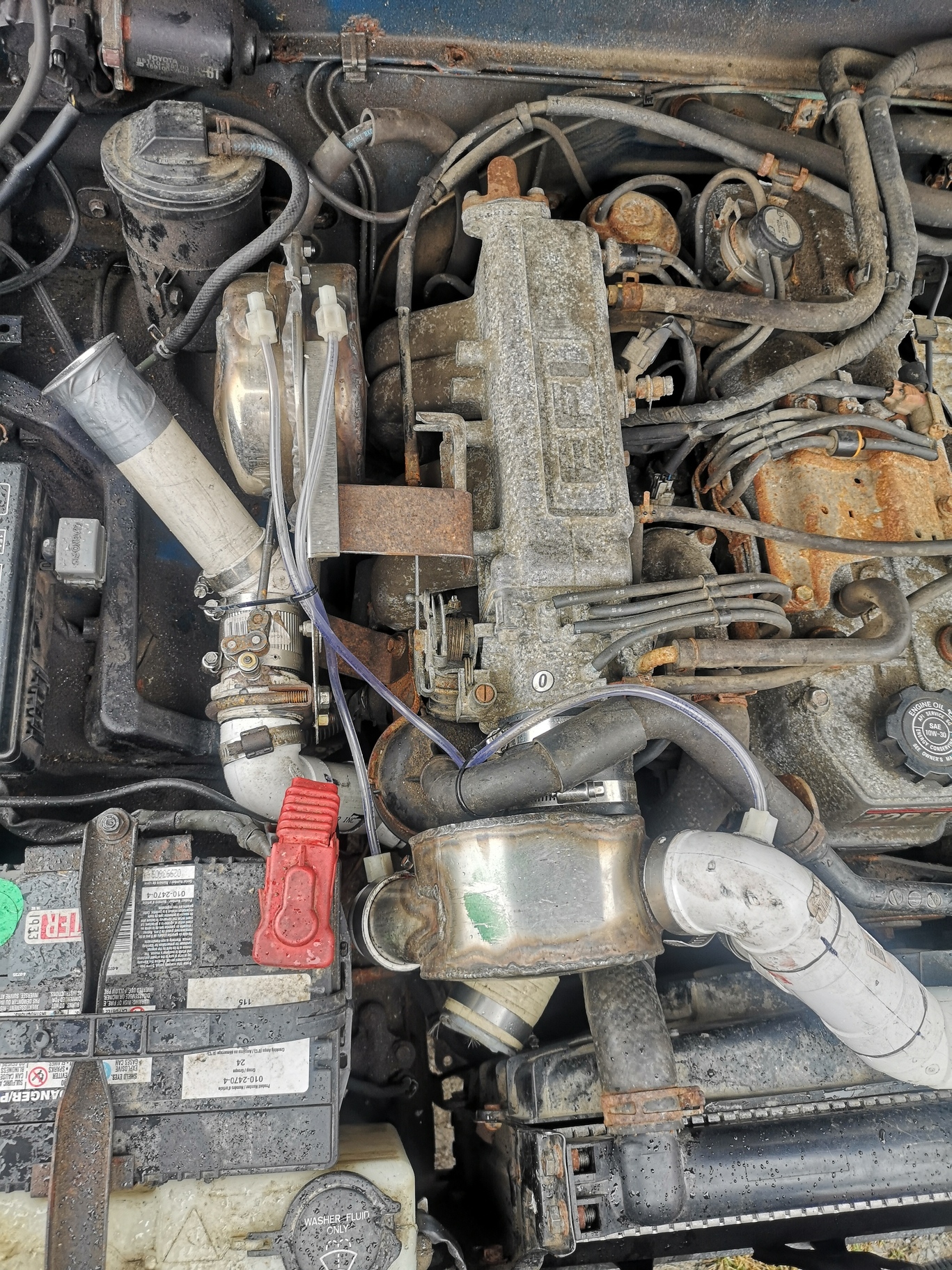
Max, see for yourself … or could I install more things? 
automixing seems to work well. on one side it is connected to gas pressure and on the other to that of air. As I said before, the space is very limited and I try to build without equal-geometry flaps
Wow, Thierry! You really put down some effort under the hood. I like the little piece of bicycle-chain on the valve axle 
Hi Thierry,
A make-more-space solution would be to move the battery out from under the hood area.
Older US cars and trucks would put the battery under the passenger side floor boards.
If you do this build with good stout wood soaked in preservative to endure the slow battery acid fumes deterioration.
Other late model FWD chassis’ underhood space can be made removing some of the elaborate air-in hush boxes. Live with the air intake hissing tones then.
Regards Steve Unruh
That wuld be extremely ilegal here. In a case of a car accident, first thing that gets done is to disconnect the battery. Hard to do that if you dont know where it is…
I did not know this equipment (Idle Air Control Valve (IAC),) Rindert, thank you for the very interesting information .you seem to say that a simple PWM could control the opening or the gradual closing of this “mini valve”?
I would like to be at this stage in my project but I think that before I worry about such fine regulation of the air / gas mixture, I still have a lot of work to do, but at some point I hope to achieve it