it looks like the consensus online is to take it off, clean it up and glue it back on with new epoxy.
5 Likes
I filled most of my gas cans up in February before the price went up. It was all E-10 and I treated nearly all with Ethanol Shield and Stabil. All except two gallons which I had planned to burn right away. Put a gallon in the log splitter and a gallon mixed with Stihl mix oil. Filled the Echo chainsaw and the Stihl weed wacker today. Chainsaw ran great at first. Weed wacker ran but sputtered full throttle. After the saw ran out of gas I refilled it with the same fuel and it would start and die right away and then wouldn’t start. I’m thinking the gas absorbed enough water to where it was sitting in the bottom of the container and I used enough fuel to get down to the water. So that’s two months to get to where untreated gas becomes crap. I’ve been thinking about engineered fuel but that’s about 30 something bucks a gallon.
8 Likes
How come you didn’t just buy Rec Gas? I buy that for small engines.
2 Likes
Because the local pump with regular gas is 90 octane, so automatically about 80 cents higher and then another dollar because it’s non-ethanol. Plus there is still about a half gallon of probably E-10 in the hose before it switches over. I normally would have treated the saw gas with Ethanol Shield and Stabil, like I do my other stored gas but I thought I’d use this stuff before it could go bad but we got so much snow that I couldn’t go out and start cutting until much later than I figured. Mostly just an annoyance since I got everything loaded up and into the woods and without accomplishing much I had to pack it all back up.
5 Likes
You can probably add dry gas to it if you think it is water.
We have a whole separate tank and pump for rec gas. The two stores that carry it have like 1000 gallon above ground tanks for it. It costs more. I filled up a couple of cans of regular gas before the governor allowed more lightweight stuff that evaporates out to be added to the gas. I don’t exactly know what that meant. It was just supposed to lower the price.
3 Likes
I guess we are going to E-15 starting in May. I’m going to have to think real seriously about that. I never knew how it was cheaper to distill alcohol than produce regular gasoline. Seems a little fishy to me. I thought it was because a lot of Mid-West politicians had financial ties to corn producers. I usually buy 25 gallons of storage gas in late october and treat it and keep it a year. I seldom use very much of it and then dump it in the car or truck. They aren’t as fussy as small engines but I generally don’t use stored gas in my small engines.
4 Likes
Ethanol ranged in price from 1.52-2.06 in the last year. with the low in january and the high a few weeks ago. it is 1.90 right now on the commodity market. RBOB (Reformulated Blendstock for Oxygenate Blending) or just commodity gas before any oxygenates like ethanol. It is traded on NYMEX (NY mechantile exchange) has traded at prices ranging from 1.66-3.40, over the same timeframe and peaks and valleys with similar timeframes as ethanol. Currently, it is trading at 3.01. (that is pre-tax)
It looks like Gas became more expensive in like mid-February. Most vehicles in the last 10-15 years or so are mandated to handle 15% ethanol. I don’t recall if they got the mandate up to 25% or not. I know they wanted to.
4 Likes
Here is my dealings with small engines gasoline . . .
Opinions, NOT accepted by many here on the DOW; or even within my circle of family and friends.
I stopped using metal cans for any storage of gasolines. Metals easily conducts temperature changes. And then they internally sweat moisture out of the air. And even sealed tight; as you use up the gasoline filling engines, you introduce a new dose of humid laden air inside of them.
Instead, I use thick gasoline rated plastic cans. Just like a cold drinking glass, plastic does not conduct heat as much; and from the air, condensate sweats much less.
But I only use plastic containers that can prove they are sealed; and not capable of breathing in and out, venting. That pressure releasing “venting” cycle loses the lighter fractions in a gasoline blend. The octane and burning rates of the gasoline then changes too much. A non-vented can; then cooled down will re-condense these back into the blend.
And finally: I religiously keep my storage, and in-use cans out of the sun.
Here. In the shade having air warmed; neutral pressurized to get rid of the overnight sides and bottoms, sucking-in:
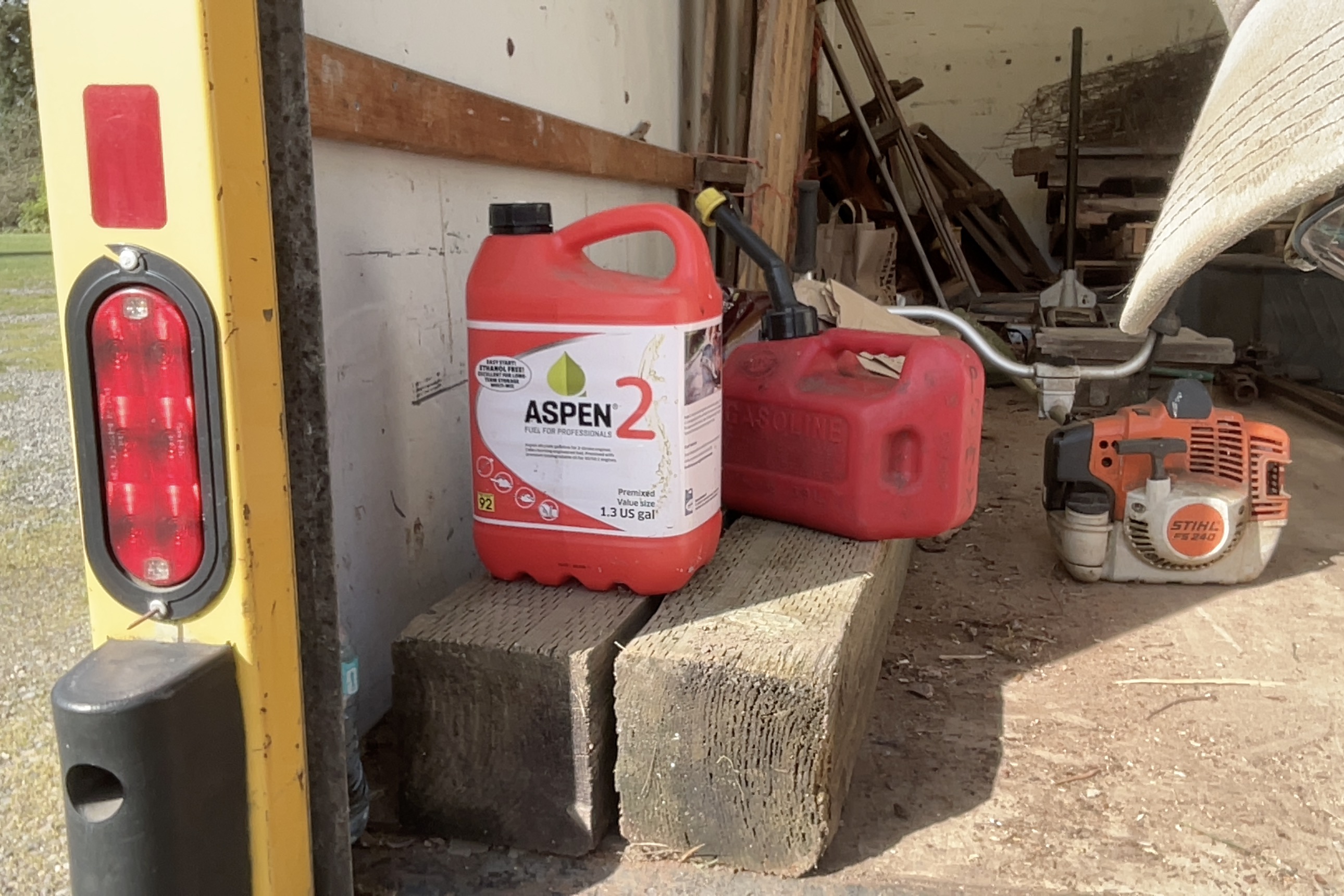
Now, after just a short time set out in the sun and vapor pressurized bulging out showing just for illustrative purposes:
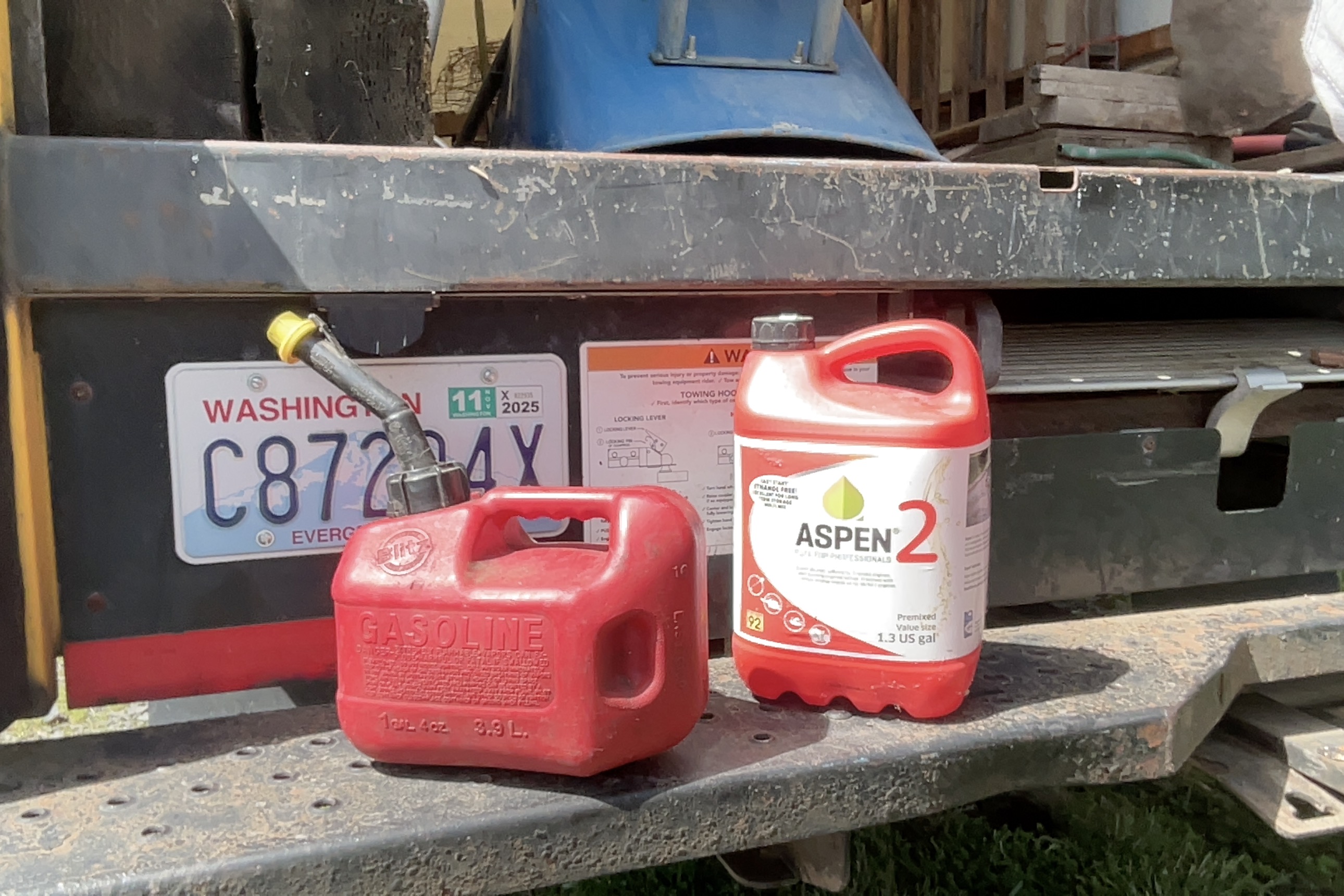
So I do pay more upfront for 2-3; five gallon cans of the “Marine” “Off-road” 92 octane non-ethanol.
One for the small engine four-strokes. One for the Mercury 9.9 outboard 2-stroke. And one for the air-cooled 2-strokes.
Then 2-3 more five gallon cans of the less expensive E-10; E-15 R/M 87 for the seasonal in-use rider lawnmower; the Honda walk behind mower. Available backup into any of the vehicles driven home and caught short of fuel.
I no longer buy any $$'s preservatives running farther up the fuel use costs.
I plan anymore for only 6 months at most, stored gasoline. IMHO futile past that.
Long term engines fuels, it will now be stored propane; and more propane. And Aspen fuels.
Only Aspen fuels anymore get non-use left in any small engine. Worth the cost for the not-made-problems, later.
Steve unruh
9 Likes
So it seems that exposure to air is what makes gasoline go bad. I’ve kicking around the idea of a small fuel bladder for quite a few years now. I also once worked on the development of an edge welded metal bellows, but way expensive. How can we keep fuel from being exposed to air?
Rindert
7 Likes
Use it? Or switch over to diesel?
Aspen is ok and maybe worth the money.
2 Likes

My bad. My little Wen inverter generator sat unused since last fall and the e-10 in it treated with Stabil and Ethanol shield was probably pumped in the summer of 2025. Decided to get all my crap functional. Been working on chainsaws. Took me a couple hours figuring out how to get the throttle linkage back on a Poulan chainsaw I got somewhere years back. I had pulled it apart to clean the carb last year and never got back to it so I forgot how the throttle linkage was routed. Finally got that put back together. Oh yeah. I was talking about the generator. I had to shoot some ether in it to get it to fire and then it only ran on half choke. Died completely on full open. Let it run for an hour like that and it didn’t improve so I drained the old gas out and put a half gallon of newer fuel in and dumped about four ounces of Sea Foam in it. I’ve never gotten Sea Foam to fix anything and the thing ran really bad, missing and surging for a few minutes and then miraculously it started to smooth out and now it’s running fine. One less carb to tear apart. Happy about that because it looks like you have to pull the outer shell off the generator to access the carb.
13 Likes
Cross-linked polyethylene fuel tanks are OK for short term storage. However - the plastic is made of molecular chains which are permeable to the octane producing constituents of gasoline. Gasoline stored in a plastic fuel container can loose 2-3 octane points per month.
7 Likes
Agreed RonO.
That is why to only use the quality, heavier, thicker rated for gasoline plastic cans. Cheap cans sides suck in. Ballon out and turn round. Bleed out the lighter fraction components.
And especially using outside - keep them out of the sun. Used outside set then down in any kind of shade. The sun moves. Move the can.
Long term storage inside of a remains cool, building.
All modern cars and pickup trucks since the 1990’s use thick plastic fuel tanks. Sealed for vapor minimizing, storage and recovery. This was mostly done to minimize the metals tanks problems created for smaller and smaller orifice fuel injection injectors and higher and higher pressure pumps.
Here in the PNW temperate rain forest everything metal day to cooled down night air dripping condensate sweats 300+ days out of the year.
Vented breathing metal cans (with out sealable caps; or missing caps) will accumulate condensed water in the gasoline in less than 30 days. They then will oxidize shed off internal zink or lead plating particles. Internally shed non-soluble abrasive iron and steel particles.
Bur mostly give up on the idea that gasoline will be good for years and years no matter what you do. It has too many long chain components that want to break down and recombine. It is a limited time use blended product designed for in-engines performance.
It is an organically derived product.
Steve Unruh
6 Likes
Agreed! Gasoline just can’t be stored long term. Maybe propane (LPG) can be stored long term if the tank doesn’t rust too much.
But what about what we DO here?!!! Charcoal doesn’t degrade or rot or really do anything over time. I say a chargas system with stored fuel should be the ultimate doomsday prepper thing.
Rindert
8 Likes
I just found out that using aviation fuel for long or winter storage is the way to go, it does not go bad like gasoline does. Yes it cost more but no need for any storage additives. Next fall when store my equipment I will dump out my gasoline and add a little aviation fuel start it up run it though the engine and shut it down. This is what my friend that owns a boat shop is doing he said he does it on all of his equipment and has no problems starting up in the spring with his equipment.
11 Likes
It does collect moisture if it isn’t sealed.
8 Likes
Yes, that’s true. But it’s not a problem.
Rindert
7 Likes
came across another interesting welding / fabricating tip on YouTube .
Dave
6 Likes
Another storm day so I decided to do tool repair. I have a Stihl MS 271 that the fuel line split on last year. I order a new one and finally got around to fixing the saw. I would love to see how they assemble these things on a production line. I have an hour and a half in the repair so far. There are two separate fuel line sections and to get to the top one that goes from the fuel tank to the carb you have to dismantle the one piece fuel tank. Then you have to pull the carb. Since I had it that far down I pulled the bracket that mounts the carb to a flexable manifold because i figured I may as well clean up everything. It came off way easier than it went back on. Took about a half hour to get that rubber sleeve back through the bracket mounting hole. Then the bent wire that opens and closed the throttle plate wasn’t working so I’ll have to pull the carb again and find a way to adjust that. Pretty flimsy engineering for a higher end saw. Of course I lost the bent wire that connects the choke lever to the butterfly. I wish I knew someone who had a pro grade saw to see if all those parts are the same. Way more complicated that either my Husqvarna 460 or my Echo 590. Just thought I’d do a little whining and wondering if anybody else has run it to the same issues with a Stihl saw. The other day I replace a fuel line on my Homelite Super XL. Cost $1.75 and took about 10 minutes.
13 Likes