2010 Chevy Silverado 4.3 liter vortex V6 Generator?

Well since we are comparing . . . here is our latest Grid electrical billing:
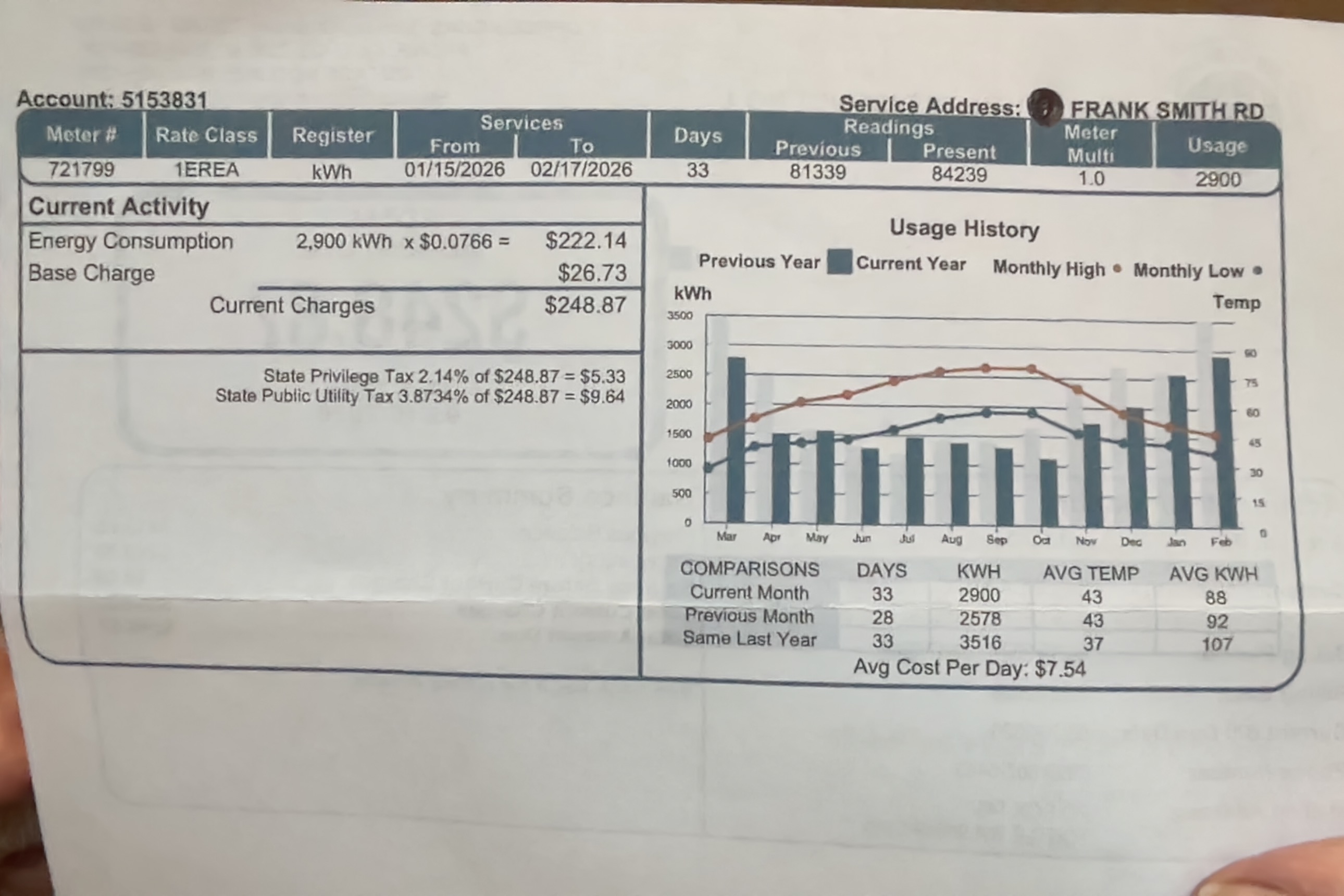

A wealth of information here.
Very cheap by the kWh at only $0.0766. Now the $26.73 monthly base by 12 at $320.26 annual buy-in to have access to that low kWh is significant!
But consumption costs do add up with minimum of two; and at times four; females in the house.

Yep. Yep. ALL the lighting except for two ambience Lava lamps are LED.
ALL appliances are 21st century low energy except for one retained big old chest freezer holding six months worth of meats. Figure it is $8-15 a month of that costs.
We are very well insulated in the ceilings and floors. Walls adequate. Vinyl framed double pane insulated windows throughout.

As this bar illustrated history of two years shows we do need heat for a full six months of the year. And now with this house, for the first time ever in our marriage, we do use some electric heat pump air conditioning in the three hottest months.

Using wood for heating saves at least an average of $100 a month for six months.
The straight electric hot water heater and the freezer, along with two older high efficiency refrigerators live in an unheated larger lower level multi-purpose room. So converting to a newer lower electrical use heat-pump hot water heater would be sucking heat out of the room needing some kind of heating for 9 months. Add future repair complexity.

So yeah. Lots of different way I could skin our home electrical use power supply costs.
BUT; the big Butt . . . any complex system I would set up would not be maintainable; or even operable by any one of the four females in this house.
Just in this last 9 months in clogged drain plumping fixes (long girl hairs and soap scums); leaking worn faucet seals; and the clothes dryer needing work twice I have saved the household a minimum $500. + $300 + $200X2 in 30-40 miles call-out service calls.
I am 73. The need for simple systems, affordable, for soon down the road service calls; $'s out weighs all monthly Grid buy-out considerations.

Now the Grid Down then a whole deck reshuffled consideration all together. Quickly those long hot girls/women daily showers; and daily and three, some times four, big full cloths washing (with hot water) and six months full electric cloths drying usages gets re-set back to boy/man standards. One-load washday, one day of the week.
Outer wear worn for 2-3 days. NOT up to three clothes changes in a single day.

Pretty simple to me now. Do not complete/compare to Big Grids in costs and capacity.

And this is addition to Washington states nearly 50% taxed higher pump gasoline and diesel costs versus the majority of the rest of the continental USofA.
Our now Washington in-state 100+ data centers: Yes! A costs upwards driver for all here.
Our state mandates insistence to fully vehicle electrify is much more the costs for all upwards driver.
Every singe full EV operated here uses the Grid electricity of one average household.
The angers of this is now ground swell raising from the common folks. The political heat from these disparities is no longer a simmering bubbling out here. A constant roiling, low boiling. Building up to a flashing into steam.
The last thing I want is to paint myself as “one of Them” with hundreds of feet of PV obvious.
Instead I will remain painted as a 19th century archaic stuck in the past with wood heating.
That does happen here much too. Through our home owners insurance companies.

Steve Unruh

7 Likes

I agree they can change. But right now where he is at, it is up to 25kw of solar, and unlimited netmetering, with unlimited rollover. The equipment is more or less duplicated, and I think Mass still has a battery storage tax incentive and there might be a circuit breaker box tax deduction as well, which the ‘smart’ ones can do like the rolling brown outs for off-grid with is handy.

The main problem with using woodgas, is not the cost of the fuel, it is the engine wear and tear. His equivalent to keep up with a 25kw array is to run his 25kw generator 2.5-4.5 hours a day (depending on exact locale and there is a variance of estimates). That is a lot of hours on equipment for saving 4 bucks an hour. IF he was already doing it but using gasoline, it would make more sense because you are looking at probably 3 gallons of fuel an hour, which is 10 bucks.

That is a lot of chunking and more or less babysitting the gasifier. Life Happens, and you may have that time now. in 5 years, you may not.

Now the affordability is always an issue because you are paying upfront for your energy. Depending on your mounting and wiring, usage, etc. it could pay off anywhere from 5-20 years, but somehow you have to make or save the money. so maybe 5 years of woodgas saves that much money, and pumping back 25kw an hour to rack up credits isn’t the dumbest idea in the world, especially when he lives close to his parents and can rack up credits for them too. If they have to see the 25kw installation he puts it up at his place, then moves it down the street to their house after he gets the permit. type of thing.

There are a lot of variables, we can’t solve, just throw out ideas to help him.

6 Likes

Appreciate everyone chiming in.

Do you know what the Bible says about consultation?

Proverbs 15:22

Plans fail when there is no consultation, But there is accomplishment through many advisers.

10 Likes

Hey guys where would I go to talk about milage on Keith’s truck? Studying the book I see he has to load the hopper every 50-100 miles. Would that not make a 2200 milage trip cumbersome? Was thinking it may make many opportunities to talk to people

5 Likes

Makes me understand what you said about baby sitting the gassifier filling it up all the time at home. For a gen set at home I was speculating about a huge hopper which may come with a huge set of complications I’m unaware of. But you couldn’t hide a huge hopper well on a truck. Unless it was a box truck.

5 Likes

Yes, gasification is usually more of a hands on operation than we are accustomed to.

6 Likes

Can you make a huge hopper for a stationary unit?

4 Likes

Hello George

I think on a stationary machine you could use a larger fuel hopper but it has been my experience on some of the older units I backed off on the hopper size to make them more airodinamic. Also keep in mind you don’t want a lot of space where explosive gas can get stored and go bang under the right conditions .

Below video is in Kentucky somewhere refueling and should be good for about 80-90 miles .
Total round trip was about 1600-1700 miles .

Usually I can fuel up without causing any attention :smile:

8 Likes

I very much agree with Mr. Wayne, who says that a large wood storage tank can be installed for a stationary unit, but a mobile one needs to be sensibly adapted to the vehicle.
The size, or rather the diameter of the hot zone is also relative, the word relativity means “dependent on”. The most important thing is that from the last air nozzle to the exit from the hot zone there is always an excess of charcoal, ideally the charcoal should burn at maximum load all the way to the exit. My opinion is that it is better if some oxygen molecules escape and cause a “hot leak” than for the tar gases to escape the conversion and form deposits on the system. You can recover the energy of the “hot leak” and use it to preheat the fresh air and the lower part of the wood storage tank, thus returning it to the process, but the tar can damage the engine. In a stationary unit, special attention must be paid to bridging the wood. It is best to build a pinifier without constrictions to the upper nozzles, where charcoal is produced. Wood tends to get stuck, and charcoal is more “liquid”.

9 Likes

Keeping in mind that I am talking about charcoal and a 389cc generator engine I have found that hard mounting the gasifier to the engine frame rattles the hopper enough that it keeps the charcoal flowing. I doubt the vibration would be sufficient to move wood chunks.

5 Likes

Here are the problems with the “make the fuel wood hopper as large as you like”.
That extra wood is a sponge. ALL rising made; and released moistures will not be outer jacket condensed out and removed by gutters.
But instead be wood soaked up to then give you thermal quenching lower down; and mid-system tars glueing.
This is not a maybe . . . it is a for-sure.

I was ever so lucky that the first gasifiers I operated were GEK II’s and III’s.
These had just above the nozzles enough space for ~45 minutes of “Experimenter” gas production time.
Once you were fuels dialed in; system and operator - you were supposed to add the 35 gallon extended run hopper.
THEN the problems I laid out reared thier heads.
Of course back then in 2007-10 we all would blame the wood dryness; the wood sizing; the wood species.
Large hoppers then add in fuel capping; bridging, failures to settle down.
Of course we all blamed trasition steps sizing. Many added slope edges then. Much debate on slope angles. Others added whole system shakers - leading to other sets of problems then. Welds cracking. Char bed packing.
I kept running ran into the same sets of problems with other extended run large hopper systems.

Mean while watch Mr. Wayne with his by then 1 hour, 2 hours reduced size hopper just kept running on and on. “Gotta stop to drain the ol’ lizard anyhow.”
Then other vehicle guys with reduced size hoppers “to cut the wind” were just not having nearly the big hopper problems others were having.

Look. And learn. Learn; from other experiences even if they did not realized what they had evolved.
GEK IV’s went then with offset large hoppers to remove the fuel mass from gasifier core rising heat energy. No longer simple wood chunk capable. I walked away then.
Johnas? the Swede guy who never CC translates, with his clean wood shavings; many motor movements systems, I see as essentially doing the same.

2 hour fuel runs and then it all can be so simple.
Really, really learning and adhering to the running the fuel down to the above the nozzles level before shutting down does wonders for avoiding problems.
A BIG hopper left even 25% full with wood and you will have problem on your next starting up.

Don’t believe me. One guy against the now decades of make-your-hopper-as-large-you-like.
Go ahead.
Let me know how that works out for you.
Size for a 4 hour run time and you’d better damn well run for the full four hours.
Steve unruh

9 Likes

Well said Steve. I like to finish my DOW drive with a almost a empty hopper. Makes it easy to check my charbed before the next starting up of the gasifier. Learned that lesson the hard way when I first started DOW.

8 Likes