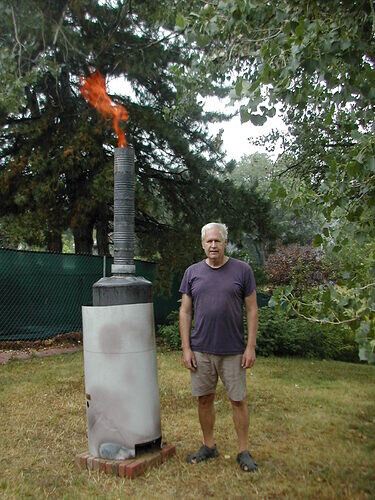
David's Stationary Gasifier

Dont get me wrong, Im just suggesting this as your start. Really get to know the most modern and best methods for charocal creation and building a simple unit will cost next to nothing and waaaaay less time and complexity. Get to know how an engine runs on the gas, tar free and consistant rpm and load and it will be tar free without worries associated with it.

Dont fall for past misconceptions because there are a few of us innovating and pushing this side of the technology. Right now Id say as far as gross feed stock verses net energy out. These technologies are equals. However I am about to push charcoal over this balance and it will become the more effiecient and practical way to fuel a stationary power generator at the smaller scale.

10 Likes

Hello everyone,

I apologize for my bluntness; I often get straight to the point.
If my words seem aggressive, that’s not my intention at all, so please don’t take it the wrong way.
I appreciate constructive criticism, so please feel free to criticize as much as you like.

Kristijan,

It’s not a translation error. Since I don’t know the technical terms, for me, anything that emits smoke is smoke, even if it’s barely visible.
I’ll try to be more careful with the terms I use.
So, I’d like to filter the gases as much as possible so they’re no longer visible or polluting.

I appreciate your conclusion, thank you.

Matt,

That’s the advantage of being a novice like me; I don’t have any preconceived ideas and I base my conclusions solely on my own analysis of what I read and understand.

My goal was never to create charcoal. I’ve made some before, but that wasn’t the intention.
However, I do have experience with wood heating, or simply burning wood to get rid of it.
It’s precisely this waste that I’d like to avoid.

Many of you say that you have to practice and try things out before you start, fail, and see what needs to be changed.

I don’t agree. I’m fortunate to have you by my side to help me and understand the mistakes others make before I repeat them myself.
I’m here to learn, that’s true, but above all to succeed!

Now let’s talk about charcoal. Why is it a problem for me?

  • The first reason is that I’d like to make my fuel in the summer, and therefore recovering the heat from charcoal production in the summer is pointless for me because I’d have to modify my setup when I already have unlimited free electricity (I agree, I can forgo that heat).
  • The second reason is that I’d like to use branches that I don’t currently use, and putting branches in a retort seems like a huge undertaking, certainly much more cumbersome than using large logs of wood (I’m not a retort expert, but so far I haven’t come across a really practical one).
  • The third reason is the water supply. A drip irrigation system, given my situation, requires a pump that will consume electricity and wear out. Is the energy consumed and the wear and tear worth it? Perhaps, if someone could tell me.

It is true that charcoal can be produced and used directly, but in my case I always have a head start; I am currently burning wood that has been stored for 6 years.

I currently prefer a wood gasifier, but perhaps if I find a way to produce charcoal more easily and under the conditions I prefer, I’ll change my mind.
I understand that the SimpleFire is much less complex than a wood gasifier; I don’t need to build one to understand that.
And if I do build one, use it, and find that producing charcoal is a hassle, I’ll stop using it anyway.
Even if it won’t cost me much, it’s still a waste.

Steve,

I wish you a speedy recovery.

Thank you for providing more details about the cooling system; that will be very helpful.
I’m currently reading many different topics and therefore many different opinions, so I’m forming my own.

In conclusion,

Thank you, and I can’t thank you enough for sharing your knowledge and for all the help you give me!

11 Likes

Good statements of purpose DavidP.

Rare, rare is the individual able to learn from others mistakes. Able to actually see that what is done is a distillation of many ideas tried and failed. What is being done is an evolved simplification distilled down to what works. No need to actually re-imagine, re-do, all attempts approaches again. This gives a real advantages in the pursuit we call Life.

David in open atmospheric combustion you “eat” visible smoke with open flaming.
In enclosed combustion the made smoke (water-vapors-steam and hydrocarbon gasses) are converted to clear gasses by controlled passing them through a hot glowing bed of made wood charcoal.
A woodgasifer will smoke emit until you get the internal wood charcoal bed up to HOT operation.
A wood gasifer will smoke when you open it up for re-fueling and stop the downward drawing of made upper smoke down through the char bed.
Operating it does become a balancing act. Too big of raw wood reservoir supply and you can overwhelm the capacity of the char bed. Not draw pulled hot enough, and then reactions balances are lost. Emitting smokes and tars vapors. You can try and force too large of wood chunks through a system and they will not convert to char chunks quickly enough and you then use-up “lose” your char bed. Too small of wood bits as in chipped fuels; or sawn flat sided wood blocks and you will restrict free gasses flows resulting in too much slow smoldering made smoke, overwhelming the system.

This next is strictly my own observed; been-there/done-it; opinions. A mistake in woodgasifiction for IC engine running is thinking you can define, refine down a system that others can actually operate. And operate well.
No matter how well you design it. No matter how well you manufacture it. People using it without a commitment to learn the real needed operator balancing acts will muck up your system you sold to them. Then blame you.
And this is why so many expensive APL/GEK systems sit idle, or are sold off for a small percentage of their original costs. They have been internally soots clogged and tarred up to unworkable.
This is why BenP’s hand built all SS systems come onto the used market for penny’s on the dollar too. Owner/users finding that truly, “It Ain’t Easy”.
Electronifing, geniusing, wood gas operating to make it, “as easy to use as any other modern consumer appliance” is a failure approach.
Again my opinion from too many hours on a customer service phone and customer service e-mails: selling completed systems to others is futile. Successful woodgasification is a do-it-yourself pursuit.
And rare is the individual who will learn the hard lessons in mucked up systems and engines to become a good woodgas operator.
And this forum is the skills learning camp.
Steve Unruh

10 Likes

A very good and reasoned defense of your chosen path into woodgas. You’re not missing anything about charcoal, it is simpler to consume but more work to create. Unless you have a use for the heat it produces, about half the fuel value goes away, and there’s no way around that.

The reason for charcoal needing a water drip is to add hydrogen to the output gas, otherwise you have pure carbon monoxide, which works but is weak. Wood gasifiers have so much water from burning the wood they don’t need a water drip - indeed, you are mainly trying to remove as much water as possible. Some charcoal users have experimented with recirculating exhaust gas, which provides some water and buffers the temperatures of charcoal, but the tradeoff is diluted gas from the nitrogen being reintroduced. All that just to point out that while a SimpleFire design is easy to start off with, actual high-output charcoal gasification is rarely done and has a lot of considerations.

I prefer to make the charcoal directly in the gasifier, with raw wood - this uses all the heat and gases to power the engine. The main distinguishing factor of different gasifier designs is their ratio of charcoal to wood, the size of active glowing charcoal in use, and the speed / temperature of the air coming in. The old Imbert designs used high speed and a small char bed. This works OK at a steady output with perfect fuel. It is sensitive to variables, which makes vehicle use difficult, like stoplights and downhills allowing the gasifier to cool off, then needing a burst of speed to accelerate again. Wayne uses a slower velocity and lots of char, higher residence time. That also provides more buffer for variable speeds, short bursts of higher output or lower output (called “turn down ratio”). This matters less for stationary applications, so Ben Peterson or the GEK design are also possibilities for you. I’m biased of course, so I prefer Wayne’s design for any application.

14 Likes

if you go with wood, you really need it to be DRY, as dry as you can make it.

And you need the gasifier to run HOT, so insulate as best you can. See if you can pre heat the input air entering the gasifier.

All of the tar cleaning that char bed needs to do requires HIGH temperatures and the reactions needed steal that heat. It’s just chemistry. The reactions actively cool the red hot char, so you need to help the bed stay as hot as possible in every way possible.

12 Likes

I think a TLUD (Top Lit Up Draft) makes little smoke, if you have experience. I live close to neighbors. But I have to monitor, as you say. LINK
Rindert
image

8 Likes

image
Here I was just learning about TLUDs. I made only enough charcoal to cook two meals on the barbecue.
Rindert

9 Likes

David,
Just to clarify about adding water to a charcoal gasifier—it is usually done with gravity feed—no pumps needed.

9 Likes

Im only suggesting this as your start. Learn the alphabet before you learn to read. Its a good experience to get and you will never know unless you build it.

What gets ,me though is there is all this " info " on what people think about charcoal without actually doing it or watching those that are comming out with new methods. Like last year I developed the VersiFier. No smoke and it only takes 1/3 the fuel of the retort to convert. Then advancements with steam injection is now pushing a 1:1 wieght ratio between charcoal and water. You dont have to make as much charcoal as we did before. You dont have to make smoke. you dont have to worry about tar. You dont need automation, it will be 100% more stable in opperation. < no one can argue any of that

And it is NOT harder fuel to make. Its just cutting and splitting wood same as for a wood stove. The retort is easy to opperate and use its not that hard. A wood fuel gasifere running a small stationary generator is going to eat 2 kgs or more per kW hour. A charcoal unit is going to eat less than 1 kg per kW hour and Im going to be pushing this much farther this year. You are not losing anything and its not harder. One thing that is different about me than others. Ive thrown well over a million dollars at this technology in the last 15 years. If its been thought of? Ive likely built and tested it. For me I build for the consumer so a product must meet critieria and if there is even small posibility that tar can be created even if the user is at fault its not a consumer product. Tar must be 100% eliminated no matter the circumstance and it cant.

10 Likes

That is how the VersiFire works except there is a center tube that re directs the gas back to the fire box. Once the retort is gasifying, this gas is MORE than enough to supply its own fuel for heat process. This years version is going to be even better and It will convert both retorts in its stack on just 20 lbs of input fuel to get it going. It will produce around 30 lbs finnished ready to run fuel from that 20 lb investment and that fuel is scrap wood anyways. So its not a loss.

7 Likes

Hello SteveU,

Thank you for the analysis of the smoke emission, I understand the system better and better.

Not to brag, but I understand and learn quickly. My sister was actually jealous of me when she was younger; according to her, I’m gifted.
For me, someone who struggles but perseveres deserves more credit than someone who learns quickly.

I understand that the gasifier is difficult to use.
But I think that if one person knows how to use it correctly, another person will inevitably learn too, if they want to and put in the effort.

Most of my coworkers have only one worry when they get home in the evening: what on earth am I going to watch on TV?
I understand that for these kinds of people, taking their hands out of their pockets becomes an ordeal.

In our region, people are dependent on assistance; if something breaks, they call a repairman—it’s easier.
And it’s a lifestyle choice that doesn’t shock me, but it’s not my lifestyle choice. It’s so much more fun and rewarding to prove to yourself that you can do everything yourself.

Hello Chris,

Thank you for this analysis; it’s very helpful.
It clarifies both the difference between the two systems and the importance and impact of the coal component for wood gas.

I understand why you advocate for the WK system, and rightly so, as it prioritizes safety.
I share this opinion; prevention is better than cure.

Hi Anthony,

Thanks for the advice, I’ll keep it in mind.
Since the water cools the mixture, the drier the wood, the better.
But I understand that too hot isn’t good either?

Hello Rindert,

Thank you for the illustrations, I hope the meal was good.
Does the sausage and bacon taste better cooked on homemade charcoal?

Hello SteveB,

Yes, you will probably need a water reservoir upstream, but to fill it, you will need to operate a pump.

Hello Matt,

One thing is certain, you’re a good salesperson and know how to highlight the effectiveness of your products.
Your opinion on charcoal is of great interest to me, as you’ve already designed many charcoal gasifiers.

However, I think your retort is still too small for my intended use. And does it reuse the gas to power itself? I’ve already considered using electricity to start the process.

Thank you for your enthusiasm.

4 Likes

You can build as many VersiFire systems as you want. There is no limit to how many can be ran at one time. I built and designed this be practical in its size that can be managed by one person past 60 years of age. You can certainly scale it up but that comes with added size and wieght.

The VersiFire is likely the most efficient retort system you are going to find. It is a two stage system that uses waste heat and reclaims it to dry the top section before it is transfered to the bottom. The water that is driven out is combined with combustion gas effectivelly eliminating what would otherwise be the smoke from this distilation process. Yes the retort gas is re directed to the combustion chamber and is burnt off and this gas is very volital gas. When the top section is lowered and becomes the retort its already dry and ready to immediatly shift into gasification mode. Thats why it dont take very much input fuel to get the processes started. The fuel you add is only to keep the retort gas ignited not so much to supply process heat. This years vdersion will have additional vent holes in the outer drums to ensure all volitile gas is burned and put into the process. These holes will be elivated raising the location of the process heat to better heat the top section and to be more ballanced.

What I dont think you fully factoring is. A stationary small scale gasifier will without a doubt require automation to activate the grate and intervene with hopper bridging. < this is physics it will happen. These fluxuations interupt process flows and will result in tar production along with fluxuating gas energy density requiring an auto gas mixer. The required complexity is likely broader than you maybe thinking at this time. This is why I recommend just buidling a simplefire and just run an engine on it. You dont have to build a complex retort at this time. Its more about making a small low cost gasifier running on charcoal and learning how water and steam can effect things. learning how stable the machine runs and without complexity. Then once here you can now factor this against a wood fuel system. Is it really worth the complexity? Is producing the fuel really all the much easier? Or is it worth to invest time into a retort system that is more viable? There are pros and cons to both but my stance here is to really show you all those pros and cons not just hearsay. As at one point I was very anti charcoal and that was a result from listening to others instead of actual doing it.

7 Likes

Yes, I understand your point of view; your system is designed for easy transport.

I don’t want to rush into creating one system or another.
Believe it or not, I’ve already grasped a good part of how a wood gasifier works thanks to the forum.
Of course, a few parameters still elude me, but that’s only temporary.

For example, it seems obvious to me that cubic pieces of wood can’t work in a hopper.
However, where I don’t follow you is why a stationary system, rather than one mounted on a vehicle, would work less well?
Perhaps the vibrations and movements of the vehicle?
Why not reproduce them mechanically?
Moving the grate is one solution, but is it the best?
Should we just create and test it?
Yes, it could work, yes, if I have no confidence in what others are doing, yes, if I believe I can do better.

But I’m analyzing, considering elements that seem logical to me, and finally, when I’ve lost the rest of my hair (don’t worry, I don’t have much left), I might have a system that works for my needs.
And if not, I’ll have already planned a possible adaptation.

This system will be a replica of someone smarter than me or someone who has persevered for a long time, perhaps a combination of several systems if that’s possible.

For the moment, I don’t intend to create a SimpleFire for testing purposes.

5 Likes

Reading and real world doing are two sepperate things and I promise you there will be issues you will need to overcome. Even after building over 500 machines I still run into unforsean things to challenge me.

Ok first question; A vehicle gasifier is going to be much larger than a gasifier designed to run a small engine. Therefore it will be much more restricitive. If you build it larger it will run to cold and produce tar. Yes a vehicle is moving and helps keep the gasifier flowing. Large engines have large valve springs that dont car if there is a small amount of tar. Where this same tar will lock up a small engine intake valve in a heartbeat.

Grate and hopper agitators are easiliy constructed but it comes as added complexity and also something that can break. Requires DC power from somewhere etc.

I spent the first 8 years developing wood fueled systems and would not even consider charcoal during that development phase. If wood gasification worked better at this scale I would still be building them and trust me its a way easier sale. Instead I have to make the case over and over again and have to actually sell the charcoal systems. Because of all the misconceptions < Im trying to change that. But I am also not trying to push you away from a wood system. Rather Im trying to get you to NOT skip buildeing a charcoal system without experiencing real world usage with one; so you can make a real comparison. On the 2026 CXF water is the primary fuel input not charcoal.

As for making them for easy transport? No the wheels are to make them easier on my back as I build them. When you have 20 machines on the shop floor its a lot easier to move them around if they have wheels. These machines are highly developed , they work they are consumer grade products. This years version will be ready for mass production and marketing for the first time. But Im not trying to sell you anything. Just pointing you on a path that is not skipping valueable steps for your success to meet your end goal.

6 Likes

But I understand that too hot isn’t good either?

At a high enough temperature some minerals in the ash will start to melt and you get “clinker” which can clog up the gasifier. That happens around 1000-1100C. You won’t get to those temperatures in a wood gasifier. Don’t be afraid of high temperatures in a wood fueled gasifier.

Also… charcoal is your friend. I slow played it, but others are hitting it hard. I agree with them. You’ll get good making charcoal faster than you’ll get good operating a wood fueled gasifier.

7 Likes

No like’s from me guys on this continual use charcoal haranguing of a new member.
This is abusive.
It must stop.
REGULAR level member Steve Unruh

6 Likes

Thats not whats going on here. I am recommending starting here not staying with it: for learning and education purposes. Whats the problem with that? Why is that abusive?

Not once in any of my writings am I saying go with charcoal over a wood fueled system. Thats not the goal or the intent. I am merelly asking that they experient with a charcoal unit first that can be built in a day at low cost as a learning tool and to experience a small scale system to learn from.

Telling a user to skip this and bring out points that are no longer relivant to the tech is more damaging and abusive not only to the comunity but also to the new comer that is learning. This is the apropriet start and if I had it to do over again this is where I would start. I see over and over again commments coming from those that have not actually built an advanced charcoal system. This thinking is what needs to stop and spreading misconseptions. I have yet to see a functionging small engine wood system on video running for more than five minutes. < there is a reason for that and you are not fooling me. I did not build inferiour tech just the contrary. I am honst and I will tell it like it is and I am a profesional not a novice. Ive done it; not read it; not watched it; but actually have done it.

I also have NOTHING to gain here. Im sharing knowledge based real experience and not one of any of you have built more machines than I have. Ive lived and breathed this for 15 years of my life every single day!

Stop taking my recommendations as anti wood gas or what ever it is you think Im proposiing. Im not in any way saying this.

7 Likes

I don’t see this discussion being any different than the hundred times we have had it before. Get some junk and build something. If it works great. If it doesn’t build it different until it does. In my many years I have found the learning is in the doing. Talking a thing to death should be left to politicians.

14 Likes

Good plan, good attitude. Go for it!

Most everyone’s needs are a little bit different. Everyone’s skills, tools, and experience are a little bit different. So, everyone’s path and plans are a little different. One thing I believe is the same - - - everyone here want’s to encourage you, and see you succeed. Sometimes our enthusiasm runs in different directions, but we’re pulling for you, and each other :slightly_smiling_face:

10 Likes

David, I’m not going to partisipate in the charcoal vs wood debate. You’re of course free to do what ever you want. What direction we go is often determined by other factors - what type of containers our neighbours happen to offer us, the size of our carports which our trailers sits under or wether we happen to have spare bathtubs or not.

I’m not that smart, so it usually takes a while to wrap my head around certain fenomena. I may understand the theory behind things, but it takes me a while to get the gears greased.
I’ve been burning wood in domestic hot water boilers all my life, but 3 years ago I got a new job operating a huge steam boiler. I already knew the basic theory behind how temp and pressure affects steam, but being so used to water in its liquid form I now had to think twice.
Maybe a long winding analogy, but the difference between straight forward burning wood for heat and gasification has simularities. What caught my attention was this:

You may already get all this, but when I first started with gasification it took me a while to clear my mind up around a few basic things.
First of all there’s a common misunderstanding - when people are told gasification is about burning wood in an oxygen restricted inviroment, they often think it’s about restricting the air flow. Not at all. It’s about the oxygen getting consumed when passing the fuel.
Another common misunderstanding is about fuel size. In a normal stove, with almost unlimited air supply, you get a hotter fire with a lot of smaller sticks vs a few big logs - more surface area. With gasification it’s the opposite - the smaller the fuel the faster the oxgen is consumed and the cooler the gasifier will run.
A third common misunderstanding is about moisture. A stove will not run as hot if you have moist wood. In a gasifier it’s the other way around. The fuel won’t shatter as quickly, the bigger pieces will allow oxygen to penetrate deeper and the gasifier will run hotter.

12 Likes