Rindert's small engine wood gasifier

You are correct Dave.
From the very internal combustion engine beginnings valve-in-block engines (flatheads) were the way to manufacture a four-stroke engine using the least number of parts and machining steps. The less power possible compensated for by going with a larger working displacement.
Anyplace; any application; that valued power-to-weigh or fuel use costs went with overhead valves. More parts. More machining operations. Tricker to lubricate.

My engine life became more valuable when I phased out of all flatheads.
Better yet again phasing out of always needing cleaning and adjusting; with wear, timing drifting, ignition contact points.

Going a step farther to overhead camshafts can give even better in and out flow possibilities. But really only becomes a value if you are pushing for much higher RPM working ranges. Then your service lives shorten from all of the added cam drive parts. You really need superior lubricants. And lubrication systems engineering.

When the flathead engine was direct driving a rotary lawnmower blade; or driving a power belt it was/is easy to convert over to a more better overhead valve engine.
But systems using the engine side case as the power drive end with generator side special crankshaft ends you are screwed for converting upgrading.

Just sell it. Step up to a more modern design. B&S and others have now been making OHV generators for neigh onto 30-40 years now.
Haunt yard, garage sales; and estate sales and you will find these. IMO just pass on the flatheads.


Look at the size and weight of the generator head stack. This system was heavy duty use intended.
Steve Unruh

10 Likes

Another old generator. It runs but the tank is plumb full of nasty. I might just get a plastic tank like the one one on Steve U’s. Anyhoo, $50 so not much worried about anything. I’m a little surprised at the efficiency. Is 92% common for a genhead? I wonder if I’ll get 50% or 2225W out of this one. That would be something good.

11 Likes

Well as long as it has cylinder and valves allow acceptable compression you should be able to make something of it.

A fellow named James Cordon runs a YouTube channel where he buys, repairs then sells these. His evaluation of condition videos are the best.
Here is a part-four video of a Champion 4-stroke that he brought back to life after it broke off and dropped a valve head. Video four he is now working on the applied load governor system to get it to keep making safe to use AC power. Alternative fueling you will want to also monitor closely your on-off electrical loads RPM and therefore frequency:

These RPM synchronous units are all pretty much See-Do mechanically controlled.
I personally have switched over to variable speed engine driven Inverter-Generator units except for the one family gifted to me unit I had pictured. A back up unit for the deep well pump.
Inverter-generator units are mostly electronically controlled. Bumps up your efficiencies and engine life. I am comfortable with my ability to swap, mix, and match the electronics packages on these across manufacturers and wattages.
Regards
Steve Unruh

10 Likes

Here is another James Cordon video showing the hatful of problems you can expect on a given-up on; then sold down cheap modern synchronous engine-generator. Fuel contamination. Clogged carburetors. Previous owner(S) busy fingers mucking up things:

At least skip to ~36 minutes and see just what you can expect from one of these for frequency; voltages; hormonic distortions; and wave forms. Not ever be Big-Grid perfect. Just good enough.

I will say this about these made-in-China units:
When B&S; Kohler; and even Yamaha are choosing one of the PRC mainland manufacturers they have their own engineers evaluate for performance and durability.
Then add in that some marketing brand names like Sears-Craftsman for decades had their own QC/engineers too for their “Best” line tools, appliances and equipments.

What astonished me about the 3600 watt (Sears) Craftsman unit I was family gifted was it did have 230/240 split phase output too. That is rare in small units. More $$$ to make that.
S.U.

6 Likes

depending on the kind of nasty, e85 dissolves a lot of it.

3 Likes

Okay, I can imagine myself getting the tank clean somehow. But what will do with the the stuff I get out of it? At this point the only answer I come up with is putting it in old oil bottles and then in the landfill. Do car washes have means of dealing with this kind of thing?
Rindert

1 Like

you can burn it or the ethanol just evaporates.

2 Likes

My Champ 3500 has that too. Makes me imagine new capabilities. Like maybe an in induction furnace in which I can melt iron and steel. Now that would be cool!
Also interesting is the 12VDC outlet. 3500/12= 292Amps! I’m doing to have read the manual on this thing.
Rindert

2 Likes

Just watched him fix the governor. I end up thinking I should mount a frequency counter next to the volt meter.
Rindert

4 Likes

I would guess it has a low voltage winding, maybe around 10 amps, 20 if you’re lucky :slightly_smiling_face:

He uses a Kill A Watt meter, or something very similar. If +/- 1Hz is good enough, then it’s a simple solution, and really useful for lots of measurements.

edit: Checked the video, and it is a Kill A Watt meter, and it reads to a 0.1Hz. That ought to do it. Though a permanently installed freq meter would not be in the way.

6 Likes

RindertW. the DC-out charging capabilty is from a small set of separately wound coils. That rough AC generated is then ran through just a small bridge set of diodes. VERY low wattage. 120 watts, usually at the most. And the DC out voltage is relatively dirty and NOT voltage regulated. Should only be used to charge up small, thick plate small engine starter batteries. For real, faster, battery safer, four-step-voltage capable battery charging use a good separate dedicated charger from one of the much higher wattage outlet ports.

Disposing of contaminated gasoline?
Depends how much gasoline you need to get rid of.
Depends greatly on where you live; your household mates; your neighbors.
Depends on whether you strictly want to abide by your areas current evolved legalities.

Last time over 20 years ago now in professional Urban area shops it was then $10 a gallon to have pick up for disposal. And someone had to sign their signature on the head of the recorded chain of custody tracking. Go cheap on the contractor; and it got ditch dumped; and it would track back to you the originator, signer.
I expect that price now will be double, triple now.
True Rural living we would store it and at an annual woody debris bonfires time pour it over the pile a day or so ahead of time. Wait for the majority of the volatiles to evaporated off and then in Early Cool of the Morning FROM A DISTANCE lite off the burn pile.
Other ways too. Most not exactly legal. The rule of the three iLL’s applies here.

James Cordon did say he would wait for the majority of settling separation, then burn it up the least contaminated portion in an IC engine. Your older generator would be the candidate for that.
Just please don’t dump it directly onto the ground. Irresponsible.
Regards
Steve Unruh

4 Likes

My TLUD, for charcoal making, seems to burn wood tar with almost zero smell. And my neighbors are used to me making charcoal. I think I’ll try soaking some wood chunks in the nasty stuff and then put them in the TLUD. Hard for me to crud up an engine even if real old.
Rindert
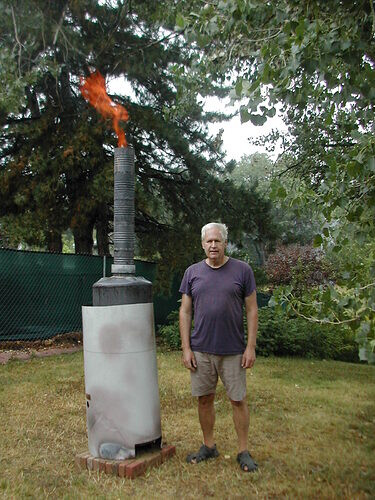
image

11 Likes

When I was doing ironwork it was common practice in the winter to fill half of a 5 gallon metal bucket with gasoline and then light it as a source of warm up heat. Surely things could have gone wrong but I never heard of anyone getting burned from the practice. If diesel was on hand we would use that the same way.

5 Likes

This IV drip type thingy, using my siphon, I came up with works so good! I sort of think there must be a commercial version of it out there.
Rindert

10 Likes

I love old gas. I mix it with biodiesel and used crankcase oil, and spray it on the fence line. Slash and burn agriculture. I tried the weed eater but I spent 5 minutes wrapping the string on it for 15 seconds of whacking. The goldenrod/burdock/tagelders/raspberries/tansy were too tough for the weed eater.
Yay! Chemistry!

7 Likes

nature can and must digest a lot…, i hope (or not?) this mess not goes in your and others drinking water…

5 Likes

I wouldn’t want to start an ecological brouhaha but there are microbes that quickly go to work on petroleum spills. I’d prefer working with them than spraying glyphosate. I have the same vegetation you listed Bruce. I got a couple circular blades for my weed wacker to work on it but it’s still slow going since everything is grown chest high now. The burdock is probably even harder to cut than the raspberry vines. I decided to wait until fall and let the frost do it’s work.

5 Likes

There is nothing left but charcoal and ash. It’s similar to the propane weed burners. I am sorry if I misled you. I use the old gas to burn the weeds. I don’t poison them.

I don’t have anything here that would poison plants.

9 Likes

I believe parts stores will take it, I know they accept old motor oil and coolant.

4 Likes

Nope. Not in the US. Liability. plus gas evaporation isn’t controlled which probably violates some epa regulation aka the gas cans.

Stihl’s have the plastic blades that can go through most of that. up to probably 3/8" of soft woody material. (it also cuts through with ease plastic edging, small wires, etc.) They also have essentially a woodsaw blade for even thicker stuff, which works great for up to about 1.5". it mows 1/2" it down like a string trimmer with grass, however, it doesn’t work well with grass.

The ‘organic’ mixtures tend to include clove oil and peppermint oil, but like the torch, they just burn down the tops so grasses and stuff will grow back from the roots.

4 Likes