Well said.
I must admit that I have not been as persistent, daily, as I should have been. My tools are not as good, economical, and reliable as Tone’s. But I have had a huge, generous measure of God’s blessing. I’m learning what it means to cooperate with Him, but I am a slow learner  .
.
But He is a persistent, patient, loving teacher  .
.
And part of His blessing is a wonderful family, and friends, to share the work and joy.
And you folks, too!
12 Likes
Who is poorer than the rich man who has no skills other than manipulating money.? He is totally dependent on others for his sustenance. He cannot feed himself or repair his home or vehicles. All money today is ephemeral. It can vanish in an instant. It is nearly all Fiat. Even if it were gold, with no other means to survive, who would trade a potato for a gold coin?
11 Likes
with gold at over 4k an ounce. I have a whole sack of potatoes for sale. It would buy me a lot of tools. 
2 Likes
jesus has sayd: you will always have poor people around you…
this has a deeper sense for the life on earth generally, when he has sayed this.
there is a big context around…from where we come, what should we learn here and where we will go once…
what is the evil, what is deep grounded in human beings, and from where it comes…
the answer to this questions explains if we can fight poverty ever or if poverty in a certain range is useful for human education (from god´s sight and plan)
look at the actual humanity, more wellbeing there is, less love to the next there is , and who feels the need to search god, and who likes to have a god over him…?
8 Likes
The immediate question, if you and your family are dying from starvation, what good is a gold coin? If there are potatoes and gold available you have options. Tools will help you build and plant for the future, if there is time. 
9 Likes
I knew I missed the point somehow..
On the other hand, if you and your family are dying of starvation, what good is just one potato? If you eat it you can stave off hunger for a day or two, if you plant it, it will be a 60-120 more days of starvation.
The wildcard is maybe you know someone who would trade a whole sack of potatoes for a gold coin that the rich person doesn’t know. Or maybe a gold coin can get you passage to an area that has more food.
It is a good lesson about opportunity costs at the very least.
7 Likes
mike spoke of potatoes in plural…
3 Likes
From my own experience, I was fortunate to have married a wife who knew how to be both frugal and an organized budgeter. When we married years ago we both had some personal debt, and I had a mortgage. My great wife got me to follow the financial advice of Dave Ramsey and paying off debt and saving. It works, we may not be wealthy, but for decades we have been debt free, save and pay cash for our needs. It helps to live in a rural area, where we can have gardens, orchard, pasture for animals, we heat with wood from our property and are content to live a simpler, more natural lifestyle. Having space to garden and raise some animals allows us to eat healthy, organic food that would be out of our budget if we depended on the market. Also living in a rural area we are much more environmentally conscious. It galls me that here in this country politicians from the most denensely populated, lest sustainable areas are trying to legislate environmental policy.
I think that changing one’s life choices is the key to leaving poverty.
kent
13 Likes
Ramsey works for that and for many it is a great system for a while. He develops much better money habits. What he isn’t good at is investing and money management at a higher level to get further ahead. However, to get from going backwards to getting to even, he has helped a LOT of people. The system is fairly simple.
2 Likes
I don’t know a lot about Dave Ramsey, and I don’t know a lot about higher levels of investing and money management. Getting out of debt, producing your own food, fuel, and other needs benefits you and also the folks around you. My guess is, that getting further ahead is often done at the expense of those around you, rather than their benefit. I’d rather not participate in that.
I know I’m generalizing here, and don’t mean to attack individuals. I’m just not sure the person who holds your mortgage, and collects the interest, is your friend.
It’s interesting (at least to me) that the word mortgage comes from the Old French meaning “dead pledge” or “death pledge.” There are various explanations of why, and as you might suspect, some are positive and some not so much.
See also Psalm 15:5.
9 Likes
They don’t have to be your friend. It is a mutually beneficial relationship. You want a property to make or save you money, and they want money for their risk and opportunity cost. Where it gets tricky is whole money management thing and living within your budget. Instead of buying the most they will lend you, if you only get what you need. Most of the mortgage issues arise when you spent at the absolute max of your budget then inflation hits. or you don’t have a fixed mortgage and interest rates went up.
The whole advanced money management arises from you can pay off your mortgage at 5% interest, but you can make say 8% on the stock market. Or maybe you figured out you can save 3k/yr on electric using solar and that system costs 35k in 12 years that has paid for itself. rather then putting the 35k towards your mortgage. It is all risk vs reward and utilizing your money where it helps you the most.
2 Likes
No question that there are arrangements that are mutually “beneficial.” I’ve heard lots of talk about Good Debt. These things seem to work for some folks some times. What is interesting is to take your example, and ask where the 5% went, and where the 8% came from. The mortgage company got the 5% for advancing the money. The 8% comes from people who sold for less than you did, and paid more than you did. Neither one is necessarily “wrong” (though I have my suspicions), but neither one is productive. Both, I think, contribute to inflation (they’re basically overhead), which grinds down the economy as a whole, and specific markets, like real estate, in particular Credit card debt would likely have a similar effect.
Summary:
Proverbs 22:7 “The rich ruleth over the poor, and the borrower is servant to the lender.”
Not necessarily a condemnation, but certainly a warning.
You are certainly right about borrowing at your limit. I would phrase it a bit differently:
1 Timothy 6:8 “And having food and raiment let us be therewith content.”
Don’t ask how I’m doing with that last one. There is an unfortunate difference between what I believe and what I do  .
.
8 Likes
Wisdom expressed in the most concise form is most often found in you, Steve!
The thought of difficult times and strong people leads to a simple conclusion: there needs to be a constant increase in the difficulty and importance of tasks, for each new generation. The first ones will learn how to grow food on their land, build a house, and obtain energy. The next generation, standing on their shoulders, will be able to solve the challenges of creating more durable and useful tools and machines, for example. Not the same junk as today. Not in monopoly factories, but in home workshops. Those who follow them may be able to create a beautiful land for living, where there are currently deserts or impenetrable swamps. And so on… Without the relaxation of human thought.
11 Likes
Bodywork ideas: home car factory.
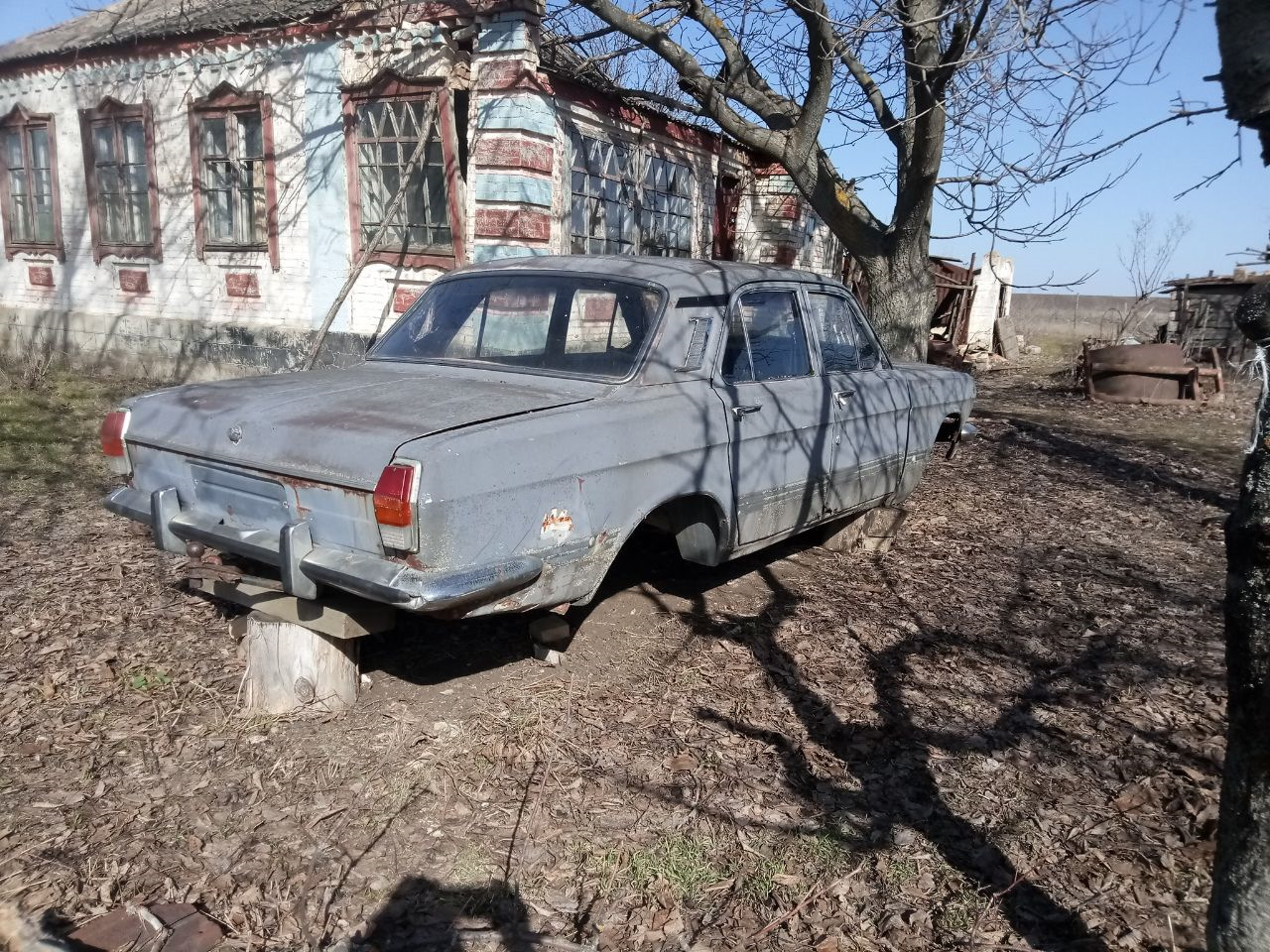
The Volga was disassembled to the body with glass`s, and now stands on stands as a monument to the automotive industry, but this car turned out to be so monumental that even passing by it, every time there is a desire to own something just as big, spacious and expressive!
And desires make you think, and this inevitably leads to new thoughts… it’s pointless to restore the iron bodywork. Plasters, patches, sandpaper, putty and other expenses of life resources will sooner (or even probably - too soon) turn into holes that will again require resources. And I want, of course, to do it once and for all!
These thoughts inevitably lead to fiberglass and a tubular frame. And fiberglass bodywork is primarily about matrices! And if you get involved in such work, then even at the level of “dreaming” you have to think about what kind of car model is worthy of such hemorrhoids all over your head that it will last all the way to your ass?!
Of all the cars I’ve ever seen, for me personally, only two are so worthy of such attention: the Ferrari F50 and the 1959 Chevrolet Impala. But the F50 is smaller than Tavria, and I’m not 15 anymore, so I want something not only bright, but also practical. And so that the whole family, not just those who were able to lie down in the F50, could feel the attention of others!
Therefore, an icon of style, for which it is worth warming your brain over the issue of budget creation of a body from scratch in a home workshop and a home (obviously not an oil) budget, is the Impala 59! — aerospace design, rock and roll and all that…
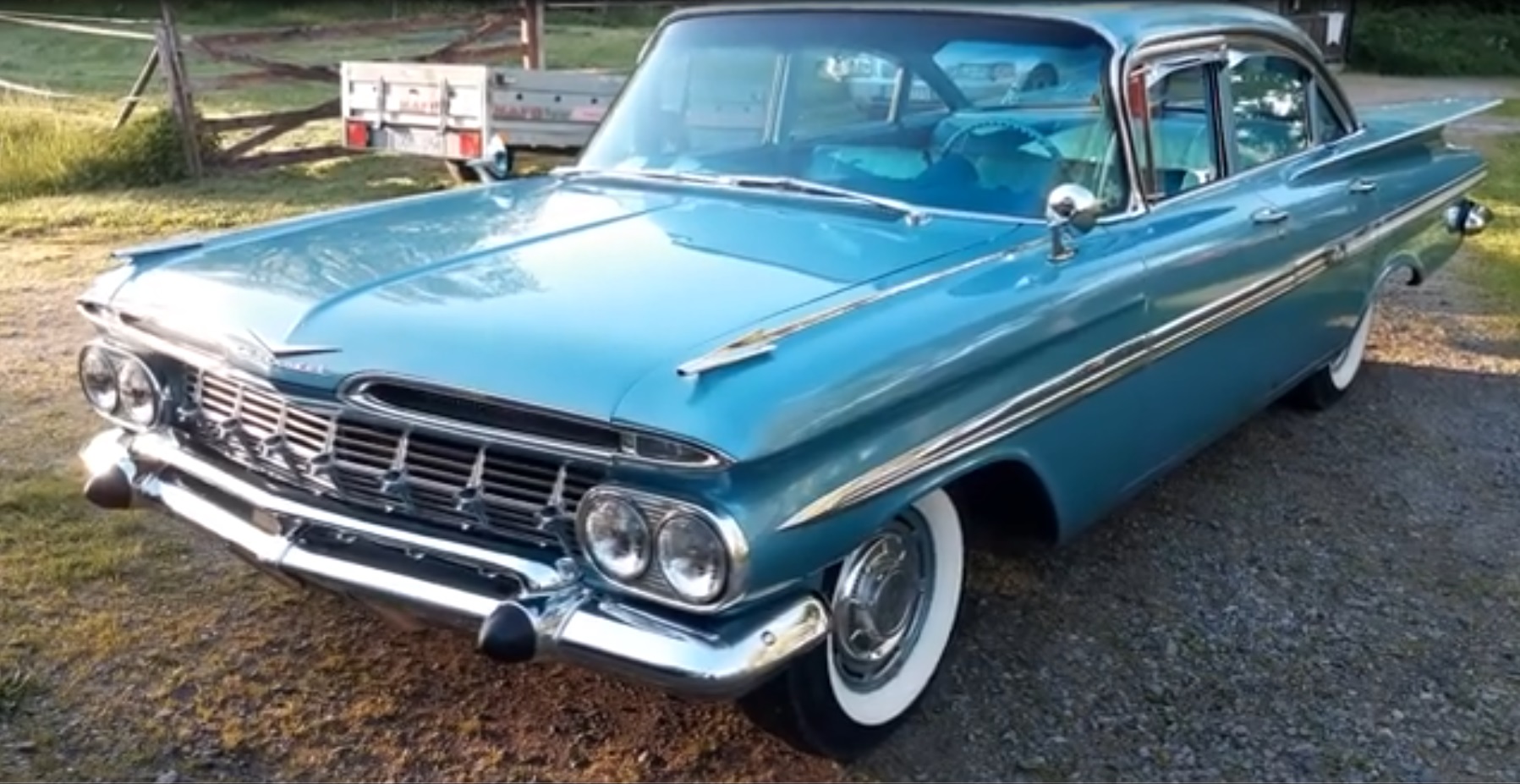
Even a cursory comparative analysis of the performance characteristics of the Volga and Impala shows that even the suspension from the Volga makes no sense to use. Volga track: front — 1,476 mm; rear — 1,420 mm. Track gauge of the 1959 Chevy Impala: front — 1532 mm; rear — 1506 mm.
This means that you need a suspension from something rear-wheel drive and obviously no smaller in width. For the first foreign cars seen in Odessa in childhood have remained forever in the memory due to their huge width. Naturally, the suspension should only be domestic — there was still not enough foreign bolts and nuts to transport their vanishingly small money across the ocean!
Perhaps there is something else, but so far the choice has fallen on Sobol 2*4 Gorky Automobile Plant from Nizhny Novgorod, not far from Dmitry Azeev.
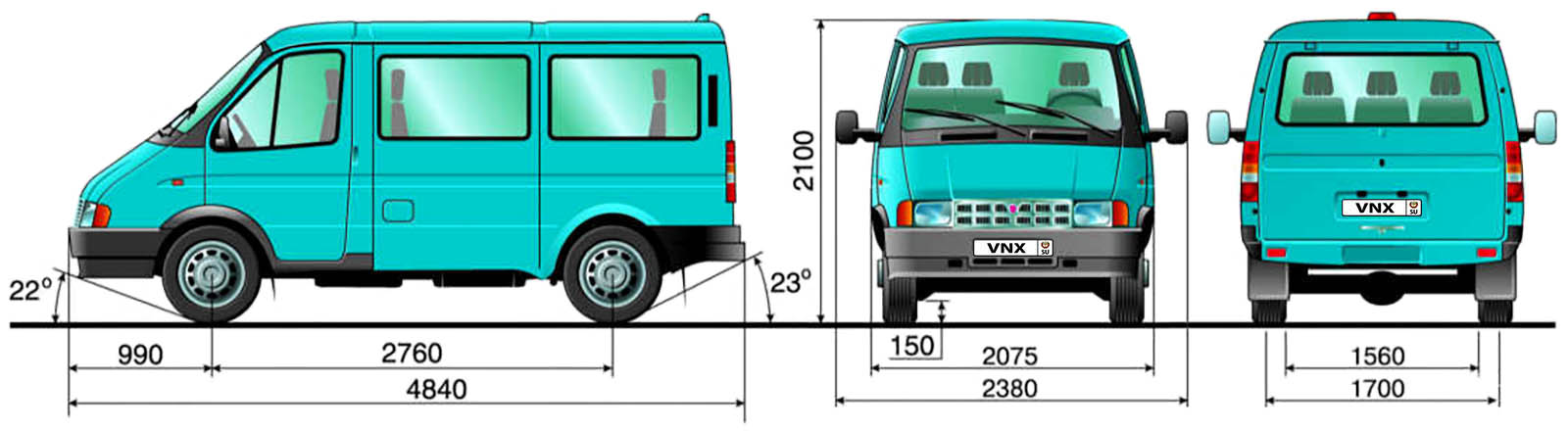
This van is practically the Volga, only wider and the track is the same for both axles – 1700 mm! This means that you can make the car even bigger than in the original. Or even increase the width and length by 10%, and leave the height the same – which visually makes it truly an automobile barge! The main thing is not to jump out of the allowed width in your crazy dreams… Fuel efficiency issues are not on the agenda because it is necessary not to save fuel, but to immediately switch to one that does not cost money. And then you ride on what you like, and not forever on what you can afford, or even can’t afford — and then you pour propane or methane into a Humer so that you can at least keep your pants on – fuck them with a crimson jacket and a gold chain to your belly…  Attributes of bandits after the collapse of the Soviet Union.
So, we have decided on the model and dimensions, which means that the bodywork will require huge matrices! And everything should be inexpensive or cost nothing at all.…
At first, I warmed myself for a long time with the idea that I needed a huge 3D printer and my own auger to produce a filament from PET bottles and spent matrices. But this additive technology has a very significant drawback – it makes steps that then need something (most likely with your hands!) to grind. Or remove the printhead and install the spindle with the milling cutter. And this means additional machine time, a place for mistakes and a completely different kinematics of a huge CNC machine, i.e. the price of the matrix! Even taking into account the fact that, in general, there is a place to put a machine on your land, and there is a place to store a set of matrices and mountains of waste for processing them into filaments. By the way, a homemade filament made of shit and sticks can also kill this whole idea in the bud. Your head will fill up with shit and your initial creative passion will turn into constant stress!
Just a couple of months of thinking about these problems, passing by the persistent Volga building, led to the idea of subtractive technologies – if you need a milling cutter after printing, then it’s easier to immediately turn excess castings into chips with a milling cutter and send the chips into a bag for subsequent melting. Moreover, the castings can be relatively small, say 500mm * 500mm * 300mm (or even square sausages 50mm* 50mm* 300mm, tightly pressed together), and processed into regular parallelepipeds on a CNC milling machine with the same relatively small working field, and then the matrix can be typed, as from Lego cubes, fixing them with the lower edge on the common shield is equipped with pins or screws.
Since the issue of a small, and not very expensive, CNC machine is theoretically solved, it’s time to think about free material for future die castings.
There are several options:
-
Polyethylene (everything, including PET bottle caps). Melting point 105-140°C, degradation temperature (without oxygen) 250-300°C, density 0.95.
-
PET (there is a lot of this stuff everywhere), but the melting point is already 250-265 °C, and the degradation temperature is 290-310 °C, density 1.4.
-
Aluminum (beer cans and other aluminum waste). The melting point is a pretty hellish 700 °C, but the destruction is very low (although there are nuances), however, the necessary fluxes for high-quality remelting are also not an easy question. And the load on the milling machine will be considerable. This option is already more suitable for small-scale mass production of body elements, but the matrices can be stolen, handed over for acceptance of non-ferrous metals and on drinking by workers.…
Of course, with a full-size machine field (for the entire area of the largest die), one can imagine that after manufacturing the die itself, fiberglass can also be sprayed using the same CNC machine. Because polyester rezin is smelly and dries quickly, which means you need to hurry up and try not to ruin your health. What kind of creativity and reflection on the meaning of life are there in such a drying race…
You can also use a full-size machine to perform all the basic operations for the development and production of body elements for different machines: 3D scanning of the original, milling of the plastic matrix, spraying of the separation layer (wax) and spraying of the fiberglass itself, finishing painting.
5 Likes
I kind of got lost after your first sentence Marat but as far as body work ideas go pretty much any body panel can be replicated with basic tools. A small sheet metal brake or combo-tool like this.
A bead roller, a sand bag to bang out complex curves and a planishing hammer to get out the dents from hammering in the sand bag. Most of these tools can be fabricated from obtanium. 60+ years ago when I was a teenager many 16 year olds were doing that kind of work on old cars and some of it was pretty crafty. I’m sure 3-D printers and other modern tech is somehow better if you have a brain that understands programming. I don’t. I believe in beat it until it does what you want it to do. Maybe I should have practiced that with my children.
5 Likes
Tom, you know, I’m watching young people today and I’m becoming more and more convinced that they don’t want to work hard with their hands. I once worked as a service engineer at a refrigerator factory, and there was a conveyor assembly. Very poorly educated young people worked there, and many of them got drunk on the day they were paid. Because of this, the factory management had to give everyone money on Friday so that the collectors could get sober by Monday!
Manual labor is very inefficient, very costly, and too expensive, with very few results.… Therefore, we have to come up with ways where a person gets the creative part, and a machine, machine tool, or robot gets the routine part. Robots don’t mind: our automatic washing machine seems to take great pleasure in its work – its speaker sings such a winning song at the end of washing. 
This year, the youngest son will enroll in the Donetsk College of Industrial Automation in the specialty “CNC machines and robotics”. It used to be called “Industrial Automation” - my father got excellent knowledge in this field there and spent most of his life automating food production. True, other people’s industries, but it was necessary to create, albeit small, but their own home production. However, in Soviet times, private ownership of the means of production was prohibited. You could have as many fur coats and furniture as you wanted, but you couldn’t have a tractor or a combine harvester or a production line. But it’s been 30 years since all this has been possible!  And it needs to be created for children.
And if they get bored growing crops with the help of UAZ on firewood, then they can create non-rotting bodies of any kind of cars. And not necessarily just copies of style icons from the past – let them invent their own masterpieces!
4 Likes
I think I must have wandered into a different topic 
1 Like
You are probably better off looking for ABS plastic to recycle as it has strength and rigidity. It is widely used on numerous consumer items. Or just making your own PLA plastic out of cornstarch, vinegar and glycerin. The you can use that as forms but it isn’t as rigid as ABS.
4 Likes