Water Heater Ideas

What is the plan? Heatexchanger?

1 Like

Best thing there is a mixing valve on the output i did this on my hot water tank i had with the Tarm wood boil in my last house. It was mechanical you set the temperature and it would mix cold water to your hot to get the correct temperature. That worked great i had a hot water tank about 700 gallons that was R60 insulation outside the house and the boiler would heat it to 190F. There was a copper coil for the hot water that would supply endless hot water at whatever i set it probably about 140F. That system would provide hot water for about half the summer just from the last heating of the house in the spring. If i was to do it again i would have a small electric heating option from a single solar panel for the summer. Or a larger solar system for electric as an opportunity load. The tarm wood boiler did suck to start in the summer sometimes i would heat the tank back up with the oil furnace middle of the summer.

You also do need a pressure release for steam on any hot water system or you make a bomb.

6 Likes

Based on my experience with rocket stoves I predict that this one will condense some water out of the exhaust.

I have been thinking about that. I may have to airtight seal the flu so it doesn’t work in reverse during hot weather. It might end up being easiest to use a 3 inch PVC flu. I’m going to have to do a lot of testing.

See post 56. Essentially I will put the barrel (heat exchanger) and heat riser from a rocket mass heater in the bottom of a tank.

Yes, I haven’t forgotten.

Rindert

3 Likes

I made a full scale layout that I plan to use for fabrication. Scale is in inches. Ask me any questions.

6 Likes

Any trick to darkening up the lines on my end? I can barely make out lines.

3 Likes

I didn’t think it was a trick, but if you just click on the drawing it sort of opens up. Then if you click on it again it zooms in. Then you can scroll up and down. And if you want to scroll left and right just hold down the shift key and use the mouse wheel. That should allow you to see everything. The odd structure in the middle is my attempt to show the heat riser with a spiral baffle around it. The wavy lines represent insulation. Thanks for your interest.
Rindert

5 Likes

If you click on the image, like Rindert said, there is an option to download the file. I did that and put it in an editor (Like Microsoft “Paint”). It is then easier for me to see the contrast in the lines. I pasted the image into the Windows 11 “fancy AI” editor and did an “Image enhance”, that was not as good as just looking at the downloaded original, zoomed in to the area of intrest. :face_with_peeking_eye: :thinking: :cowboy_hat_face:

5 Likes

I tried to enhance it in GIMP. Not very good.

2 Likes

Someone out there has the same basic idea that I do. LINK Things like this make me think we are GOING to get a new water heater eventually. Hopefully, I am contributing to it.
Rindert


Here are pictures of my proof of concept build so far.

Here the water heater is disasembled. From left to right we see the tank, the heat exchanger, and the base, with the burner unit in place.


Here the heat exchanger has been placed on the base.

Here the tank has been placed on the the assembly. The end product will have to be insulated, but I will leave it as it is for the proof of concept.

6 Likes

Here is what Eric came up with combining hot water production with his take on the Versifire. It works quite well and is really simple and cheap.

I am working on Version 2 of the burner for the VersiFire. Part of the re design is so I can produce it on the new 48 inch machine. So I wll need to design it so I can build the outer shell in two pieces. But that is going to be kinda cool because the door section I am going make universal so it can bolt to the actual burner or just bolt onto a 30 gallon drum as a lower cost solution solution.

I will be setting up my version of this and I will be using this not just showing it. My hot water tank burst this winter so its toast and I need hot water anyways. Yeah just his little set up over produced and easily heated a 55 gal drum full of water.

https://youtu.be/BEop8qmmt4M

On an off grid system if using an electric water heater for this much water. That is 5 to 12 kW net energy this system is putting back into your battery bank from the charcoaling process. This may not seem like much but when you factor producing that 5 to 12 kW net energy into your battery reguardless if its woodfueled, chargas fueled or even gasoline. Thats a huge gain. The CXF hopper is generally good for 5 to 6 kW net output for battery charging. This more than doubles the net energy this system can produce. < a wood fueled system cant touch that!!!

5 Likes

Off grid is really cool but really what I am going for. I think I can make a nat. gas / propane water heater that uses 20-25%. Like. imagine if you lived out in the country and one 30lb tank of propane would make all the hot water you need for a year.
If I get this up and running, then maybe I’ll repower it with woodgas via a gasometer.
Rindert

4 Likes

If you want to run propain should look into an on demand heater. They are already designed and they are highly eficient never never have to maintain the heat so there no losses.

This system with the VersiFire theoretically it will be able heat 200 gallons from 70F ot 160F or better in the 2 to 3 hour window it typically runs. This is enough water mass for a hydonic thermal heating system. A single system one VersiFire 200 gallons would be plenty enough for a suplimental heating system plus on demand hot water via another fresh water coil in the 55 gallon drum. This way I can use glycol so it dont freeze. If I ran two VersiFires and 400 gallons that actually might heat my RV in the midst of winter by itself and thats plenty of charcoal for daily battery charging without solar. For me anyways my system is only a 10 kW system.

3 Likes

So then why do so many consumers stick with ‘b-vent’ water heaters? Answer: reliability.
So why are demand water heaters so much less reliable? Answer: hard water deposits in heat exchange tubes.
So how can your water heater be both efficient and reliable? Answer: the barrel heat exchanger part of Rocket Stove heater directs flue gasses downward while convection currents in the heated fluid travel upward. This creates a counter current exchange effect which is, by nature, very efficient. And the heat exchange surface is vertical, so gravity does not cause hard water deposits to settle on it. Hard water sludge is removed periodically by opening a valve at the bottom of the tank, just as is done with a ‘b-vent’ water heater.
Rindert

4 Likes

Rindert, sorry to say this, but if you want counterflow you need to change direction of the water.

3 Likes

I don’t think so. Cold water comes in at the bottom and goes out hot at the top. Hot combustion gasses go up the center chimney, but then they go down to the exhaust pipe. This will create a counter current.
image

2 Likes

Especially a cold water startup, wouldn’t that create a situation where the condensates would fall back towards the burner? or when it shuts off after getting to temp, the condensate drops, and also the CO could come backwards with back pressure.

1 Like

Hopefully this part sketch of the pan helps. I does the task of keeping the cooled exhaust separate from the hot gasses as they come from the burner.
Rindert

4 Likes

Ok. The j tube above is not yours. A bell works very well, but only if the flow is very low/ laminar. Peter Berg or Permies is a good source to determine the size.

4 Likes

Yes, have built a few of Peter v. d. Berg’s stoves.

4 Likes

Tom Holtontcholton717Premium Member

Jun '21

I built a charcoal maker somewhat like that It was a 55 gallon drum shaped into a cone with a sliding door on the base. It sits over a two foot section of an other drum. Burns small branches and stuff. Got the idea from Don Mannes charcoal maker. Char comes out almost fuel size. I’m going to start using it again shortly. I’ll post new pictures. This picture is when I first built it so it’s just sitting on a trash can.

When I first rejoined the site I had a discussion with Oregon Carl about reusing waste heat from charcoal making. My solution ended up being a combo radiant greenhouse heater and hot water heater. Haven’t used it yet. I think I only have one pic. It’s a 30 gallon compressor tank inside a 44 gallon well pressure tank. I’ll do better pictures or a video when I start using it. Inside the inner tank is a copper coil. Along side the heater is a 500 gallon water tank. The heater gets fed fuel from the top. Chunked wood would be best. As it burns it heats the water in the jacket between the tanks and other water thermosyphons up the coil to heat the water in the storage tank. Char can be continuously shoveled out an access door at the bottom and put into a sealed cooling container. I would still like to get more out of the flue exhaust. I’ll be thinking about that.
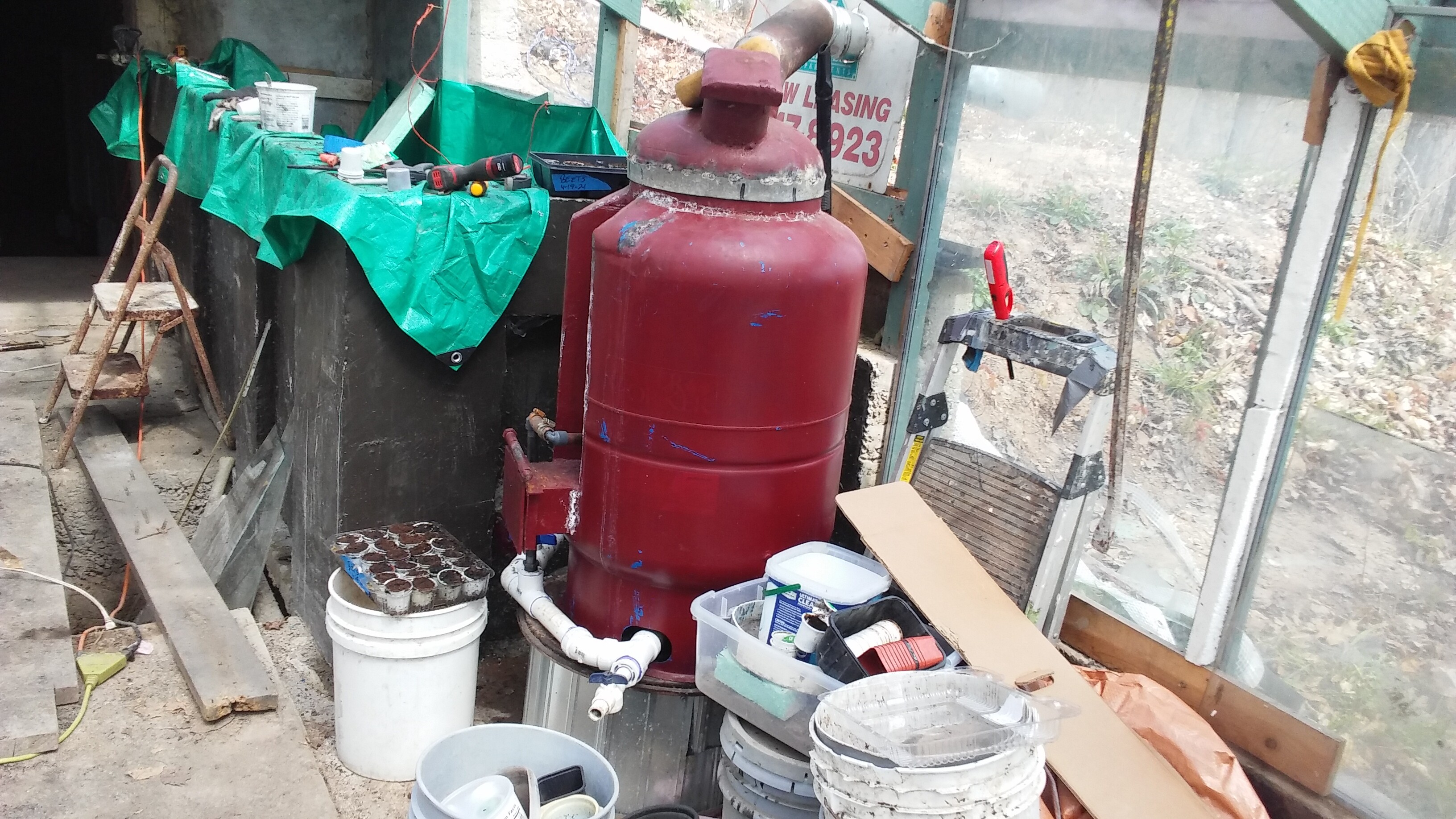
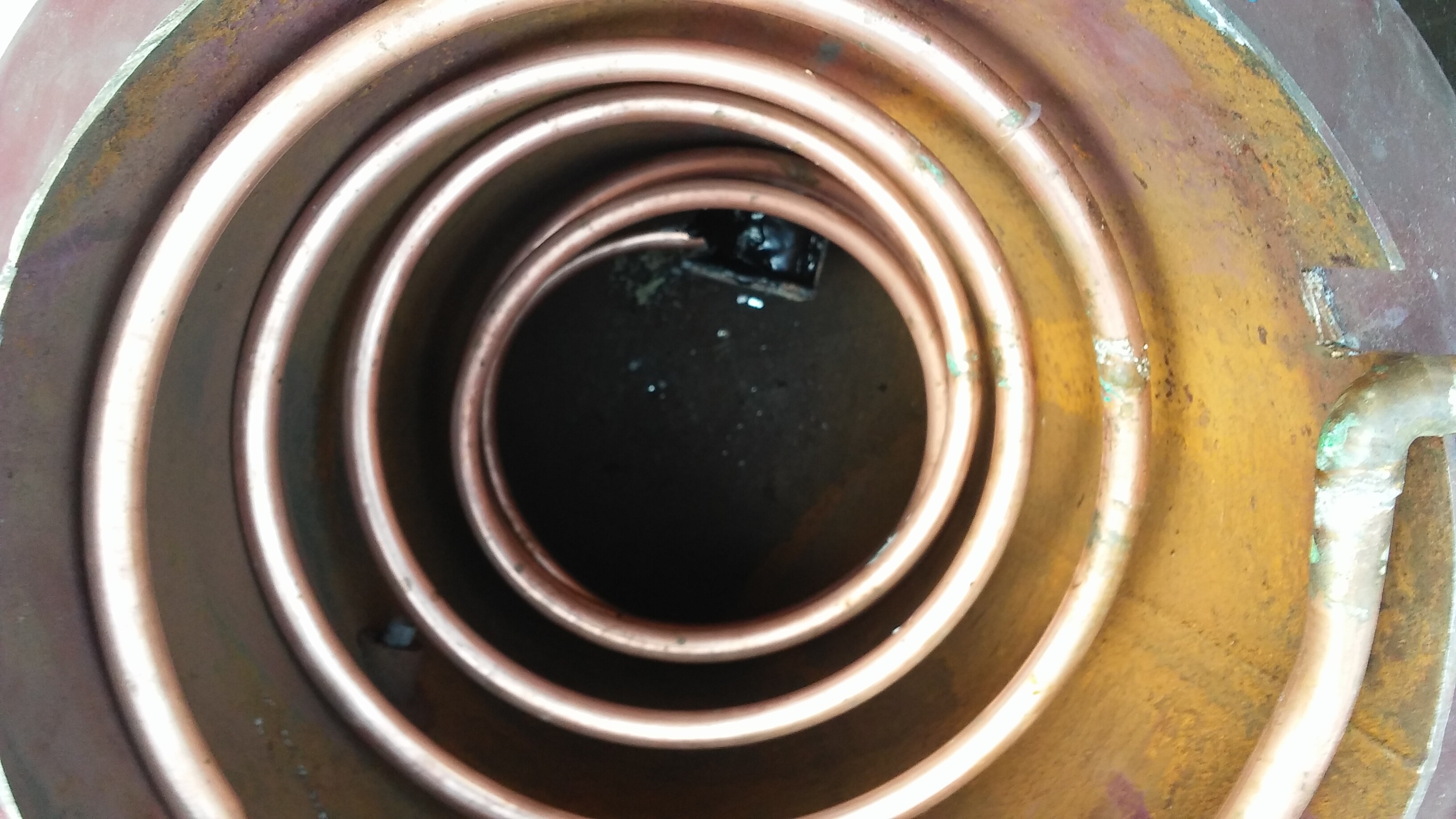
A water heater I built a while back to heat a water tank in the greenhouse when I was planning on doing aquaponics. First picture is of a charcoal kiln I never reported about after it was used. It worked fine but burned out after four years of use. The water heater also worked pretty well. It was fed chunks though a port in the top and char was removed from a port in the bottom as it built up allowing it to run as long as you were there to feed it. Too much fuel at a time absorbed some of the heat in the upper section of the coil so it was more efficient with only about half a load of chunks. It did take a while to get the water in the tank up to around 75F which was about optimum for keeping the 27 gallon totes full of planting mix I had at the top of the tank set a couple of inches into the water. The water in the jacket between the heater tanks provided ambient heat along with the Rocket Mass Heater on the other side of the GH. I never reported much about it because I quickly found out that trying to maintain a working greenhouse during our fairly rough winters was more than I could handle. Anyway the build did work if you were willing to spend all day tending it.

9 Likes