The Beaver - Small woodchipper / chunker

Hi there y’all! I am new here but not new to the idea of wood chunkers and chippers.

If you think this post is too long, feel free to scroll to just above the first picture where it says Tl;dr :slight_smile: If not I found it really helpful to write down my thoughts, so thanks in advance!

I have had the dream to build my own woodchipper and chunker since about 2017. The reason being that this is about the time we started thinking of moving to the countryside in Greece from the Netherlands. The concept has gone through several iterations in my head and sketchbook, refining it as I found parts and new ideas. I am actually grateful for this project getting postponed for so long because it has allowed me to mature as a maker and get it right the first time. Also I speak decent Greek now. Enough to communicate with a machinist. I would have made some big mistakes if I had executed on version 1.0 :slightly_smiling_face:

We made the move in late 2018 and have about 30 olive trees on our 3000m2 / 0.7 acres and I am now at a point where I am landing jobs to prune and harvest other peoples’ trees as well as maintaining our own. I am a permaculture designer and don’t really agree with the current ‘standard operating procedure’ around pruning and harvesting the olives. Which is mostly to just cut them hard, save the bigger branches for firewood and burn the rest in giant piles. Or dump it on the side of the road somewhere for the council to clean up.

  • I see a LOT of unused resources there.
  • I see piles and piles of woodchips for feeding the soil of our growing food forest and a swale of 90 meters / yards. We can capture up to 160.000 liters of water in these earthworks (42.000 gallons?). And it fully fills up about once a year it seems. It partly fills up a few other times. The water then infiltrates over the next few days.
  • I see firewood for our Rocket Mass Heater, because unlike fireplaces, our heater runs fine on branches of an inch or even smaller.
  • I see coathangers, lampshades, table lamps, doorhandles and other things in all the curvy, weird branches that come off of the olive tree. Its an amazing wood for artistic stuff like that.
  • I see employment in doing this work RIGHT because a lot of people (not everyone) just chop the trees very roughly without proper pruning methods and yields can drop for years.

Anyways, enough about my reasons for wanting something like that, let’s move onto what components I have already gathered.

  • I own a Bertolini 310S two wheel tractor (I have a playlist for it on my youtube channel). It is powered by a 12hp 500cc (30cu?) single cylinder diesel engine by Lombardini (BLD510n - 1985). It is a BEAST. I have handled a few small implements like that, mostly gas ones. All of them feel like toys after working with this machine. And like you can imagine, very simple and reliable. A simple rotation until you reach the compression stroke, wrap it with a 1.3m cord, set it for manual start and pull the cord. I very rarely have to pull twice; though it doesn’t get cold enough here to freeze outdoor copper pipes. No electrics or battery to go bad. If you wanna see something cool, check out this video.
  • I own an industrial strength reducer, all steel and cast iron. Needs three people to lift it. The ratio is 8 to 1.
  • Over the years I have gathered a couple of different pulleys, axles, bearings and stuff to make everything come together.
  • I bought two cutting heads out of a ‘silent garden chipper’. These will work to chip the smallest stuff into woodchips using torque rather than momentum.
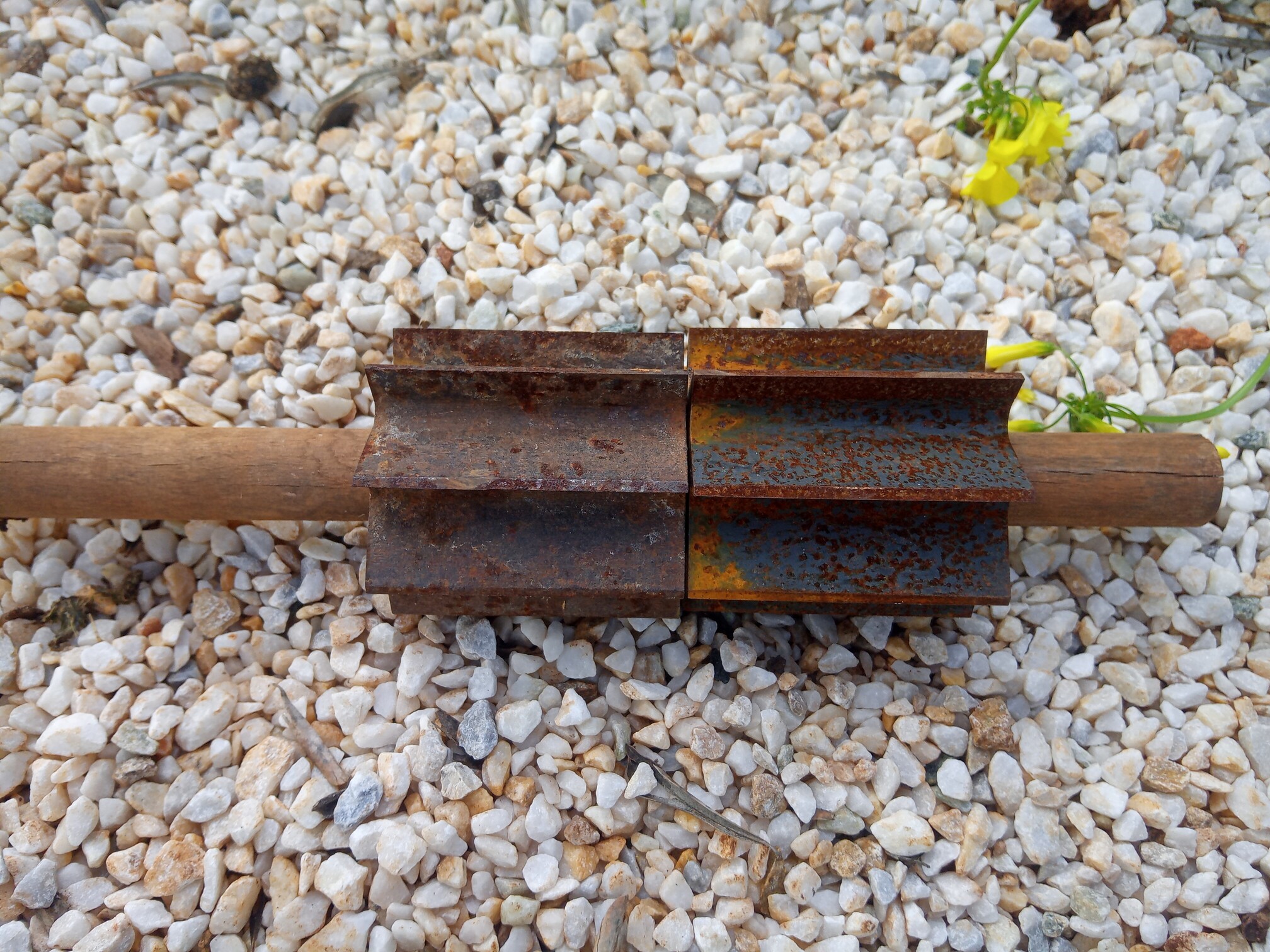
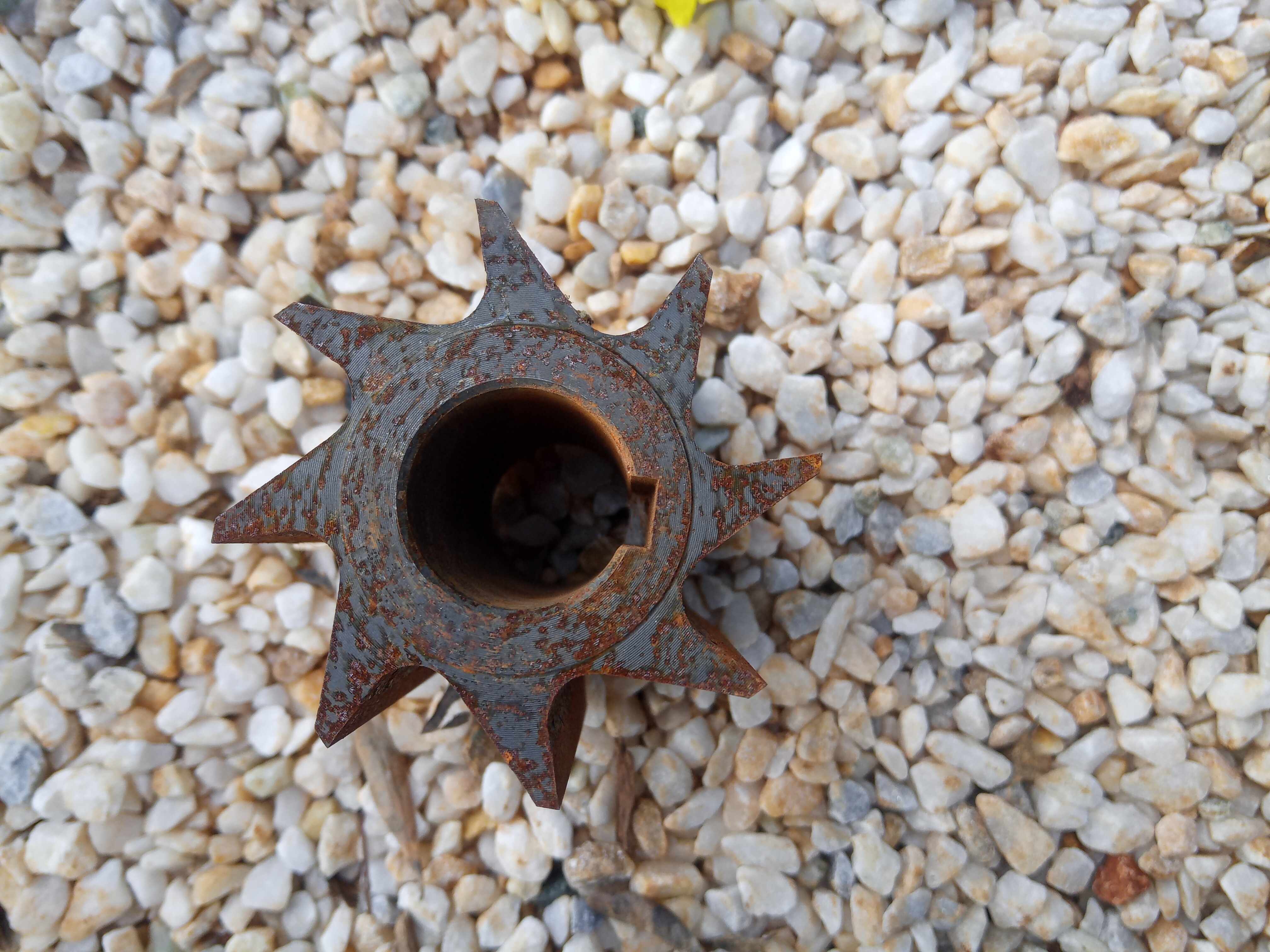
Ο Κάστορας / O Kástoras (The Beaver in Greek ;))

I hope to make a device that is mounted behind the tractor, but instead of it being a rotortiller, it is a wood processing machine. It will have a woodchipper and a spiral chunker. I intend for it to be much smaller than most chunkers, the thickest branch I imagine cutting would be like two inches of fresh olive wood.

The massive reducer would reduce the PTO speed from about 500RPM to 60rpm, so one full rotation of the axle per second. I believe the outer edge of the chunker would rotate slower due to it being further away from the central axis (??). Further reduction is possible using different sized pulleys if need be. I have designed everything so the pulleys and chunker blade are replaceable. The torque coming out of that reducer should be insane. Plenty of power to run everything I have in mind.

I intend to drive everything through V-belts because it protects the wormgear in the reducer. I only have one, it was quite expensive and I want it to outlast me. The belt drive system will effectively act like a sheer-pin. Instead of the irreplaceable wormgears being torn to shreds in case of failure, I might have to replace some rubber belts. Also it allows me to place the ‘working axle’ at a comfortable work height whilst the massive weight of the base and reducer are as close to the ground as possible. Lastly I will leave the belts kind of loose and add a ‘clutch’ to engage the ‘work axle’. I didn’t draw that.

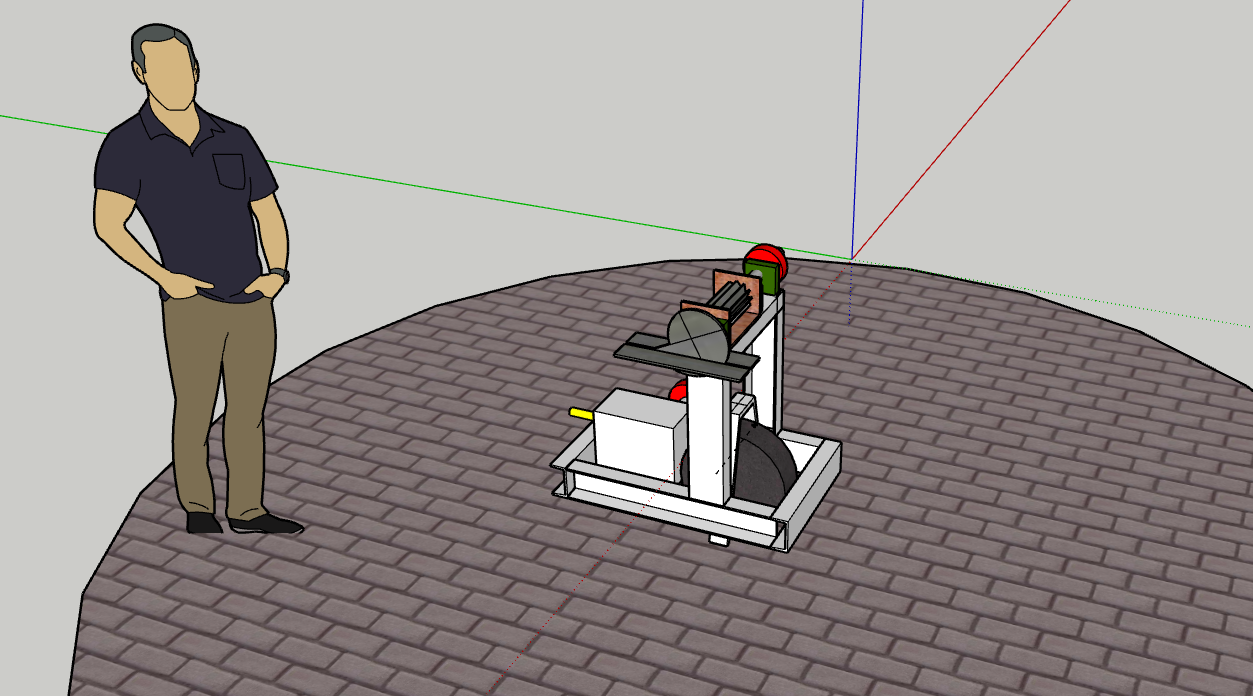
Below are some pictures of a model I made in sketchup. I am not great at sketchup but I hope it will help communicate what I have in mind.

Tl;dr? I want this kind of chipper and this kind of chunker, mounted on the same axle.

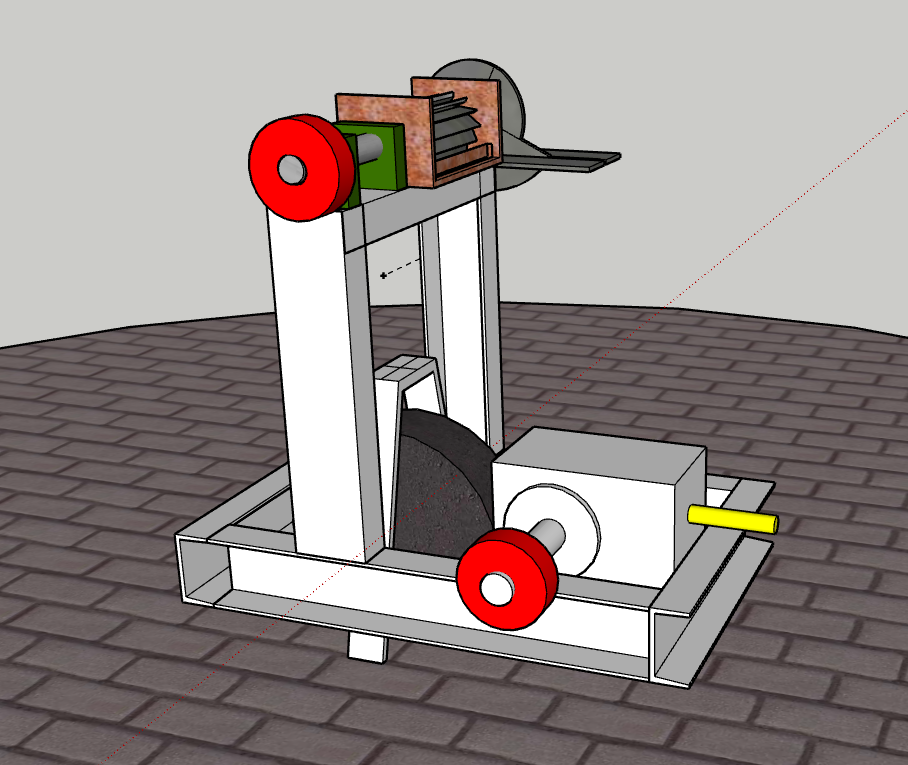
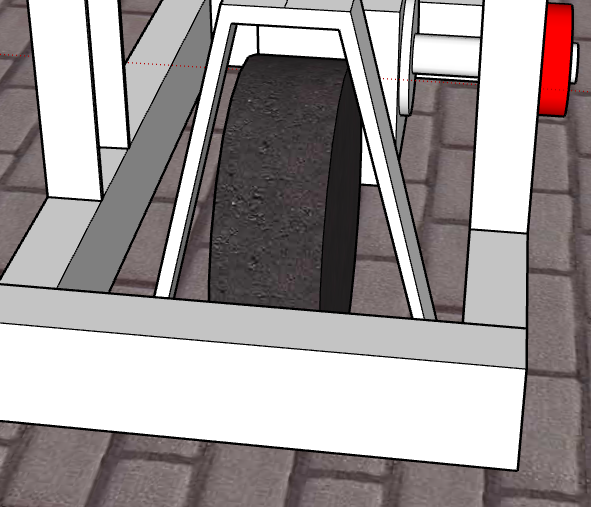
The yellow axle will attach directly to the PTO of the tractor using the standard PTO coupling. The white box sitting at the bottom is the Reducer, which transfers the motion to a 50mm shaft; this shaft sits at 90 degrees to the original rotation of the PTO. That black wheel in the middle is an airless wheelbarrow wheel and will allow me to steer (it’s a two wheel tractor, the back wheel will swivel from left to right). The two red circles are the pulleys which will use three V-belts to transfer the energy from the Reducer to the Axle. The green boxes represent bearings, the chipper is in a brown metal box, the chunker on a grey metal platform.
Other side of the device, showing the pulleys.
Below are two pictures of the steering wheel, it will be attached with an axle going straight up and through two bearings. I will add a steering wheel to that, which I haven’t drawn here.

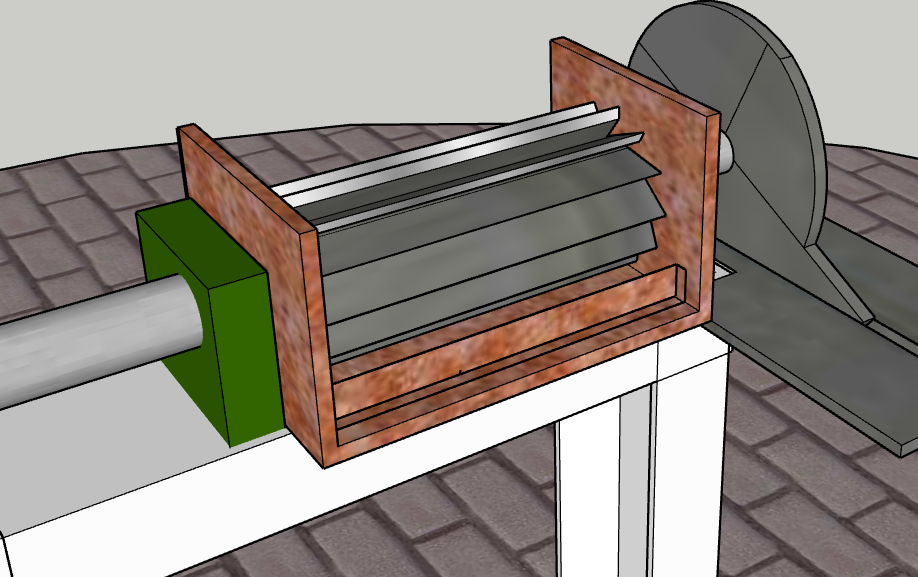
The chipper. Branches will be pulled into this and come out as very fine mulch on the other end. One of my biggest frustrations with woodchippers is when you have to push the material into it. Obviously this box would be enclosed and have some kind of chute on it.
The chunker. This will be used to cut the firewood out of the branches and in the same motion throw the ‘leftovers’ into the chipper.
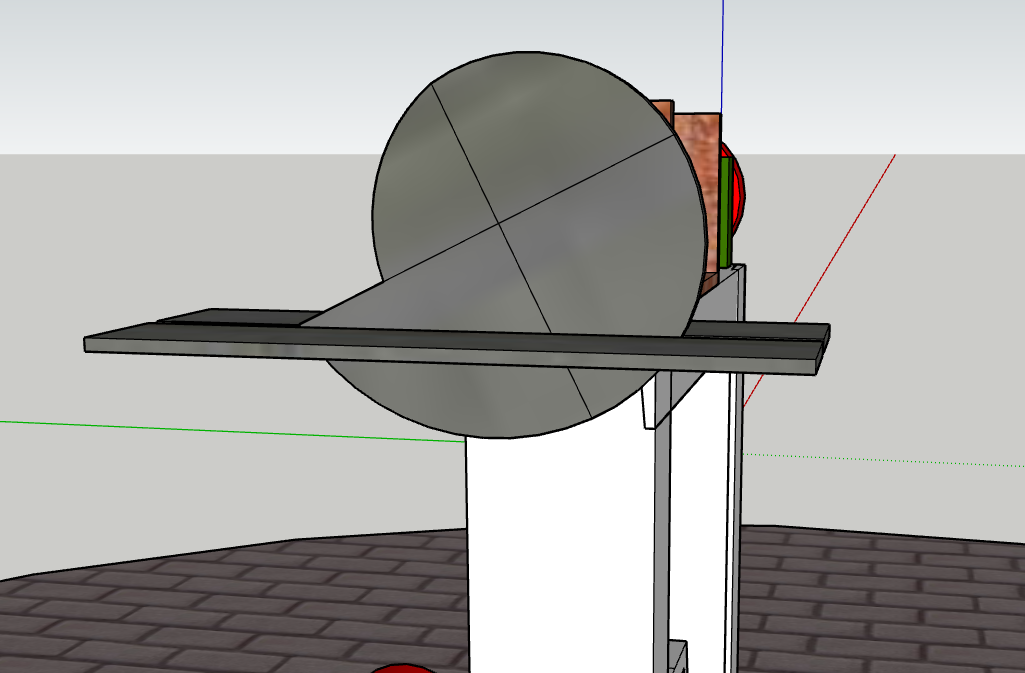
That’s it! Now I would like to open it up to feedback.

Specifically about that axle. Right now the chipper blades have an internal diameter of 32mm (see the pictures below). I am planning to buy a 35mm axle and ask the machinist to turn it down to 30mm, allowing me to fit the bearings I want.
Is 30mm / 1.18 inch thick enough for what I want to do?
What do you think about mounting the chunker at the end of the axle like that?
Anything I am overlooking?

Thanks for your attention and I look forward to your feedback!
9 Likes

Interesting design.

Have you looked at the Rebak style wood chunkers? One of our members built one, but they are also commercially available. It’s what I would use if I needed to build a chunker from scratch.

9 Likes

Welcome to the DOW BramH.

Good you are approaching wood gasification from the make fuel standpoint.
Anything; and every system made up, whether raw wood or a charcoal system, is worthless without a sustainable fuel supply.

So first you must ask, “What does a small woodgasfier to make engine grade fuel want?”
For a raw wood input system it wants; clean, uniform, and very dry fuel wood bits.
Here in this video you will see a bucket of prepared fuel wood input for StephenA.'s system:

And he did make these with a three point tractor PTO driving a re-set disc chipper.
Described here:

All of his sites videos are down now as he stepped away from DIY woodgasification as of 2019.
But do read his discriptions. He only chips his hardwood sucker growths in winter no-leaf, sap down. He then screens the results. Rejecting out ~1/3 of his chipped production.

Pretty much making prepared fuel for a woodgasifer is a Garbage-In then you will have Garbage-Out situation.
J.O. and others are by hand hacking off first all of the fine twigs and branches first.
Otherwise you must then set up, and spend the additional time to do a lots of size screening, and size classifying. More equipment. More time involved.

Regards
Steve Unruh

9 Likes

Bram, welkom.
Rebak hebben we hier ook. All the small stuff is processed through. You can build one with your gear but what Mr Steve said. What size do you need?
I have a diskchipper here that needs some TLC, something for you? Needs around 20-25 hp, I think. Stuffed in the back somewhere.

9 Likes

Hi there Chris,

I was hoping to see some feedback from you.

Yes I have thought about the Rebak style wood processor. But first of all it doesn’t offer me the option to cut things a certain length. You sort of push the material in and it gets decimated into whatever size the machine is set up for. There is no control what so ever. I want to be able to make little bunches of sticks 1.5 ft / 45cm long. They will fit into our RMH perfectly and burn nice and bright, exactly what we need to charge up the mass.
Secondly, they don’t really work for me as a woodchipper. The material that will come out of the woodchipper I have in mind will be half an inch max in size. So if I throw in a branch that is a meter / yard long, I will get a bunch of fine woodchips. Closer to sawdust than ‘chunks’.
Thirdly I want to protect my little tractor. We don’t have a lot of money and the Rebak gets connected straight to the PTO. It looks fantastic in videos, but should something get stuck all the energy is going straight into the tractor. With my design the worst that can happen is that I burn up a few v-belts.

Do you think 30mm / 1.18 inches is sturdy enough for this type of chunker? There will be a bearing right behind it and I will ask the machinist to turn out thick flange that allows me to exchange the blade so I can experiment a bit.

5 Likes

Hi Bram,
I also tried to design a chunker with a worm drive. But then I read somewhere that worm drives produce a lot of heat because of friction so they are not used for larger than 5hp. And I looked at things out there that I could buy, and it seems to be true. So then I tried to imagine and invent a worm drive that uses ball bearings or rollers, something like that. I don’t have any success with this.
I wish you success.
Rindert

6 Likes

Bram,

I have experience running a wood chunker based on a square baler gearbox. You can see that project here:

It runs on a 5hp electric motor, but could easily be adapted to a small tractor. The heavy gearbox and 200 lb flywheel takes all the abuse, the motor just spins the flywheel back up via a double V belt.

I also have run a woodchipper/shredder behind a BCS 853 two wheeled tractor, Lombardini 11hp diesel engine. I understand being worried about overtaxing the small tractor. The chipper I used was made by Caravaggi in Italy, rebranded as the BIO-100.

It makes very small chips and then what you can’t push through the chipper (side opening) gets tossed into the hammermill-style shredder (top opening). If you push into the chipper too hard you’ll bog down the engine. If you throw too much in the shredder, it will stall and you can’t restart until it is shut down and cleaned out manually. Really a pain and to be avoided. Those units are driven by double V-belts, which do stretch and wear, and over time lose power transfer, which makes it even more prone to clogging. But the belt is an important safety stop, to avoid slamming the motor if you chunk a rock or steel by mistake.

JO’s Rebak is running off a 5hp motor, belt driven with no flywheel. You could belt drive yours as well, to save the tractor. I think the Rebak design requires the least cutting effort for making proper sized wood chunks. Less power input is probably easier on your tractor and all the drivetrain.

It takes quite a bit of power to grind a long branch into 1/2" pieces for mulch. I believe that is a very different tool than a wood chunker to make gasifier fuel.

Making the blade style chunker work, either cylindrical like mine or flat blade like your design, will need a heavy flywheel to complete the cut. This should be spinning fast to provide any advantage, so before the gearbox. The gearbox must be able to take the pounding of chunks being cut and released, the gears inside will load up and release over and over. This is why I used a square baler gearbox, they are designed for this exact purpose and cadence while packing hay into bales. Very heavy duty, and easy to find in the US. Maybe not so much where you are at.

One final question I wanted to ask, your Bertollini has a driven wheel trailer, making it essentially 4 wheel drive, correct? Meaning the PTO turns faster or slower as the wheels go faster/slower, in different gears, etc. Is that a separate PTO than the normal implements would use, like a tiller? It appears to be in the same spot as your tiller would attach. Usually PTO is independent of the wheel speed. How does that work on a Bertollini? I would love to have a driven wheel trailer, but they won’t work with BCS because the PTO is independent only, same speed regardless of wheels. Perhaps when EV drive motors are cheap enough, I’ll build a push trailer.

8 Likes

Hey hoi, leuk om een Nederlander hier tegen te komen.

The Rebak is not really what I want. I responded to Chris with a bit more detail. And I have never really liked the disk chippers because they don’t draw the material into it. This is more what I have in mind.

What do you think, is the 30mm shaft strong enough for a chunker like this?

5 Likes

Cheers I will have a look. Right now I am not looking at any woodgasifiers, just firewood and woodchip production. But if the time comes and the zombies are at our door, I will probably be happy I already created step one! :slight_smile:

5 Likes

This makes a big difference! I misunderstood what you needed to create. Sorry if I misread your original post.

In that case the disk chunker you have designed will probably be fine, but what I said above regarding flywheels and gearboxes is still important. You also have a speed mismatch between the disk and the chipper, one wants to go slow and make slices, the other wants to be faster and get through chips quickly.

7 Likes

BramH. when you say you desire “firewood” what does this mean?
30cm to 50cm lengths cut to work in a bulk wood stove? Fireplace? Or a specific whole house furnace like J.O., JanA and most recently newest Premium member DavidP had pictured up using to heat his home.
Or cut stems and branches cut like in your reference video for use in an Eastern European type auger fed furnace?

In none of these is twig ends and small branches with leafs, or needles covered; wanted, or desirable.
Feed these in, and most chippers and shredders will bind up and clog stopping.
UNLESS hugely flywheel effect oversized, and oversized engine brute force powered.
This is just the reality of it. Same-same anywhere in the world.
Steve Unruh

3 Likes

He’s talking about a Rocket Mass Heater SteveU. I have one in my greenhouse. Just a feed port that small pieces of wood stand in and burn from the bottom. I never worried much about the size of my fuel length. Smaller diameter is better but requires pretty much constant feeding. For those not familiar, here is a link.

If I were going to build another one I do one of these batch designs.

4 Likes

Wow! That’s a lot of responses all at once! :smiley: I don’t know if I can answer all individually so I’ll just make a general post that addresses all of them (I hope).

Yes I am only looking at making fine woodchips and firewood in terms of bundles of medium sized branches. Gasification is something that I might look at in the future but it’s not an immediate goal.

Normally people burn branches that are smaller than a wrist in a big bonfire. But our Rocket Mass Heater burns that kind of stuff happily. If you want to see a video of our specific RMH, check out this video. I hope to produce bundles of about a shoebox in size, maybe a bit longer. Those bundles I can just plunk into the RMH it’ll save on a lot of handling.

I already own a very similar chipper to what Chris posted about, the kind that speed up to 2500rpm or so and chip the branches through a spinning disk with blades or with a hammerlike drum. And yeah my experience also has been that they tend to clog up pretty fast. Also the chute on mine is so narrow that it doesn’t take branches that are slightly twisted.

But what I have in mind here doesn’t care about high RPMs, both the chunker and the chipper can operate at a relatively low RPM. The 60ish RPM I’ll get after the reducer should be fine because both the chipper and chunker work on torque. The chipper blades I posted above are from a garden chipper that specifically runs at a low RPM and doesn’t produce noise. It just pulls the material into itself and with a bunch of torque, munches up the branches. If you’ve ever seen those high torque shredder machines that eat up whole cars? That’s kindof how this chipper worked in the original setting. The original machine had 3hp fed into a small reducer. Mine will be 12hp, reduced via the PTO and then again through the reducer. I estimate that it’ll have anywhere from 60 to 100hp in terms of torque.

Lastly Chris asked about my tractor and the trailer that can attach to it. So I wanna say that my tractor only came with a rotortiller, those videos in the playlist are from other people. But it has two PTOs coming out the back. One is the regular kind of PTO which spins clockwise and has two speeds and neutral. The other PTO is slightly smaller in size, has no gears and spins counter clockwise. This is what the people connect the trailers to from what I understand.

6 Likes

Good details. Able to use good sized wood also.
Thanks for showing the made up door in the front for going cold draft safety. And the bypass into the chimney to insure up drafting starting and later going bed for the night.

No thin burn through sheet metal.

So not a barrel drum enthusiast “Hippy Killer”.
Steve Unruh

5 Likes

Correct. I recently found out my Agria has a broken PTO. We are using the small one :grinning: without knowing it is for driving. Strange things happen when you go backwards with a mower :grinning:. Well, no one told me…

Blockquote If you’ve ever seen those high torque shredder machines that eat up whole cars ?

Blockquote

Here is a 3 kW version. Works ok. And in another corner of the shed. Replaced by a 18 kW Gross shredder. Interested in the small one?

:grinning:edit, just watched your riserless core. You are a do-er. You will just fit in here.

35 mm is ok!

3 Likes

Yeah my wife and I just didn’t want a big oil barrel in the room. Ever heard of the term fugly? Besides that, this version allows you to see the fire and you can cook on it. Which is a nice backup to have when winter is the time we have the most power outages.

8 Likes

So in general the consensus is that this 30mm/1.18inch axle should be sturdy enough to run the chipper and chunker?

2 Likes

Good Morning BramH.
I think no one knows. And being uncertain with your different approach none willing to say anything.
Here is a link into a topic that may give you guidance:
https://forum.driveonwood.com/t/branch-logger-stekovac-wood-processor-design
Has an embedded YouTube of one of the only other examples of a single shaft system. Most are building using opposing blades two shaft systems. Note that the flywheel is on the power working side of the for-safety belt drive.
Scroll up and Tom Collins was able to post up manufactures dimensioned diagrams of a commercially made system.
Maybe someone else finished actually working system in this group of 35 topics can give you shaft sizing direction.
Users say it would be really really nice to be able to power reverse to more easily clear out clog/binding jams.

You can click on “Wood Chunkers” in the headers anywhere in this topic to open up the 35 topic listings.
Try reading “Axle for clunkers” Feb 21 started by Low-and-slow.
Steve Unruh

5 Likes
4 Likes

Bram,
There are many, many sample calculations out there. Search: shaft torque calculator. Those numbers mean something to me because I used them many thousands of times.
But in your case I cannot say anything because I am not familiar with your machine. For you I would recommend not to use numbers. Think like a farmer. Compare your machine to other machines you see that use similar torque and cyclic loading. If you want to save weight, a hollow shaft can deliver more torque at the same weight.
Rindert

5 Likes